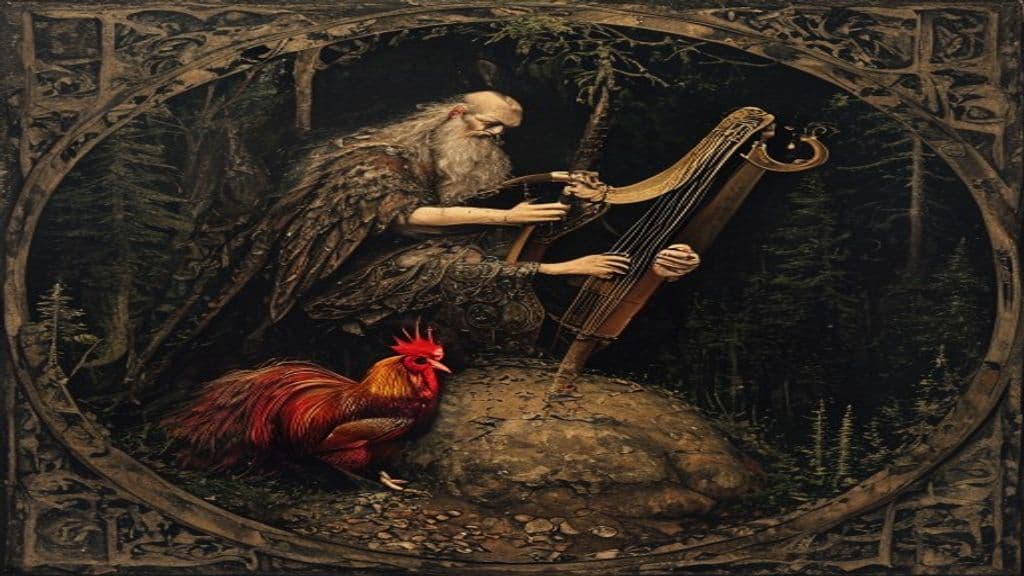
Eggþér appears in the eschatological sequence of the Old Norse poem Völuspá as a jötunn-associated herder seated on a mound at the beginning of Ragnarök. Scholarly commentary identifies him as the herder of a female jötunn dwelling in Járnviðr (Ironwood) who raises the kin of Fenrir; some scholars often identify that female jötunn with Angrboða, though that identification is presented as a scholarly suggestion rather than explicit in the poetic text.
In the Völuspá stanza Eggþér is described as sitting on a mound and joyfully striking his harp while the red rooster Fjalarr crows to herald Ragnarök. Beyond the harp, mound, and his joyful demeanor at the eschatological moment, the sources supply no further physical description; classification as a jötunn only implies membership in giant-kind within Norse conceptual categories.
The poem presents Eggþér functionally as a herder connected to the female jötunn of Járnviðr who raises Fenrir's kin (wolves). Scholarly interpretation reads his harp-striking as intended to rouse or arouse those charges to ferocious deeds at the onset of Ragnarök and frames him as an agent who participates in marshaling jötnar/wolf-kin for the final conflict; this is an interpretive reading of the poetic image rather than an independently enumerated catalog of supernatural powers in the sources.
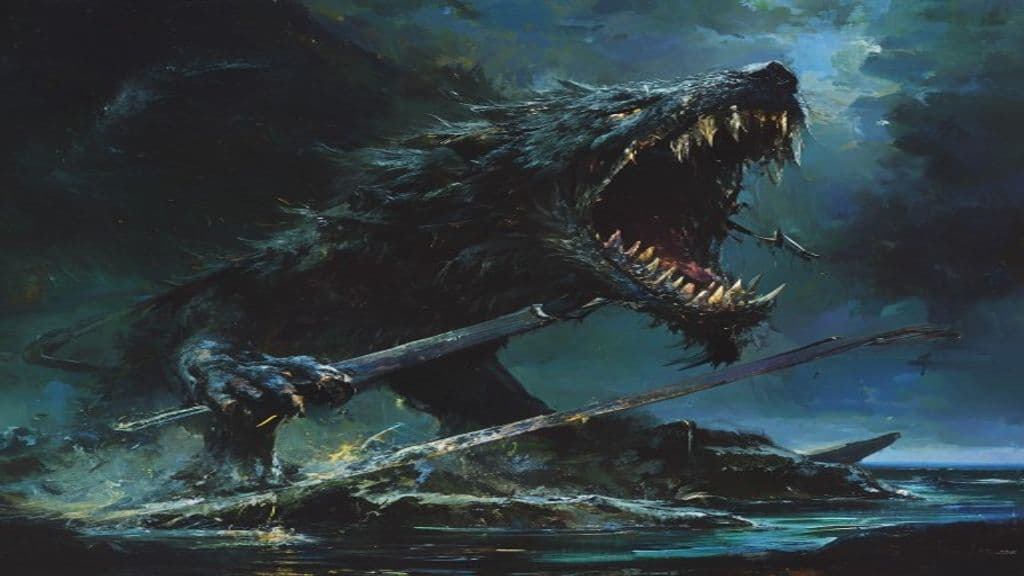
Fenrir
The monstrous wolf son of Loki, bound by the gods with a magical ribbon until Ragnarök — when he will break free and swallow Odin, and the world.

Angrboða
Angrboða is a jötunn (giantess) in Norse myth attested briefly in the Poetic Edda and Prose Edda as the partner of Loki and the mother of three world‑shaping offspring: Fenrir, Jörmungandr, and Hel. Surviving medieval attestations are sparse; most descriptions of her beyond genealogy derive from modern retellings and popular culture.
Borr
Borr (Old Norse Borr, Börr, Burr; anglicized Bor/Bör/Bur) is a scarcely attested figure in Old Norse theogony: the son of Búri, husband of Bestla, and father of Odin, Vili, and Vé. He appears by name in verse 4 of the Völuspá and in chapter 6 of Gylfaginning but is otherwise functionally an ancestral name with no preserved deeds or attributes in the supplied sources.
Elf
An elf is a humanoid supernatural being from Germanic folklore, especially prominent in North Germanic (Norse/Icelandic) myth and in later early-modern Scottish and Scandinavian belief. Elves are typically depicted as magically powerful and unusually beautiful, ambivalent toward humans and capable of helping or harming them.
Glasir
Glasir is a named tree or grove in Old Norse mythic geography that stands before the doors of Valhalla in Asgard; its foliage is described as red gold and it functions in skaldic and Eddic poetry as a kenning for gold.
Eeyeekalduk
Eeyeekalduk is identified in multiple compiled references as an Inuit supernatural figure associated with medicine, healing, and good health. The available sources list the name among Inuit deities or pantheons but provide no primary ethnographic detail about myths, rituals, or iconography.
Efnisien
Efnisien (also spelled Efnysien or Efnissien) is a human royal figure in the medieval Welsh Second Branch of the Mabinogi (Branwen ferch Llŷr). Presented as an explosively violent and disruptive kin whose cruelty precipitates international war, he ends the tale by sacrificing himself to destroy a magical cauldron used by the Irish to revive the dead.
Egbere
Malevolent humanoid supernatural beings in Yoruba mythology, residing in woods and active only at night. (Note: 1. Power tier should be Greater (powerful regional) based on the description as malevolent beings residing in woods. 2. Abilities need more specific information, such as their connection to darkness o)
Egeria
Egeria is a Roman nymph of springs and sacred groves, cast in legend as the divine consort and counselor of Numa Pompilius who imparted laws and ritual forms to Rome's foundational king. She functions as a local tutelary female deity associated with the origin of Roman rites rather than as a cosmic power or a hostile spirit.
Egg Ghost (Korean Tradition)
In Korean folklore, the Egg ghost is a malevolent entity that resembles an egg in appearance and serves as a harbinger of death. (Note: - The draft states "malevolent entity", but Source 1 doesn't explicitly state this. - Power tier: Based on the ability to determine a person's death upon sighting, it seems more likely that the Egg gh)
Eglė the Queen of Serpents (Žilvinas)
A central figure of a Lithuanian folktale in which a speaking serpentine ruler—called the grass-snake/serpent prince Žilvinas—marries the human maiden Eglė, keeps an underwater palace and household, can be summoned by a secret chant, and whose story culminates in human→tree metamorphoses after betrayal.
Ego the Living Planet
Ego the Living Planet is a fictional sentient planet created for American comic-book mythology (Marvel Comics) by Stan Lee and Jack Kirby. Presented as an individual, planetary-scale organism, Ego appears across Marvel cosmic stories as a thinking, willful celestial body that can interact with gods, heroes, and galactic civilizations.
Egregore
A polyvalent Western‑esoteric concept naming an emergent, non‑physical collective form produced by sustained coordinated thought, will, ritual, or activity of a group. Usage ranges from a descriptive term for a 'collective mind' to a belief in a semi‑autonomous spiritual entity nourished by group devotion, and in contemporary discourse is often used metaphorically for organized online or political phenomena.
Egremus
Egremus is a named mortal figure in Greek myth attested only as a combatant who fell in the war between Eumolpus and Eleusis. He is identified by the patronymic 'son of Eurynomus' and appears only in genealogical/war-list context in the cited source.
Community Record
- [1]Eggþér (Wikipedia). Wikipedia: Eggþér article (summary of Völuspá attestation and scholarly commentary)wiki
- [2]Wikidata: Eggther. Wikidata entry for Eggther (identifier and links to attestations)other