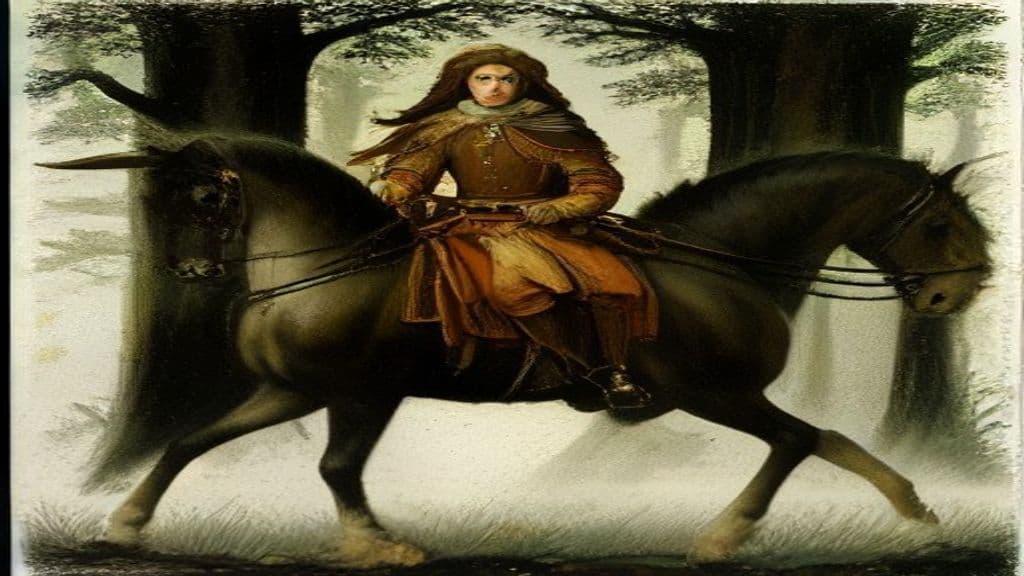
In the Middle Dutch poem Karel ende Elegast, Elegast appears as an outcast vassal of Charlemagne who has been banished to the forest and lives by thievery; the narrative frames him within older Germanic mythic space. His name is interpreted by scholars as deriving from Common Germanic *albi-gastiz ('elf-guest'), a compound that marks him as an otherworldly guest/outsider in the vernacular mythic imagination. The poem stages Elegast as a liminal figure who bridges pre‑Christian forest lore and the Christian court: he aids Charlemagne (who meets him in disguise), refuses to steal from the king, uncovers treachery, duels a courtier, and is restored to favor, thereby integrating the outsider into the social order.
The poem presents Elegast chiefly as a forest‑dweller who can appear in courtly guise: he is depicted riding as a knight on a black horse and also as an outlaw living in the woods near Charlemagne's castle in Ingelheim. The supplied sources do not give detailed physical descriptions (facial features, stature, clothing beyond his knightly/armored presentation in certain scenes). Some related Low German and northern traditions identify a figure named Elbegast as a dwarf‑type being, but within the primary Middle Dutch material Elegast appears in both knightly and outlaw modes without a precise anthropometric portrayal.
Explicit magical capacities in the poem include the ability to put people to sleep by magic, to open locks without keys, and possession of a magic herb which, when placed in his mouth, allows him to speak with animals. Behaviorally he is characterized as a thief who steals from the rich and is kind to the poor (a 'noble robber'), as well as loyal to Charlemagne despite his outlaw status. In the narrative he uses theft and burglary to uncover and expose a plot against the king, and he fights and defeats the conspirator Eggeric, actions that restore his honor and social standing.
Elders of the Universe
A class of individual immortals in Marvel Comics defined as the last surviving members of otherwise extinct races; each pursues an obsessive passion that shapes their abilities and actions, often with cosmic-scale consequences within Marvel continuity.
Eldir
Eldir is a named servant of the sea-being Ægir in Old Norse myth, attested in the poem Lokasenna where he stands outside Ægir's hall and speaks with Loki. His name, Old Norse Eldir, is glossed as 'fire-stoker' and marks him as a household attendant and threshold interlocutor rather than a deity.
Eleazar
Eleazar (Hebrew: אֶלְעָזָר, Eleazar/Elʿazar) is a biblical and historical personal name borne by several individuals in Hebrew tradition; chief among them is Eleazar son of Aaron, who succeeds his father as Israel's high priest and performs custodial and ritual functions in the Exodus, wilderness, and settlement narratives. He is treated as a human priestly office‑holder and is commemorated in some Christian liturgical calendars.
Electra
Electra (Ancient Greek: Ἠλέκτρα, Ēléktrā) is a Mycenaean princess in Greek myth and drama, daughter of Agamemnon and Clytemnestra, whose primary role across Aeschylus, Sophocles, and Euripides is as an avenger of her father's murder and a focal figure for questions of filial duty, revenge, and ritual consequence.
Electrocutioner
Electrocutioner is a mantle used by three human characters in DC Comics who wear circuitry-lined costumes that project electricity. Presented as minor adversaries of Batman, the identity functions as a technological persona rather than a supernatural entity.
Electryon
Electryon (Ancient Greek Ἠλεκτρύων) is a mythic king of the Perseid line in Greek tradition, ruler of Mycenae and Tiryns whose conflict over stolen cattle, the deaths of his sons, and his own death set the succession events that lead to Amphitryon, Alcmena, and the birth of Heracles. He is presented in classical sources as a mortal dynast rather than a supernatural being; versions differ on whether his death was accidental or the result of homicide.
Elegua
Elegua (Ẹlẹ́gbára / Eleguá / Exu / Legba variants) is an Orisha and liminal mediator in Yoruba and Yoruba-derived religions. He is guardian of roads, doorways, and crossroads, the messenger who must be acknowledged before other rituals, and a trickster-enforcer who manages balance between opposites.
Eleius
Eleius (Ancient Greek Ἠλεῖος, Ēleîos) is a legendary eponymous king in Greek myth who functions as the ancestral founder of the Eleans and the region of Elis. Attested in mythographic traditions summarized in Pausanias and later compilations, Eleius appears in genealogical sequences linking local dynastic identity to divine and heroic lineages.
Elemental (tradition)
A Renaissance occult and alchemical category, especially associated with Paracelsus, for intermediate, element‑bound beings tied to the four classical elements (gnomes/earth, undines/water, sylphs/air, salamanders/fire). Paracelsus described them as beings 'between creatures and spirits' with physical, commonly humanoid bodies that live in and are sustained by their native 'chaos.'
Elendil
Elendil is a human Númenórean leader in J. R. R. Tolkien’s legendarium: a refugee of Númenor who founded the northern realm of Arnor, led the Faithful, and fought in the Last Alliance against Sauron. He is remembered as a dynastic founder whose proclamation and heirlooms shaped later kingship in Middle-earth.
Elephantis
Elephantis (Ancient Greek: Ἐλεφαντίς) is a name attested in two distinct registers of the ancient Greek world: (1) a late 1st century BCE Greek poet/physician credited in Roman and Greek authors with erotic manuals, cosmetics and abortive recipes, midwifery, and medical remedies; and (2) a mythographic/mortal figure listed among the wives or consorts of Danaus and named as mother of some Danaïdes in variant genealogical traditions.
Elephenor
Elephenor (Ancient Greek: Ἐλεφήνωρ) is a mortal king of the Abantes of Euboea in Greek mythic-historical tradition, known as a captain of a contingent to the Trojan War, a purifying figure in one homicide episode, and as the subject of variant local foundation or exile traditions after the war.
Community Record
- [1]Elegast. Wikipedia: 'Elegast' entry (summary of Karel ende Elegast and related traditions)wiki
- [2]Karel ende Elegast (Karolingsche Verhalen references and editions). Karolingsche Verhalen (J. A. Alberdingk Thijm) — edition and discussion referenced in source notesliterary
- [3]Horae Belgicae (archival reference). Horae Belgicae — archival edition cited among source materials on the poem and its contextother
- [4]Knights in the Middle Dutch Epos ‘Karel Ende Elegast’ (Acta Poloniae Historica). Scholarly article discussing the poem's portrayal of knights and the Elegast episode (summary in provided notes)academic
- [5]Elegast (Person) – Tim Boucher (discussion). Modern commentary and summary of Elegast's role and name-ethymology as presented in secondary literatureother