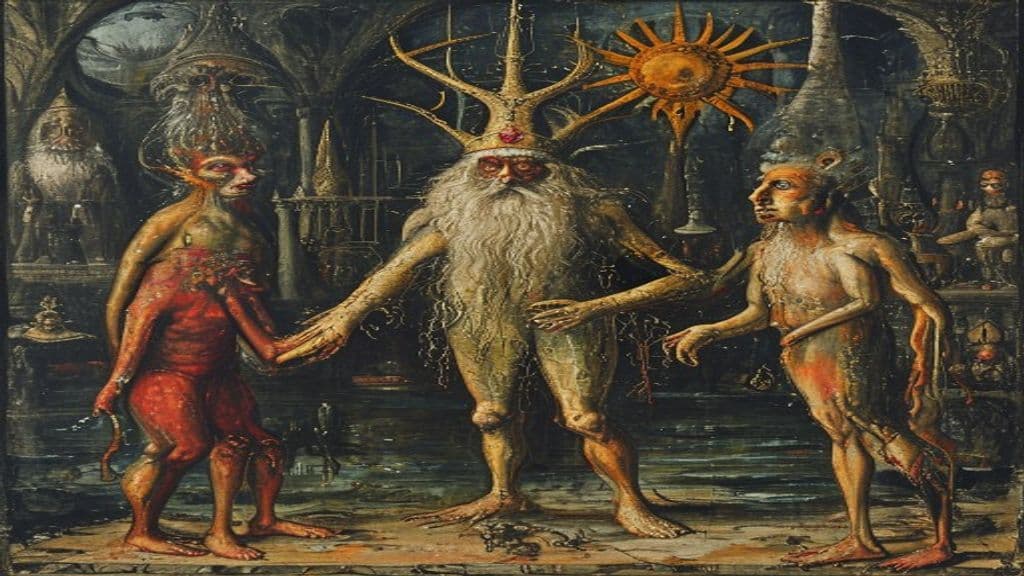
In Paracelsian natural philosophy elementals are classificatory inhabitants of the four classical elemental 'chaoses' rather than products of a single mythic creation tale. Paracelsus framed them as distinct ontological classes—gnomus (earth), undina (water), sylph (air), salamander (fire)—drawing on older elemental theory (Empedoclean fourfold cosmology) and Renaissance alchemical thought. Later writers and commentators (parallel taxonomies in Agrippa; popularization and elaboration in Comte de Gabalis; Rosicrucian claims about perceiving elementals) adopted and adapted this Paracelsian framework, but Paracelsus himself supplied the core tripartite anthropology and the fourfold elemental taxonomy.
Paracelsus described elementals as commonly humanoid in body with ordinary life functions: they eat, sleep, and wear clothes like humans. He gave comparative physical notes for the types: gnomes short; undines similar to humans in size; sylphs 'rougher, coarser, longer, and stronger' than humans; salamanders long, narrow, and lean. Later commentators vary in descriptive detail, and some later sources add gendered or romanticized traits not presented systematically by Paracelsus.
Each elemental moves through and is at home in its native element in the way humans move through air: gnomes through earth and rocks, undines through water, sylphs through air, salamanders through fire. Paracelsus asserted that they are 'healthy' in their own chaos and suffer or die in other elements (for example, sylphs are harmed by fire or drowned by water). Paracelsus also located them ontologically as lacking the immortal divine soul; he discussed the possibility that an elemental could obtain a soul by marrying a human, producing offspring and thereby crossing the boundary between elemental life and human immortality. Normally invisible to mankind, later Rosicrucian and related practices describe alchemical/initiatory procedures that purportedly enable vision of these beings.
Weaknesses
- conditionelemental incompatibility with non-native elements (Paracelsus)
Wards
- ritualRosicrucian eye purgation with the Panacea (related practice)
- ritualPrepared element‑filled glass globes exposed to sunlight for one month (related practice)

Undine (Ondine)
An elemental water spirit from Paracelsian occult cosmology later developed into a literary water-nymph archetype. Undines are humanoid, almost always presented as female, inhabit watery places, lack an immortal human soul by default, and—according to Paracelsus and later literature—may acquire a human soul through marriage with a human.
Electra
Electra (Ancient Greek: Ἠλέκτρα, Ēléktrā) is a Mycenaean princess in Greek myth and drama, daughter of Agamemnon and Clytemnestra, whose primary role across Aeschylus, Sophocles, and Euripides is as an avenger of her father's murder and a focal figure for questions of filial duty, revenge, and ritual consequence.
Electrocutioner
Electrocutioner is a mantle used by three human characters in DC Comics who wear circuitry-lined costumes that project electricity. Presented as minor adversaries of Batman, the identity functions as a technological persona rather than a supernatural entity.
Electryon
Electryon (Ancient Greek Ἠλεκτρύων) is a mythic king of the Perseid line in Greek tradition, ruler of Mycenae and Tiryns whose conflict over stolen cattle, the deaths of his sons, and his own death set the succession events that lead to Amphitryon, Alcmena, and the birth of Heracles. He is presented in classical sources as a mortal dynast rather than a supernatural being; versions differ on whether his death was accidental or the result of homicide.
Elegast
Elegast is the noble robber figure from the Middle Dutch epic Karel ende Elegast, portrayed as a forest-dwelling outsider whose name and attributes align him with Germanic 'elf' (and in some northern parallels 'dwarf') traditions. In the poem he possesses magical faculties (sleep‑casting, lock‑opening, a herb enabling speech with animals), lives as an outlaw yet shows loyalty to Charlemagne and moral concern for the poor.
Elegua
Elegua (Ẹlẹ́gbára / Eleguá / Exu / Legba variants) is an Orisha and liminal mediator in Yoruba and Yoruba-derived religions. He is guardian of roads, doorways, and crossroads, the messenger who must be acknowledged before other rituals, and a trickster-enforcer who manages balance between opposites.
Eleius
Eleius (Ancient Greek Ἠλεῖος, Ēleîos) is a legendary eponymous king in Greek myth who functions as the ancestral founder of the Eleans and the region of Elis. Attested in mythographic traditions summarized in Pausanias and later compilations, Eleius appears in genealogical sequences linking local dynastic identity to divine and heroic lineages.
Elendil
Elendil is a human Númenórean leader in J. R. R. Tolkien’s legendarium: a refugee of Númenor who founded the northern realm of Arnor, led the Faithful, and fought in the Last Alliance against Sauron. He is remembered as a dynastic founder whose proclamation and heirlooms shaped later kingship in Middle-earth.
Elephantis
Elephantis (Ancient Greek: Ἐλεφαντίς) is a name attested in two distinct registers of the ancient Greek world: (1) a late 1st century BCE Greek poet/physician credited in Roman and Greek authors with erotic manuals, cosmetics and abortive recipes, midwifery, and medical remedies; and (2) a mythographic/mortal figure listed among the wives or consorts of Danaus and named as mother of some Danaïdes in variant genealogical traditions.
Elephenor
Elephenor (Ancient Greek: Ἐλεφήνωρ) is a mortal king of the Abantes of Euboea in Greek mythic-historical tradition, known as a captain of a contingent to the Trojan War, a purifying figure in one homicide episode, and as the subject of variant local foundation or exile traditions after the war.
Eleuther
Eleuther (Ancient Greek: Ἐλευθήρ) is a personal name borne by several distinct figures in Greek myth — including a Curete, an Arcadian son of Lycaon, a possible variant of the divine epithet Eleutherios (linked to Dionysus), and a son of Apollo credited with musical distinction and with founding a local Dionysian cult. The attestations present Eleuther as eponym, cult-founder, performer, and minor mythic personage rather than as a single ontological class of being.
Elf
An elf is a humanoid supernatural being from Germanic folklore, especially prominent in North Germanic (Norse/Icelandic) myth and in later early-modern Scottish and Scandinavian belief. Elves are typically depicted as magically powerful and unusually beautiful, ambivalent toward humans and capable of helping or harming them.
Community Record
- [1]Elemental (Wikipedia). Wikipedia contributors, 'Elemental,' Wikipedia, The Free Encyclopedia.wiki
- [2]Elemental (Wikidata). Wikidata entry Q5358855, 'Elemental'.wiki
- [3]Elementals (archive references and related materials summarized). Archive item summarizing related discussions and references to elemental topics (provided in research notes).other