
Elric appears in Michael Moorcock's Elric sequence (first appearances in stories beginning with the novella "The Dreaming City", 1961; the collected novel Elric of Melniboné 1972). He is presented as the 428th emperor (styled Elric VIII) of Melniboné, heir to a long line of rulers whose political legitimacy rests on ancestral pacts and sorcery. Brought up in the decadent, long‑lived Melnibonéan culture, Elric is physically frail, scholarly, and morally introspective—at odds with his people's callous traditions—and comes to rely on inherited pacts (notably invocation of the patron Arioch) and, later, the black sword Stormbringer, events that shape his tragic, doom‑laden narrative within Moorcock's secondary‑world cosmology.
Primary descriptions portray Elric as albino and strikingly pale: "the colour of a bleached skull" flesh, milk‑white long hair, "two slanting eyes, crimson and moody," and "two slender hands, also the colour of bone." He is presented as beautiful but physically weak and anaemic; one passage depicts him emerging from the loose sleeves of a yellow gown.
Within the fiction Elric is an accomplished sorcerer and summoner who can call upon the traditional patrons of the Melnibonéan emperors—explicitly Arioch (named a Lord of Chaos and "Duke of Hell")—and uses ancient ancestral pacts and agreements with various non‑human beings. His rulership and magic are rooted in imperial institutions (including the ability, culturally, to summon dragons that sleep in caverns beneath Melniboné). Elric's personal power is also bound to the sentient sword Stormbringer, which grants him vitality and martial prowess but must be fed on the souls of intelligent beings and brings disaster to those close to him.
Weaknesses
- conditionphysical frailty and drug dependence prior to Stormbringer
- otherStormbringer's moral/cosmic cost (the sword consumes souls and ultimately claims Elric's own soul)
Wards
- othernone specified in sources
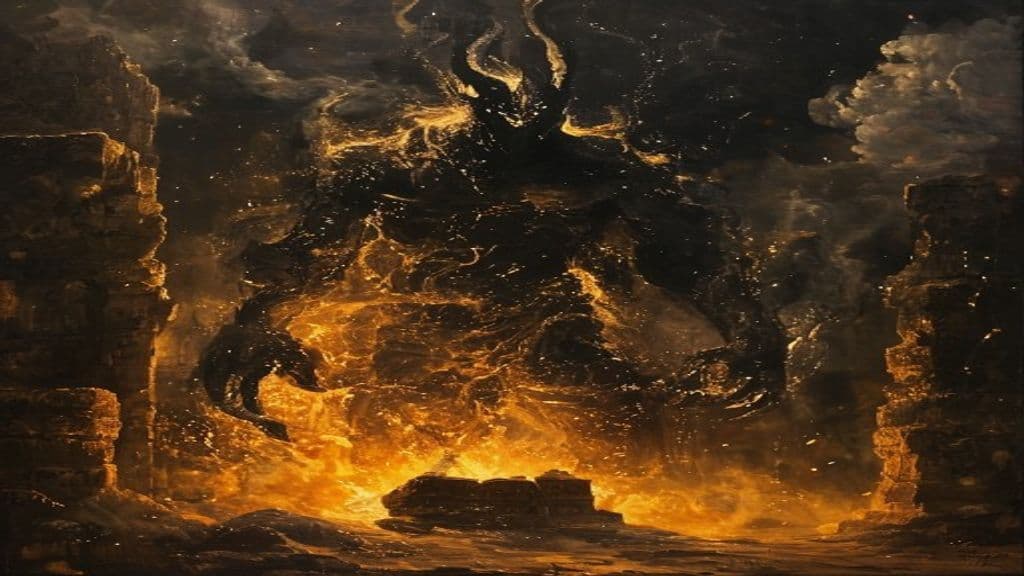
Ifrit
One of the most powerful classes of jinn in Islamic and pre-Islamic Arab tradition — a fire-born being of immense strength and cunning, capable of great works of engineering and terrible violence.
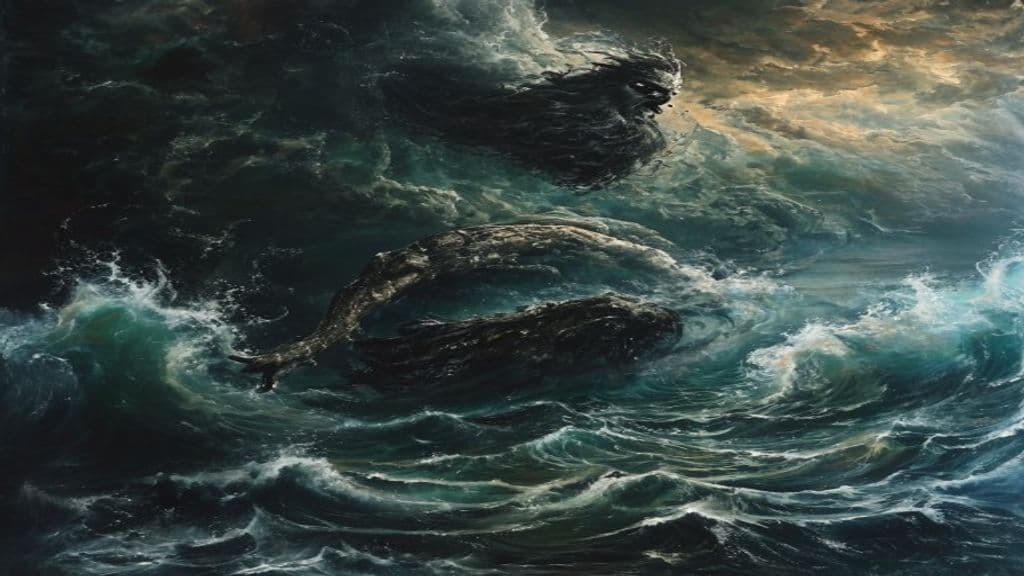
Marid
The most powerful class of jinn in Islamic tradition — beings of the sea, associated with the deep ocean, storms, and the granting of wishes at terrible cost. The classic genie of the Arabian Nights.
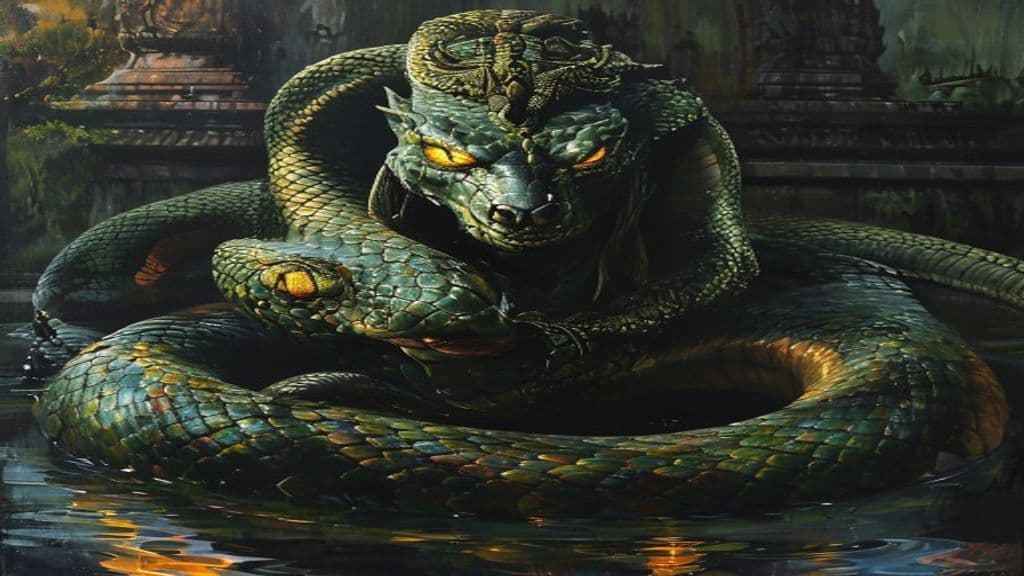
Naga
Divine serpent beings of Hindu, Buddhist, and Jain cosmology — powerful guardians of water, earth, and underground treasures. Revered as deities in South and Southeast Asia.
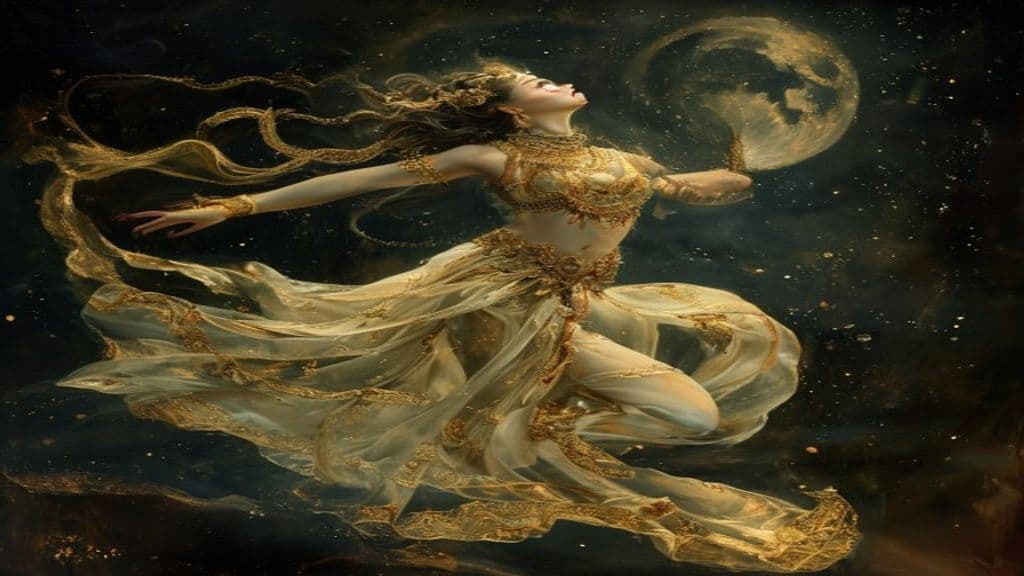
Apsara
Celestial dancers and water nymphs of Hindu cosmology — beautiful semi-divine beings who dance at the court of Indra and, by his command, descend to earth to distract sages from excessive asceticism.

Rakshasa (Himalayan variants)
A Himalayan reception of the pan-Indian rakshasa motif: hostile or disruptive non‑human beings known from Sanskrit epic and Puranic literature, here noted where Himalayan sources and discussions intersect with the broader epic tradition. The supplied sources do not document distinct, well‑attested Himalayan folklore variants; the entry therefore presents primarily the epic/legendary profile as transmitted into Himalayan contexts in general references.
Eliwlod
Eliwlod is a figure of early Welsh literary tradition, described as a nephew of King Arthur renowned for eloquence and commemorated in triads and praise-poetry; in a surviving poem he appears postmortem speaking to Arthur in the form of an eagle.
Elkanah
Elkanah is a human figure from the Hebrew Bible, presented as the husband of Hannah and father of the prophet Samuel. He appears as a patriarchal household head who practices annual pilgrimage to Shiloh and is variably identified in the biblical texts as an Ephraimite or, in Chronicles, as a Levite; later rabbinic tradition lists him among prophets.
Elli
Elli is the Old Norse personification of old age attested in the Prose Edda (Gylfaginning). In the single surviving episode she is summoned from Útgarða-Loki’s hall and bests Thor in a wrestling-match, illustrating the inevitable weakening effect of advancing age even upon gods.
Elloe Kaifi
Elloe Kaifi is a Sakaarian noble-turned-gladiator in Marvel Comics who becomes a pledged member of the Warbound alongside the Hulk. Her arc spans Planet Hulk and World War Hulk storylines in which she pursues revenge against the Red King and later accompanies the Warbound to Earth.
Elpenor
Elpenor is a named human figure in the Homeric epic tradition (Odyssey) who dies accidentally on Circe’s island and later appears as a shade in Hades during Odysseus’ katabasis to plead for a proper cremation and burial. He functions in the poem as an example of neglecting funerary obligation and the moral duty of the living to care for the dead.
Elphaba Thropp
Elphaba Thropp is a fictional human character created by Gregory Maguire as a revisionist reinterpretation of Baum's Wicked Witch of the West. In Maguire's Oz she functions both as a political actor—opposing the Wizard's regime—and as a legendary figure whose life and reputed witchcraft enter the internal folklore of that secondary world.
Elrond
Elrond is a named fictional individual in J. R. R. Tolkien's Middle-earth legendarium: a Peredhil ('Half-elven') who served as master of Rivendell (Imladris), bearer of the Elven ring Vilya, counselor and refuge-giver across the Second and Third Ages, and a figure bridging the great ages of Tolkien's world.
Elua and His Companions
Elua and His Companions are divine and semi-divine figures within the fictional religion of Jacqueline Carey’s Kushiel’s Legacy, functioning as central mythic personages in the series’ alternate-medieval Western European setting.
Elves (Middle-earth)
In J. R. R. Tolkien's legendarium, the Elves are the Firstborn of Ilúvatar, a prime pre‑human race whose lives are long and whose spiritual destiny differs from Men. They dwell in Middle‑earth and in the Undying Lands of Valinor; slain Elves' spirits go to the Halls of Mandos in Aman, and many eventually yearn to sail from the Grey Havens to Valinor.
Elwetritsch
A regional legendary chimera reported in southwestern Germany (especially the Palatinate): a bird‑like, chicken‑sized imaginary creature assembled from parts of different animals and embedded in local mock‑hunts and folk identity. One scholarly interpretation traces the modern motif to a linguistic and cultural miniaturization of older night‑pressure spirits (Albdrude/Albdruck), though this continuity is presented in sources as an interpretation rather than uncontested fact.
Elyan the White
Elyan the White is a human knight of Arthurian legend attested in the medieval prose romances of the Lancelot‑Grail (Vulgate) and Post‑Vulgate cycles (and in the Prose Tristan). He is presented as the son of Bors the Younger, a member of the Round Table, a loyal kinsman of Lancelot, and a martial participant in episodes such as the rescue of Guinevere and Lancelot's exile; one Vulgate strand prophesies he will become Emperor of Constantinople.
Elymus
Elymus is primarily a botanical genus of perennial grasses (family Poaceae) whose species include wild ryes and quackgrasses; the name also appears in classical mythic reference as a personal name (the purported ancestor of the Elymians and as a man slain by Gorge). The available sources treat Elymus as a taxonomic label and a mythic personal name, not as a defined supernatural being within a living folk cosmology.
Community Record
- [1]Elric of Melniboné (Wikipedia). Wikipedia contributors. "Elric of Melniboné." Wikipedia, The Free Encyclopedia.wiki
- [2]Elric of Melniboné (novel) (Wikipedia). Wikipedia contributors. "Elric of Melniboné (novel)." Wikipedia, The Free Encyclopedia.wiki
- [3]Elric Of Melniboné - Sufficiently Advanced (forum/essay). Sufficiently Advanced discussion and summary on Elric of Melniboné.other
- [4]Omni Books 5 Elric 1 (archive). Archive.org scanned collection containing Elric materials.other
- [5]Michael Moorcock: Elric of Melniboné (fan/author resources). Steven H Silver's reference page on Michael Moorcock's Elric.other