
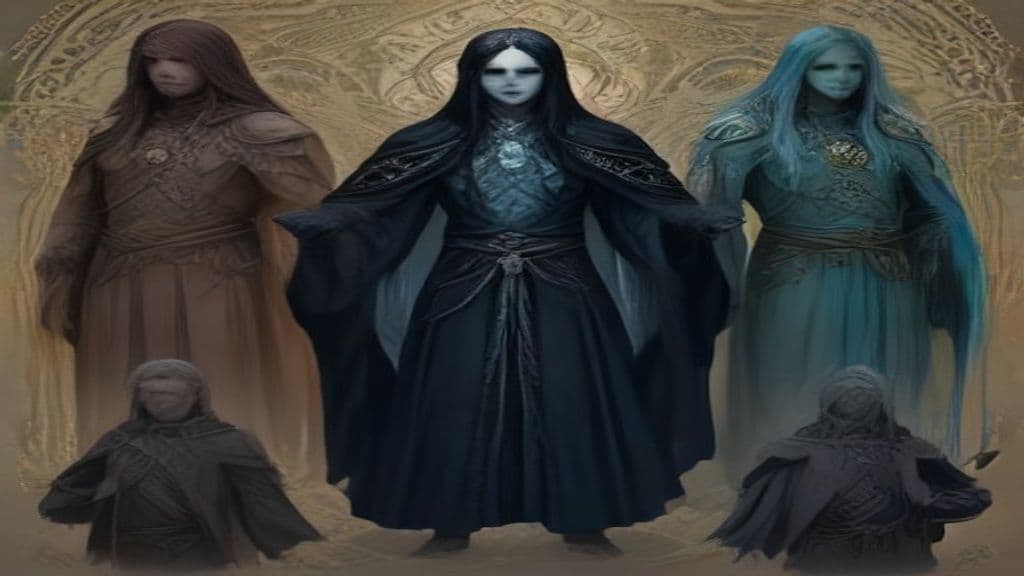
Tolkien's Elves are presented in the legendarium as the Firstborn of Ilúvatar (the Children of Ilúvatar), deriving from the wider mythic cosmology he fashioned from Northern European sources. As described in the provided materials, they are a prime, pre‑human kind with a special place in the world's making; their fate is bound up with the Undying Lands of Aman and the Halls of Mandos. The research notes emphasize that Tolkien deliberately reworked medieval and folkloric references (Old English, Old Norse) into this cosmological role, making the Elves a distinct, firstborn people whose spiritual destiny differs from that of Men.
The supplied sources do not provide exhaustive physical minutiae but emphasize inherited folkloric traits that Tolkien integrated: Elves are beautiful, potentially numinous or 'angelic' in moral aspect (Galadriel is cited as an exemplar of numinous goodness), often associated with dwelling in wild natural places, and traditionally portrayed as skilled and graceful. Older poetic sources characterized elves as large, dangerous, beautiful, and practised in archery; Tolkien's portrayals preserve an emphasis on uncanny beauty and skill while varying concrete details across his works.
Canonically (in the provided extracts) Tolkien's Elves do not die of disease or old age; if slain or dying of grief their spirits go to the Halls of Mandos in Aman, and many Elves long for and may sail to Valinor from the Grey Havens. From the folkloric background that Tolkien used, elves were associated with exceptional skill (notably archery), with causing certain ailments in humans (concepts like 'elf‑shot' and water‑elf diseases in medieval sources), and with ambiguous moral character—both beautiful and dangerous. Tolkien's synthesis preserves the immortality‑from‑old‑age trait and the metaphysical fate of Elven spirits while integrating older motifs of beauty, peril, and possible intimacy with humans (including traditions of intermarriage).
Weaknesses
- conditiondeath by violence or grief leading to spiritual transition to the Halls of Mandos
Wards
- ritualálfa‑blót (folkloric sacrificial practice — historically contested)
Valar
In J. R. R. Tolkien's legendarium the Valar are the greatest of the Ainur who entered the created world (Arda) to shape, govern, and protect it. They are described as the 'Powers of the World'—personified, supreme spiritual beings who implement and elaborate the creator Eru Ilúvatar's themes and who stand above Maiar and the peoples of Arda.

Barrow-wight
A wraith-like tomb-spirit coined by J. R. R. Tolkien that inhabits burial mounds (barrows). Modeled on Old Norse mound-spirits (haugbúar/draugr), Tolkien's barrow-wights animate or occupy ancient tombs and, in his narrative, can place living intruders under an enchanted sleep and arrange them with grave-goods until relieved by a powerful agent.
Elloe Kaifi
Elloe Kaifi is a Sakaarian noble-turned-gladiator in Marvel Comics who becomes a pledged member of the Warbound alongside the Hulk. Her arc spans Planet Hulk and World War Hulk storylines in which she pursues revenge against the Red King and later accompanies the Warbound to Earth.
Elpenor
Elpenor is a named human figure in the Homeric epic tradition (Odyssey) who dies accidentally on Circe’s island and later appears as a shade in Hades during Odysseus’ katabasis to plead for a proper cremation and burial. He functions in the poem as an example of neglecting funerary obligation and the moral duty of the living to care for the dead.
Elphaba Thropp
Elphaba Thropp is a fictional human character created by Gregory Maguire as a revisionist reinterpretation of Baum's Wicked Witch of the West. In Maguire's Oz she functions both as a political actor—opposing the Wizard's regime—and as a legendary figure whose life and reputed witchcraft enter the internal folklore of that secondary world.
Elric of Melniboné
Elric of Melniboné is a fictional literary protagonist created by Michael Moorcock: the albino, sorcerer‑emperor of the decaying island realm Melniboné (Imrryr), wielder of the soul‑feeding sword Stormbringer and a manifestion/facet of Moorcock's Eternal Champion theme in later treatments.
Elrond
Elrond is a named fictional individual in J. R. R. Tolkien's Middle-earth legendarium: a Peredhil ('Half-elven') who served as master of Rivendell (Imladris), bearer of the Elven ring Vilya, counselor and refuge-giver across the Second and Third Ages, and a figure bridging the great ages of Tolkien's world.
Elua and His Companions
Elua and His Companions are divine and semi-divine figures within the fictional religion of Jacqueline Carey’s Kushiel’s Legacy, functioning as central mythic personages in the series’ alternate-medieval Western European setting.
Elwetritsch
A regional legendary chimera reported in southwestern Germany (especially the Palatinate): a bird‑like, chicken‑sized imaginary creature assembled from parts of different animals and embedded in local mock‑hunts and folk identity. One scholarly interpretation traces the modern motif to a linguistic and cultural miniaturization of older night‑pressure spirits (Albdrude/Albdruck), though this continuity is presented in sources as an interpretation rather than uncontested fact.
Elyan the White
Elyan the White is a human knight of Arthurian legend attested in the medieval prose romances of the Lancelot‑Grail (Vulgate) and Post‑Vulgate cycles (and in the Prose Tristan). He is presented as the son of Bors the Younger, a member of the Round Table, a loyal kinsman of Lancelot, and a martial participant in episodes such as the rescue of Guinevere and Lancelot's exile; one Vulgate strand prophesies he will become Emperor of Constantinople.
Elymus
Elymus is primarily a botanical genus of perennial grasses (family Poaceae) whose species include wild ryes and quackgrasses; the name also appears in classical mythic reference as a personal name (the purported ancestor of the Elymians and as a man slain by Gorge). The available sources treat Elymus as a taxonomic label and a mythic personal name, not as a defined supernatural being within a living folk cosmology.
Elyon
Elyon (ʻElyōn, עֶלְיוֹן) is an ancient Northwest Semitic divine title/name meaning “the Upper/Most High.” In Israelite and neighboring Levantine texts it functions variably as an epithet of the God of Israel, as a high deity in regional treaty and mythic lists, and as a theological/poetic term emphasizing divine supremacy and cosmic height.
Emain Ablach
A mythical island paradise in Irish mythology, associated with Manannán Mac Lir and said to be an idyllic landscape filled with swans and yews. (Note: * Power tier: Reduce to Greater (Primordial implies a cosmic entity, Ancient implies deity-level, which may be excessive for an island paradise) * Origin story: Clarify that it's associated with Manan)
Emathion
Emathion is an onomastic figure in Greek and Roman literature: a name applied to several mortal personages of the heroic age (kings, courtiers, princes, and companions) rather than to a single supernatural being. Occurrences include a king of Aethiopia/Arabia killed by Heracles, a king of Samothrace who sent troops to Dionysus, an aged Ethiopian courtier slain in the Perseus–Phineus brawl, and a companion of Aeneas recorded in the Aeneid.
Community Record
- [1]Elves in Middle-earth (Wikipedia). Wikipedia, 'Elves in Middle-earth'.wiki
- [2]Khraniteli (Russian teleplay) summary on Archive.org. Archive.org, 'Khraniteli' summary and recording.other
- [3]VOA Africa broadcast (archive). Archive.org, VOA Africa broadcast (contextual material cited).other
- [4]The Curse of Morgoth - Morgoths Fluch (archive). Archive.org, 'The Curse of Morgoth - Morgoths Fluch' (contextual material).other