
No cosmogonic origin or creation myth for the far darrig is present in the supplied sources. Instead the figure is recorded in nineteenth- and twentieth-century collections and summaries of Irish folktales (for example Crofton Croker's Munster account, and later indexed summaries), where it is classified among solitary fairies alongside figures such as the leprechaun and clurichaun. The extant material frames the far darrig as a type within the Irish sidhe/otherworldly folk rather than as a deity or ancestral spirit.
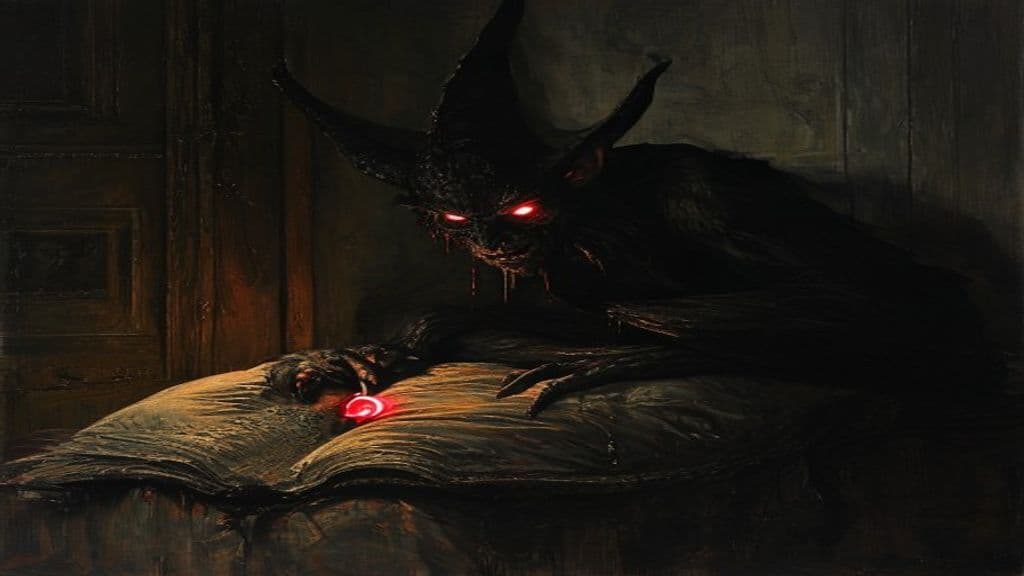
Sources consistently note red dress—specifically a red coat and cap—and generally small stature, though size descriptions vary. A Munster account (Croker, 1832) describes a figure about 2.5 feet tall with a wrinkled face, long grey hair and a sugarloaf hat; other descriptions call them 'rather fat' or nickname them 'Rat Boys' for dark, hairy skin, long snouts and skinny tails. Some summaries add that they can change size, and overall accounts emphasize variability across informants.
Primary behaviour is trickery and practical joking, described explicitly as including 'gruesome joking.' Traditions attribute to the far darrig baby-switching (replacing babies with changelings) and a 'some connection to nightmares,' indicating an ability to affect infant fate and sleep or dream-states in folk explanations. They are said to be sociable in certain respects—smoking by campfires, thinking, and eating meals if offered—and sources stress that refusing a far darrig's request invites unlucky and imaginative punishments; conversely, their presence in a house is sometimes said to bring good luck.
Weaknesses
- conditionhospitality (offering a meal)
- conditionsocial deference (not refusing requests)
Wards
- otheravoid refusal; offer food to placate
Alp-luachra
Alp-luachra is an Irish folkloric fairy described as an invisible being that consumes half of a person's nourishment by taking the unseen 'pith' or 'quintessence' of food; accounts say it appears in the form of a newt and crawls down a sleeping person's mouth at water margins.
Biróg
Biróg (also Biroge, Birog of the Mountain) is a female supernatural helper in Irish narrative tradition who aids Mac Cinnfhaelaidh/Cian in gaining access to the imprisoned Ethniu and rescues the surviving infant of that union; later retellings variably portray her as a leanan sídhe (female familiar spirit), a filidh (poet/seer), or a druidess.
Cat sìth
A feline supernatural being in Celtic folklore, especially Scottish tradition, described in some accounts as a large black cat with a white spot on its chest associated with the fairy/otherworld; alternative traditions identify it as a witch able to transform into a cat up to nine times.
Clurichaun
A solitary Irish fairy-like household and cellar spirit associated with drinking places (breweries, pubs, wine cellars). He is a heavy drinker and smoker, a mischievous trickster who can also act as a protective domestic spirit for a household that tolerates him; accounts are primarily from 19th-century collectors and later summaries.
Crom Dubh
Crom Dubh is a fluid mythological and folkloric figure from Irish tradition, variously represented as a remnant cultic god, a pagan chieftain or robber, a servant-figure, and the focal figure of seasonal first-fruits rites (Crom Dubh Sunday). In later narratives he is frequently framed as an antagonist subdued or reinterpreted by St. Patrick.
Gancanagh
A male member of the Irish little people traditionally portrayed as a seductive, fairylike 'love-talker' who courts and harms human women; depicted variously as a leprechaun-like little man and in poetic sources as an incubus-like handsome seducer.
Leprechaun
A diminutive, solitary supernatural being from Irish folklore, commonly depicted as a shoemaker who delights in mischief and is associated with hidden or buried treasure. Prominent in later folkloric collections and the 19th‑century literary revival rather than central early mythic cycles.
Maine mac Darthacht
Primordial entity associated with darkness and light, connected to Celtic mythology's Tuatha Dé Danann pantheon. (Note: 1. "Primordial entity associated with darkness and light" - source material only mentions association with night/darkness, but not explicitly light. 2. Power tier should be reviewed as Maine mac Darth)
Merrow
A sea-being of Irish/Celtic folklore, the Merrow (Hiberno-English) denotes a class of half-human marine supernatural persons — often female 'sea-maidens' and uglier male counterparts — capable of interaction and occasional intermarriage with humans. Medieval Irish terms connect the figure to older siren- and sea-nymph motifs, while 19th-century collectors shaped much of the modern folk image.
Pillywiggin
Pillywiggins are very small faery or 'little people' in English and Irish folkloric compilations who function as guardians and personifications of spring flowers and small flora. Described in modern sources as trooping, winged flower-fairies, they are generally benign and largely indifferent to humans, associated with gardens, meadows and the seasonal rhythms of plants.
Stray Sod
A clump of enchanted grass attributed to faeries in Celtic tradition, causing disorientation and loss of direction. (Note: - Power tier: Primordial (not Lesser), as the effect described is far-reaching, causing disorientation even in familiar surroundings. - Abilities: Add that the effect can persist even after leaving th)
Will-o'-the-wisp
An atmospheric 'ghost light' — a small, mobile, lamp-like light seen at night over marshes, bogs, wet ground, or graveyards. In many cultures the phenomenon is interpreted as a supernatural being or manifestation (wandering nature-spirit, soul of the dead, transformed witch, or treasure-indicator); modern science offers chemiluminescent explanations for some occurrences.
Community Record
- [1]Far darrig — Wikipedia. Wikipedia, 'Far darrig' article (summary of traditional descriptions)wiki
- [2]Munster account (Crofton Croker, 1832) as summarized. Crofton Croker, Munster description (1832) summarized in collected sources (cited in Source 1 notes)folk
- [3]The book of Irish weirdness : a treasury of classic tales of the supernatural, spooky, and strange (archive listing). Contents listing includes 'Far Darrig in Donegal' (archive collection reference)folk
- [4]Modern and literary adaptations and indexes (selection). Mythus: 'Phaeree Tales: The Pranksters of Phaeree' and related bestiary entries (derivative/literary treatments referenced in notes)literary