
God L does not have a single preserved 'origin story' in the supplied sources; rather, he occupies an established place in Maya cosmology as an aged supernatural 'Mam' who mediates travel, wealth, and underworld forces. In Postclassic codical contexts some scholars interpret God L as a personification of Venus rising from the underworld or as an underworld lord connected to Xibalba, but these are interpretive readings of codical Venus vignettes rather than a unified mythic birth narrative. Narrative scenes on Late Classic pottery and on monuments place him within episodic interactions with other deities (for example, denudation/clothing episodes, interactions with God K, and scenes of captives) that illustrate his role at the intersection of commerce, ritual authority, and violent power.
In the Dresden Codex the main name sign for God L is the head of an aged man painted black; codical and ceramic depictions more broadly show an elderly male figure with recurring attributes: a broad feathery hat often surmounted by an owl, jaguar features (jaguar ear, jaguar mantle or cape, sometimes patterned like an armadillo shell), a walking stick, a bundle of merchandise, and a frequently depicted cigar. On monuments he appears in palace or throne contexts (e.g., Palenque Temple of the Cross doorjamb, Temple of the Sun reliefs) and on ceramics (Princeton Vase) in narrative court scenes. Specific objects of regalia attributed to him in iconography include a mantle and a footprint‑marked loincloth.
God L governs and bestows wealth (bundles of merchandise, cacao orchards, maize, and women in certain vase scenes), embodies long‑distance travel and mercantile activity (footstep motifs on cloth), and manifests shamanic or apotropaic magic (cigar smoking, owl headdress, jaguar associations). His jaguar and owl attributes also link him to sorcery, violence, and warfare; in some Dresden Codex Venus‑related scenes he is interpreted as rising from the underworld and hurling spears, and ceramic scenes (e.g., the Princeton Vase) depict captive executions associated with his jaguar palace. He is sometimes paired with or carries an infant K'awiil (God K) — attested in the Bakna carved column and related ceramics — indicating interactions with lightning/seed deity imagery.
Weaknesses
- otherNone recorded in supplied sources
Wards
- ritualDraping of acantun with God L's mantle and footprint‑marked loincloth during wayeb
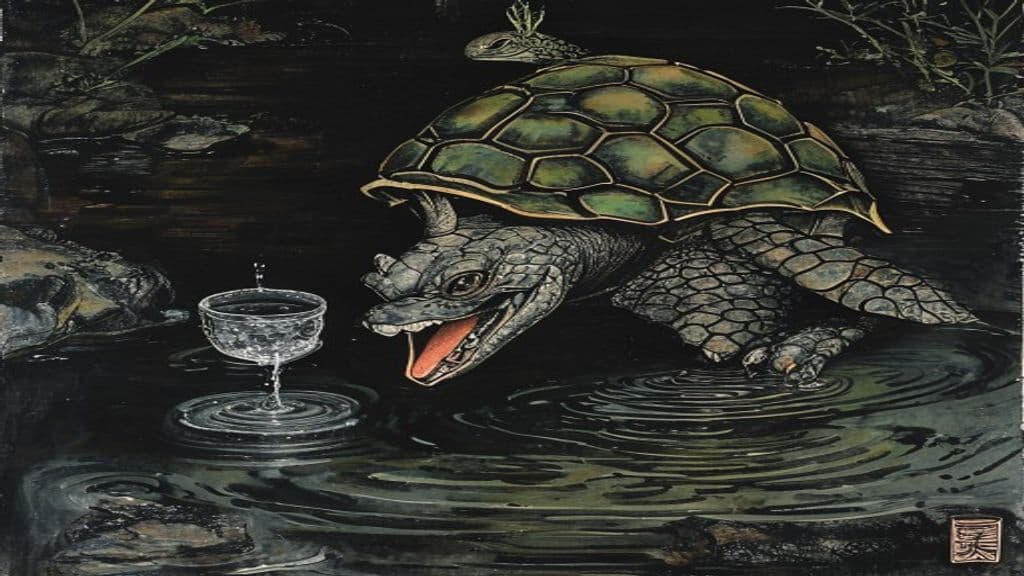
Kappa
A water-dwelling imp of Japanese folklore with a bowl of water on its head. Mischievous but bound by strict codes of politeness; dangerous near rivers.
Kappa
A water-dwelling imp of Japanese folklore with a bowl of water on its head. Mischievous but bound by strict codes of politeness; dangerous near rivers.
Gnadenstuhl
An iconographic motif in Christian art, the Gnadenstuhl (German: 'seat of mercy') depicts the Trinity with the Father supporting or presenting the crucified Christ and the Holy Spirit as a dove, functioning as a visual theology of divine mercy and the cross as an event of the Triune God.
Gnome (tradition)
A class of animate subterranean beings from early-modern European natural-philosophical and miners' lore. Treated by Paracelsus as earth elementals (gnomi) and recorded in German mining tradition as Bergmännlein / Berggeist, these small, humanlike mountain-spirits explain and personify phenomena in mines — from mischief to the discovery of ore.
Goatman (urban legend)
A modular North American roadside/woods urban legend about a half-goat/half-human figure tied to specific local sites (notably Prince George's County, MD; Denton County/Old Alton Bridge, TX; and Nags Head Woods, NC). The Goatman functions as a liminal, threatening presence in stories—blending animal and human traits—and is used to explain local misfortunes and to police risky spaces.
Goblin
A class of small, often grotesque humanoid beings in European folk belief that range from household helpers to tricksters and violent figures. Goblins occupy liminal spaces—hearths, cellars, ruins and wild places—and their behavior toward humans depends on region, story, and reciprocal treatment.
Gochihr
In Zoroastrian tradition, Gochihr is a powerful dragon associated with water and chaos. (Note: The power_tier should be adjusted to "Primordial" based on the provided source, but with the understanding that Primordial entities are often cosmic in nature and Gochihr's association with water and )
God (Christianity)
In the Christian tradition represented in the sources, God is the eternal, supreme being who created and preserves all things, is both transcendent and immanent, and is understood in mainstream theology as one God in three Persons (Father, Son, Holy Spirit). Christian doctrine emphasizes God's action in history (covenant with Abraham, revelation in scripture, the Incarnation of the Son, and the sending of the Spirit).
God in Buddhism (concept)
A doctrinal and conceptual topic concerning the status of a creator or ultimate deity within Buddhist thought. Most sourced summaries state that Buddhism does not include belief in a creator deity, while noting that some schools posit transcendent, unborn, or unconditioned ultimate realities.
God the Father
In Christian doctrine, 'God the Father' names the First Person of the Trinity who is described as creator, origin, and paternal principle in relation to the Son and the Holy Spirit. Trinitarian formulations present the Father as consubstantial, co‑equal and co‑eternal with the Son and Spirit, while non‑Trinitarian traditions interpret the Father differently (e.g., as supreme, as a distinct being, or as title‑variants). Scriptural material frames the Father as the heavenly addressee of prayer and the source of life, authority and moral order.
God the Son
In the Christian theological tradition represented by the provided sources, 'God the Son' designates the second Person of the Trinity—identified with the pre-existent Logos and historically incarnate as Jesus of Nazareth—who participates in creation, revelation, and the purifying work for sins and is exalted to the heavenly right hand.
Goddess
A goddess is a female deity — a sacred female divine figure found across many polytheistic and religious traditions. The term functions as a classificatory label for diverse culturally specific female divinities and metaphysical female principles, ranging from local patronesses to supreme cosmic realities.
Goddess I (Taube designation)
Goddess I is an important Maya deity, chiefly attested in the Dresden Codex and in Classic‑period imagery. She is represented as a youthful woman who presides over feminine vital functions—eroticism, human procreation, and marriage—with an aged aspect associated with weaving.
Godform (tradition)
A contemporary occult and artistic category: a created or assumed divine persona evoked by ritual, visualization, or creative practice. 'Godform' appears across modern occult instruction, paid ritual offerings, online forums, and artistic projects as a technique or object for psychospiritual work, group ritual, or aesthetic deification.
Community Record
- [1]God L (Wikipedia). Wikipedia, 'God L' entry (accessed sources summarized in research notes)wiki
- [2]Princeton Maya Vase with God L (Wikipedia). Wikipedia, 'Princeton Maya Vase with God L' (vase imagery and description referenced in research notes)wiki
- [3]The Dresden Codex Venus Table (online archival reference). Dresden Codex Venus Table (codical Venus vignettes and acantun depiction referenced in research notes)other