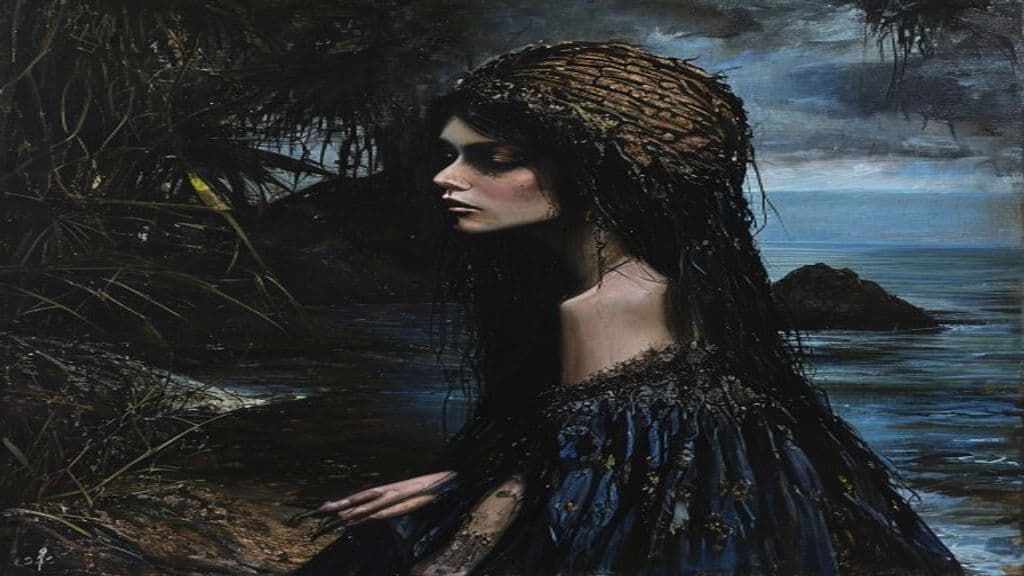
According to Indonesian origin myth, Hainuwele is a figure from the Wemale and Alune folklore of Seram Island. Her story is associated with the creation of humans.
Hainuwele is referred to as 'The Coconut Girl', but no physical description is provided.
As an origin myth figure, Hainuwele is involved in significant events in human history and development on Seram Island. Her story likely involves the creation of humans.
Haftvād
A legendary character in Persian tradition associated with the rise of the Sassanid empire. (Note: - Power tier: should be "Ancient" (since it's a legendary character associated with the rise of the Sassanid empire and not explicitly described as cosmic) - Appearance: note that there is no informat)
Hag
A hag is a folkloric figure typically depicted as an old, wizened woman who appears across European traditions in multiple roles: a nightmare spirit, a witch-like or fairy-type being, a river or household monster, or (in some cases) a form adopted by sovereignty or storm goddesses. The figure functions variously as a cautionary monster, an explanation for sleep paralysis and nightmares, and a liminal test-figure in myth.
Hagar
Hagar (Hebrew: Hāgār; Arabic: Hājar) is presented in the Book of Genesis as an Egyptian female servant (שִׁפְחָה) in Sarai's household who bears Abram a son, Ishmael; later Jewish and Islamic traditions expand and reinterpret her status and story, including rabbinic identifications (e.g., Pharaoh’s daughter, potential identification with Keturah) and Islamic accounts linking her to the origins of Mecca and the Zamzam well.
Hagbard and Signy
Hagbard and Signy (also Habor and Sign(h)ild) are legendary human lovers of Scandinavian heroic tradition whose tragic saga—preserved in medieval prose (notably Saxo's Gesta Danorum) and in a long-lived ballad tradition (TSB D 430)—was widely sung and commemorated in place-names and monuments across Scandinavia.
Hagen
Hagen (German; Old Norse Hogni; Old English Hagena; Latin Hagano) is a named Burgundian warrior and retainer in the corpus of Germanic heroic legend, prominently attested in the Nibelung material. He functions as an important counselor and martial figure within the Burgundian court and is implicated in central narrative conflicts of the cycle, including enmity with figures such as Siegfried.
Haietlik
The haietlik (Nuuchahnulth: ḥiʔiiƛ̓iik) is a lightning serpent or lightning spirit in Nuu-chah-nulth (Nootka) mythology. It functions as an animate lightning-being allied with thunderbirds, integrated into whaling technology and ceremonial life along the Pacific Northwest coast.
Hakini
Tantric goddess of the Ajna chakra — the third eye between the brows. White-complexioned and six-faced, Hakini governs the boundary between individual perception and divine vision. Her favour opens the third eye; her displeasure collapses the distinction between dream and reality.
Hakuzōsu
Hakuzōsu (白蔵主) is a named kitsune character in Japanese folklore who adopts the social role of a Buddhist priest or uncle in multiple local legends and theatrical versions. As a concrete fox-spirit tied to Inari-associated cultic contexts and village life, Hakuzōsu appears in narratives that emphasize shapeshifting, impersonation, and interaction with hunters and temple communities.
Halaesus
Halaesus (also Halesus; Latin Alesi) is a named figure in Greek and Roman mytho-historical tradition, portrayed as a mortal hero/warrior. He appears in two main strands: as an Emathian Lapith killed at the wedding of Pirithous and Hippodamia, and as a companion (sometimes called an illegitimate son) of Agamemnon who, after escaping the slaughter at Mycenae, travels to Italy and is credited with founding Falerii; in Roman epic tradition he fights against Aeneas and is slain by Pallas.
Halahala
A powerful poison in Hindu mythology, created during the churning of the Ocean of Milk. (Note: 1. Power tier should be Primordial, not Greater, as it can kill gods. 2. Add sensory cue: "A presence that threatens all life". 3. Add weakness: "None mentioned, but Amrita is a countermeasure" 4. Sum)
Half-elf
A being born of a union between an elf and a human; across sources the category functions as a genealogical/hybrid personage whose significance ranges from a locus of metaphysical choice (Tolkien) to narratively potent, sometimes dangerous figures in Norse sagas, and to a flexible playable race in modern fantasy gaming.
Halitherses
Halitherses (Ancient Greek: Ἁλιθέρσης) is an Ithacan seer and elder in the Homeric Odyssey cycle, named as the son of Mastor. He interprets signs from Zeus, pronounces their meaning publicly, and counsels restraint and deference to the gods; his warnings are often disregarded by the suitors and portions of the community.
Community Record
- [1]