Hemann is not a single fixed origin tale but a category of local beings in Germanic folk cosmology: often a restless soul punished for a specific offense (notably a Grenzfrevler who unlawfully moved a boundary stone), sometimes a field sprite or corn-demon receiving the last sheaf of the harvest, and occasionally treated as a domestic spirit. Across regions the figure develops from local concerns—boundary morality, forest and wood theft, and harvest reciprocity—so the 'origin' is a social-moral function embedded in landscape and seasonal practices rather than a single creation myth.
The Hemann is predominantly auditory and usually invisible; accounts emphasize hearing its shrill, onomatopoeic cry more than seeing it. When sighted, forms vary by locality: Upper Palatinate Hoymann may appear as a tall man in hunter's costume with a broad-brimmed hat or as a giant and is also sometimes said to wear a smock-frock; Westphalian Homännchen/Heitmännchen appear as small manikins (a little man in a gray camisole or a little blue flame) or as tiny green, kobold-like Hojemännlein in Lechrain; other reports describe flame-like manifestations. The dominant pattern remains an ephemeral or partial visible manifestation rather than consistent corporeal form.
The Hemann's primary trait is a characteristic, shrill yell (regional cries recorded include 'he he!', 'he helfts!', 'heh', 'hoho!', 'hüp hüp!', 'heit heit!', 'ju ju!'), with the name often capturing that cry. It repeatedly scares people through yelling—chasing them with its voice but typically not overtaking them—and in many regions punishes imitation by 'aufhocken' (leaping onto a person's back/neck to force them to carry it). Some variants punish specific transgressions (e.g., theft of wood; leading people astray; slapping offenders). Other regional roles are helpful: as a field sprite it may assist at harvest if offered the last sheaf or food (a sandwich in Westphalia). Naturalistic explanations are noted in the tradition: many Hemann accounts were likely inspired by bird calls (owls, eagle-owls, hoopoes, nightjars, ravens), and in some areas (Silesia, parts of Upper Palatinate) owls or ravens are explicitly identified with the Hemann. The Hemann can also function as an omen or timekeeper (Lower Lusatia noon cry; Ropenkerl's cry as weather omen).
Weaknesses
- conditionDo not imitate its yell
- conditionProper observance of local harvest/boundary customs (avoid provoking it by wrongdoing)
Wards
- ritualOffering the last sheaf (agrarian propitiation)
- ritualFood offering (e.g., sandwich to Heitmännchen in Westphalia)
- conditionAvoid answering or imitating the Hemann's cry
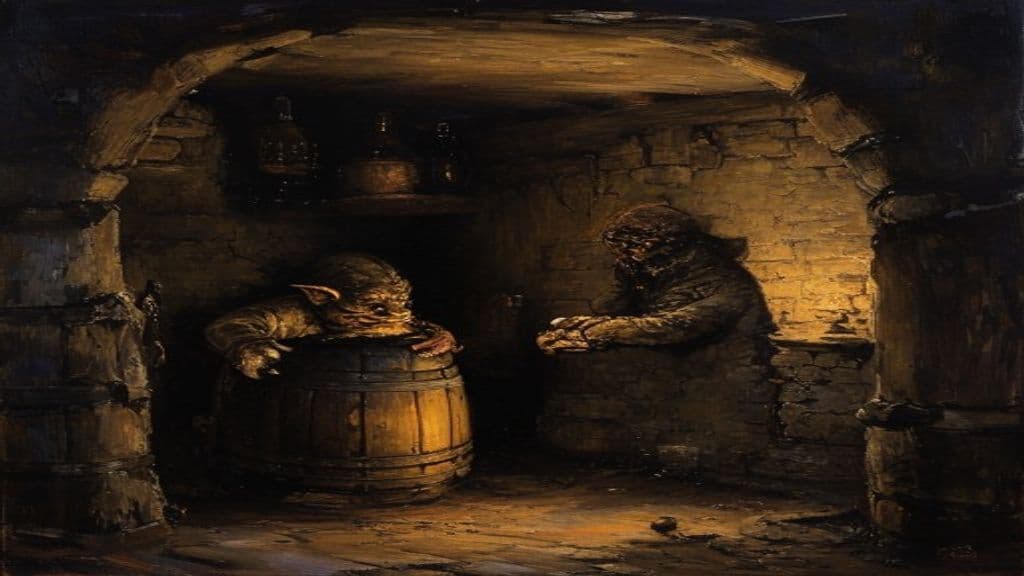
Kobold
The German household and mine spirit — a mischievous but potentially helpful small being who attaches to a household, bringing luck or disaster depending on how it is treated.
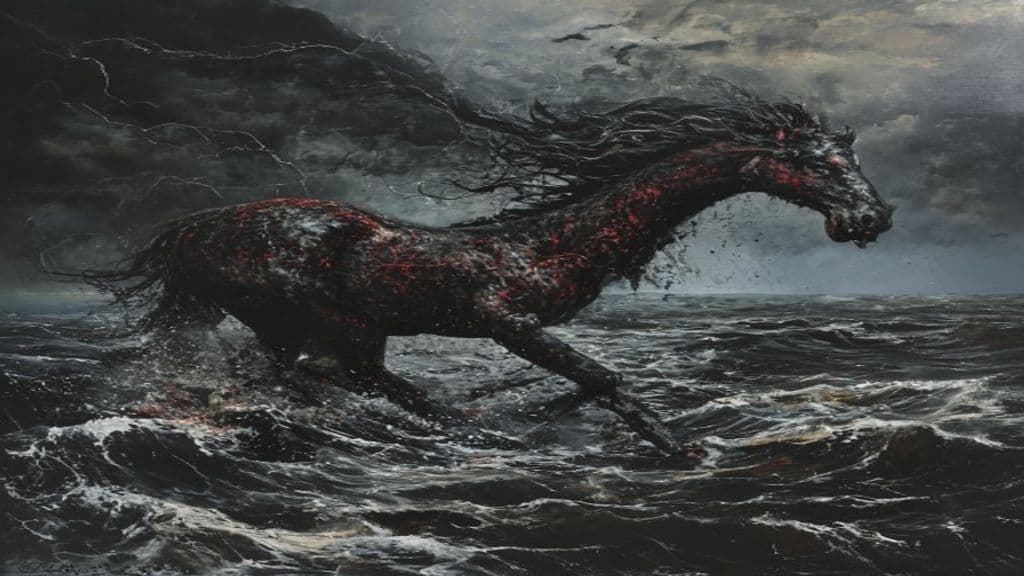
Nuckelavee
The most terrifying creature of Orcadian folklore — a skinless, horse-headed demon of the sea whose breath spreads plague and whose presence causes crops to wither. It cannot cross fresh water.
Abraun
Abraun is an attested name in German-language plant-legend scholarship (Der abraun, ein beitrag zur pflanzensagenkunde, 1916) and a short database entry (Wikidata) labels it as a spirit from German mythology. Surviving accessible documentation is extremely limited: the principal academic treatment is a 1916 contribution to pflanzensagenkunde (plant-saga studies), but the excerpts available here contain only bibliographic metadata and do not record tales, descriptions, or rituals.
Adils
Adils (Old Norse Aðils; also Eadgils, Adillus, Athisl, Adhel) is a semi‑legendary sixth‑century Swedish king attested in Old Norse saga material and later medieval traditions. He appears in saga episodes as a storied royal figure involved in warfare, court acts, and marriage suits rather than as a supernatural being.
Agilaz (Egil)
Agilaz (reconstructed Proto-Germanic) — commonly recorded in medieval sources as Egil or Ægil — is a legendary archer attested in Germanic heroic tradition. He appears as the brother of Völund (Wayland/Weland) in the Old Norse poem Völundarkviða and in the Thidreks saga, and his name is also inscribed on early medieval objects (Franks Casket, Pforzen buckle). The attested material presents him as a named heroic human archer within saga and inscriptional contexts rather than as a recurrent supernatural species.
Alaisiagae
A group of Germanic female deities attested in Roman Britain, worshipped by continental auxiliary troops at a shrine near Vercovicium (Housesteads) on Hadrian's Wall. Epigraphic evidence records dedications to named members (Beda, Fimmilena, and in other lists Baudihillia and Friagabis) alongside Mars Thincsus and the numen of the emperor; modern scholarship interprets them variously as war/victory goddesses, as goddesses associated with assembly/justice, or as part of Matronae‑type fertility/ancestor cults.
Alberich
In Germanic heroic legend, Alberich is a dwarf associated with elven qualities and power. (Note: 1. Power tier: Reduce to Ancient as Alberich's abilities are not described beyond being a dwarf with elven qualities. 2. Origin story: Clarify that Alberich is mentioned in multiple Germanic texts, bu)
Alcis
A pair of youthful brother-deities worshipped by the Naharvali, attested only in Tacitus' Germania (c. 98 CE). They were venerated in a sacred grove under the care of a priest in female attire and are compared by Roman ethnography to the Graeco‑Roman Dioscuri (Castor and Pollux).
Alf and Alfhild
Alf and Alfhild are legendary human figures from Old Norse/early Scandinavian narrative tradition preserved principally in Saxo Grammaticus' Gesta Danorum. The tale presents Alf as a Danish prince and Alfhild as a Geatish princess who becomes a shieldmaiden and leader of a fleet of female raiders; their story includes combat, recognition, marriage, and later dynastic conflict.
Alp
A German-speaking folkloric figure associated with nocturnal disturbance of sleepers. Historically tied to the broader Germanic family of 'elves' and treated variously as an eerie nature-being in medieval glosses and as a male nocturnal spirit in later folk accounts that sits on sleepers' chests and causes nightmares (Alptraum) and 'elf-pressure' (Alpdruck).
Alraune
Alraune is the German folkloric figure identified with the humanoid-shaped mandrake (Mandragora officinarum) and the eponymous female character in Hanns Heinz Ewers's 1911 novel. In folklore the mandrake/Alraune is associated with love philtres, fertility, and a medieval gallows-origin legend; in literature the name labels a woman artificially conceived from a criminal's semen, whose emotional life and actions dramatize the folk moral about such origins.
Altgermanische Religionsgeschichte
A historical survey of Germanic religious history, providing an overview of the pantheon of gods and goddesses. (Note: - Power tier is not applicable to historical surveys - The article should reflect that it's a historical survey, not an entity with abilities or appearance - Consider adding information on the signifi)
Amleth
Amleth (Old Norse: Amlóði; Latinized Amlethus) is a legendary medieval Scandinavian prince and saga-hero best known from Saxo Grammaticus' Gesta Danorum. He is a human protagonist whose story centers on feigned madness, cunning survival, exile to Britain, marriage, wealth-gathering, and eventual vengeance against his father's murderer; the tale later inspired the character of Shakespeare's Hamlet and numerous adaptations.
Anglo-Saxon Deities
A list of deities from the Anglo-Saxon pantheon, likely derived from Old English and other Germanic languages. (Note: 1. Power tier: Primordial seems too high given the sparse written record and limited information on abilities. 2. Appearance: Delete statement as no physical descriptions are provided in available sou)
Community Record
- [1]Hemann — Wikipedia. Wikipedia contributors, 'Hemann,' Wikipedia, The Free Encyclopediawiki
- [2]Wikidata entry: Hemann. Wikidata: Q37088085other
- [3]Archive: gov.uscourts.ohnd.31531. Archive.org resource cited in research notesother
- [4]Archive: Myrtle Leaves in Spring Time; Or, Early Friends and Friendships. Archive.org scanned text cited in research notesother
- [5]Archive: Ein rheinisches Mädchen beim rheinischen Wein (Hoppe). Archive.org scanned text cited in research notesother