
The Alcis are known only from a single ethnographic passage in Tacitus' Germania (c. 98 CE). Tacitus reports that among the Naharvali there is a grove 'of immemorial sanctity' cared for by a priest 'in female attire' and that the deities worshipped there are called Alcis. He further notes a functional resemblance to Castor and Pollux in Roman terms but insists the cult is indigenous rather than imported. No mythic birth or narrative origin is preserved in the surviving sources; the sole attestation frames them as established local cult deities associated with a sacred grove.
Tacitus explicitly states that the Alcis 'have no images,' and records only that they are venerated 'as brothers and as youths.' There is no ancient pictorial or idol description in the surviving evidence. Later modern devotional or artistic depictions (for example contemporary neopagan renderings) are modern reconstructions and are not attested in the primary ancient source.
Tacitus provides no direct account of specific powers, deeds, or mythic functions for the Alcis. Roman interpretatio equates them with Castor and Pollux, and modern scholarship commonly situates them within the Indo‑European 'Divine Twins' motif (whose members elsewhere act as rescuers, protectors, or healers). Such functional attributes for the Alcis are comparative reconstructions based on parallels rather than direct attestation and therefore remain hypothetical.

Castor and Pollux (the Dioscuri)
A pair of mythic twin brothers of Greek and Roman tradition (the Dioscuri/Gemini) who occupy a liminal heroic/divine status. They function as patrons and protectors of sailors, travellers, horsemen and athletes, and are ultimately placed among the stars as the constellation Gemini.
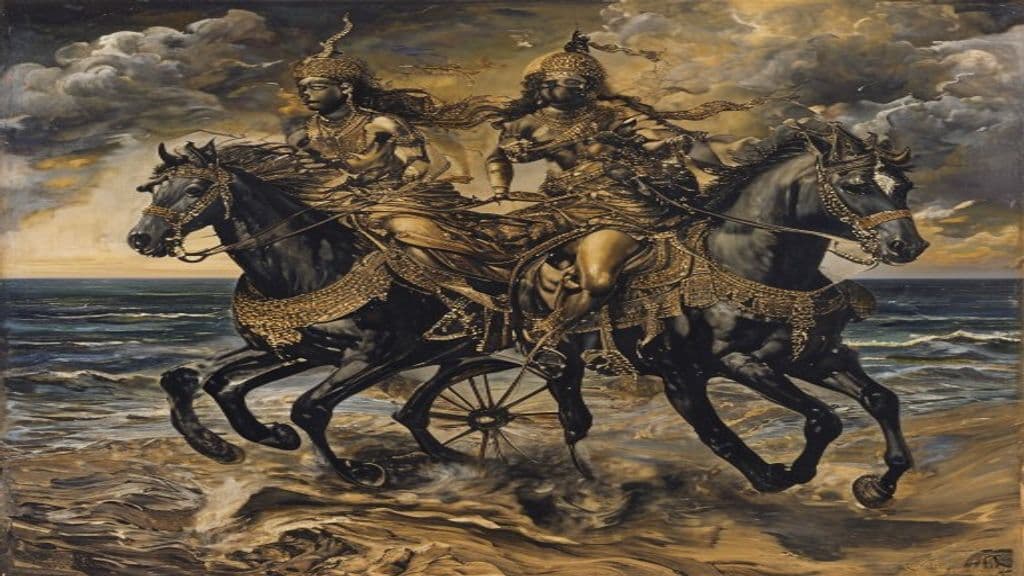
Ashvins
The Aśvin (Ashvins) are Vedic twin divine horsemen invoked in the Rigveda as youthful rescuers and restorers who travel in a swift chariot; they are closely associated with dawn/twilight, healing, and medicine and are repeatedly called upon to save, restore, or bring home those in peril.
Alcimede
Alcimede (Ancient Greek Ἀλκιμέδη, 'mighty cunning') is a mortal woman of heroic-age Greek myth: daughter of Phylacus and Clymene, wife of Aeson, and in several traditions the mother of the hero Jason. She functions as a genealogical and maternal figure in the Argonautic cycle rather than as a supernatural being.
Alcimedon
Alcimedon is a personal name borne by several distinct figures in Greek myth and later literary tradition rather than a single supernatural entity. Attestations include a Tyrrhenian sailor metamorphosed into a dolphin for attempting to abduct the infant Dionysus; an Arcadian eponymous hero tied to a plain and family narratives; a Myrmidon commander under Patroclus in the Trojan War cycle; a skilled craftsman mentioned in Virgil's Eclogue 3; and a Locrian companion of Ajax the Lesser slain at Troy.
Alcimenes
Alcimenes (Ancient Greek Ἀλκιμένης) is a personal name borne by multiple mortal figures in Greek myth and literary history — including a Boeotian prince, one of the sons of Jason and Medea, and several authors. The sources treat Alcimenes as human characters within mytho-historical narratives and literary tradition rather than as a distinct supernatural class or spirit.
Alcimus
Alcimus is a name used for multiple figures in classical and Jewish-historical traditions. Most prominently, Alcimus (Greek Alkimos; Hebrew Elyaqum / Jakeimos) is recorded in Hellenistic Jewish sources as a high priest of Israel (c. 162–159 BCE) associated with pro-Seleucid, Hellenizing policies and opposition to the Maccabean revolt; separately, the same Greek name appears as a label for several minor mortal figures in Greek mythographic and epic lists.
Alcinous
Alcinous (Ancient Greek: Ἀλκίνοος, Alkínoos, "mighty mind") is a legendary human king of the Phaeacians in Greek epic tradition. He is portrayed as an ideal hospitable monarch who receives wandering heroes (notably Odysseus and the Argonauts), presides over feasts and games, adjudicates disputes, and provides ships, gifts, and safe passage. Variant genealogies and island-identifications appear across sources, but his role as a beneficent royal host is consistent.
Alcippe
Alcippe (Ancient Greek: Alkippe / ᾿Αλκιππή) is a personal name applied to multiple distinct female figures in Greek mythic genealogies—including a daughter of Ares, an Amazon, and one of the Alcyonides—rather than a single uniform supernatural being.
Alcmaeon
Alcmaeon (Ancient Greek: Ἀλκμαίων, Alkmaíōn) is a heroic human figure in Greek mythic‑historic genealogy, known chiefly as one of the Epigoni who led the Argives to capture Thebes in revenge for the Seven against Thebes and as an eponymous ancestor claimed by the Alcmaeonidae. Multiple distinct personages share the name in different traditions.
Alcmene
Alcmene is a mortal heroine of Greek myth, daughter of Electryon and wife of Amphitryon, best known as the mother of Heracles by Zeus. She appears in multiple classical sources as a noble matron whose body becomes the site of divine intervention in the conception and birth of Heracles and who received at least local veneration in antiquity.
Alcmenor
Alcmenor (Ancient Greek: Ἀλκμήνωρ) is a mythic human prince in Greek genealogy, named as one of the sons of King Aegyptus. He is recorded as having married the Danaid Hippomedusa and being slain on his wedding night when the daughters of Danaus killed their husbands on their father's command.
Alcmeonis
A lost early Greek epic poem (Ancient Greek: Ἀλκμεωνίς / Ἀλκμαιωνίς) traditionally counted among the Theban cycle; known only from a small number of fragmentary references, it narrated the story of Alcmaeon’s killing of his mother Eriphyle in vengeance for the death of his father Amphiaraus.
Alcon
Alcon (Ancient Greek: Ἄλκων) is a personal name borne by several mortal figures in Greek mythic and genealogical traditions, typically noted as skilled hunters or archers and appearing in local dynastic or hunting narratives rather than as a distinct supernatural being.
Alcyone (daughter of Sciron)
Alcyone is a minor figure of ancient Greek myth who, in variant traditions, is transformed into the kingfisher (Greek ἀλκυών). Two main traditions survive: an Attic tale in which Sciron casts his daughter into the sea for sexual transgression (reported via Pseudo-Probus/Theodorus), and the better-known Alcyone-and-Ceyx couple-story (Ovid/Nicander tradition) in which divine pity results in metamorphosis and an etiological explanation for the "halcyon days."
Community Record
- [1]Alcis (gods) — Wikipedia. Wikipedia: 'Alcis (gods)' article summarizing Tacitus and scholarly discussionwiki
- [2]Tacitus, Germania (summarized). Tacitus, Germania, ch. 40–41 (as transmitted in modern summaries): passage describing the Naharvali grove, priest in female attire, and the Alcisliterary
- [3]Hail Alcis (modern devotional page). Contemporary devotional material noting modern reconstructions and invocations (modern, not primary evidence)other