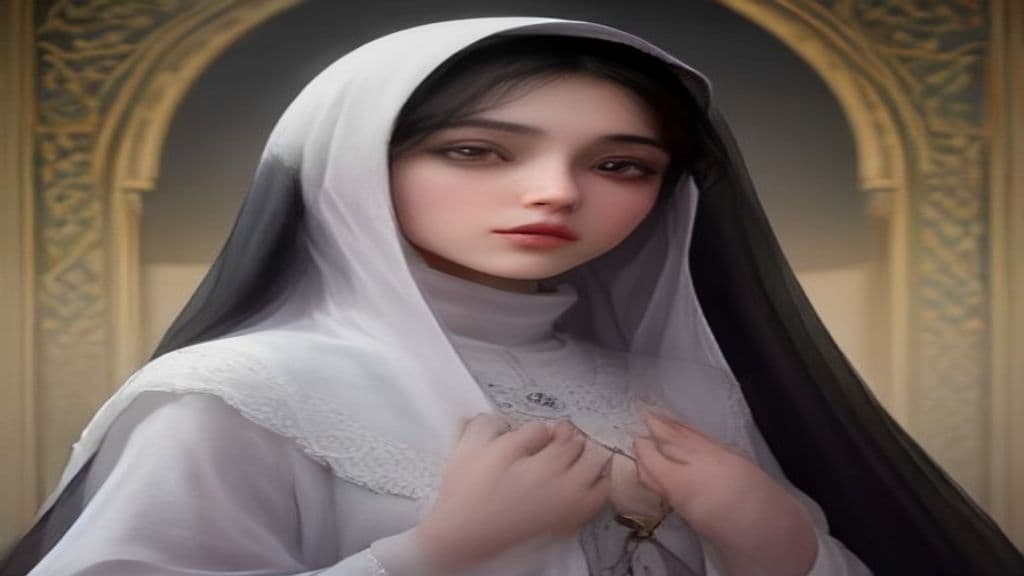
Qurʾānic verses mention houris as companions in Paradise; later hadith and tafsīr expand those mentions into fuller descriptions. Classical commentators and later scholars disagree about their ontology: many treat houris as a separate created class distinct from earthly humans, while some interpret Qurʾānic references as describing the transformed, perfected state of human inhabitants of Paradise. The textual sources therefore present houris as part of the hereafter's created order, with the precise metaphysical status debated in the tradition.
Qurʾānic epithets describe houris as maidens of modest gaze and beautiful/wide eyes, 'bright-eyed' or with intensely black eyes set against the whiteness of their irises, 'as elegant as rubies and coral,' 'reclining on green cushions and beautiful carpets,' and 'untouched beforehand by man or jinn.' Hadith literature (as summarized in the sources) provides further ornate details: layered scent-and-color imagery (saffron, musk, amber, camphor), many fine gowns (traditions give numbers from seventy to 70,000), descriptions of flesh so fine that 'the marrow of their bones' is visible, eternal youth, hairlessness except for head and eyebrows, and absence of ordinary bodily infirmities.
Primary function in the cited texts is paradisiacal companionship and spousal association for the faithful in Jannah. Certain hadith traditions assert that 'everyone will have two wives from the houris' (a hadith summary cited from major collections), while the Qurʾān itself provides no numeric specification. Hadith and tafsīr attribute to houris the absence of ordinary needs and ailments (no sleep, no pregnancy, no menstruation, no spitting or nose-blowing, never sick) and ascribe relational behavior in Paradise (including at least one hadithic report of a female houri addressing an earthly woman in a hortatory manner). The sources do not depict houris as agents of possession, moral judgment, or tricksters; their role is reward and aesthetic/spiritual companionship.
Hortdan
A Turkic folkloric figure denoting a troubled soul of the dead that rises from the grave; in older accounts a mournful grave-apparition, and in later popular retellings sometimes recast as a vampire- or zombie-like undead.
Horus
Horus (Ancient Egyptian ḥr.w) is a major Egyptian deity associated with the sky, the sun and moon, kingship, protection, and healing. He appears in multiple local and chronological manifestations (e.g., Horus the Elder, Horus the Younger) and serves as the divine model of the living pharaoh and avenger/heir of Osiris.
Horus Name
Title or crest used by ancient Egyptian rulers, symbolizing divine connection and royal identity. (Note: - Power tier should be Ancient (deity-level) as it represents a connection to a deity and is used by rulers, not just regional spirits. - Summary: While accurate, could be rephrased for clarity: "Titl)
Hoturapa
A Māori chief from Hawaiki who is tricked by Kupe, leading to consequences. (Note: - Power tier should be Lesser or Minor Spirit, as there's no indication that Hoturapa has deity-level abilities. - Sensory cues are missing and should be added based on the source material (e.g., perh)
Hoturoa
In Māori tradition, Hoturoa is a founding ancestor and leader of the Tainui canoe during its migration to New Zealand around 1400. He holds significant cultural and spiritual importance as a figure of historical and genealogical significance. (Note: - Power tier should be Primordial, as Hoturoa's historical and cultural significance far exceeds regional or local spirit levels. - Origin story: Add that his origins are unclear and not explicitly st)
Hou Yi
Hou Yi (后羿) is a mythic Chinese culture‑hero famed as an extraordinary archer who, by commission of a sky/imperial authority in variant traditions, shot down multiple suns and slew dangerous monsters. He is associated with receiving an immortality elixir, the tragic separation from his wife Chang'e (linked to the Mid‑Autumn Festival), and with variable portrayals ranging from mortal tribal leader to semi‑divine xian or legendary king.
House of Goudarz
In Persian mythology, the House of Goudarz is an important family descended from Kave the Blacksmith, embodying noble values and ideals. (Note: - Power tier: Lowered from Greater to Lesser, as there's no indication that they possess deity-level abilities. - Abilities: Specify that the abilities are actually related to their noble values and i)
House of Nowzar
Important Iranian clan in Shahnameh and Persian mythology, ruling Iran for seven years. (Note: 1. The summary should mention that the House of Nowzar ruled for seven years after Nowzar's death, not just "ruling Iran for seven years". 2. Power tier should be Primordial or Ancient, as they are an)
House of Sasan
The House of Sasan (Sasanian dynasty, Sassanids) is a hereditary royal house that founded and ruled the Sasanian Empire (Ērānšahr) from 224–651 CE. In source traditions it functions as a political-dynastic institution fused with Zoroastrian religious legitimacy, associated with sacred fires and priest-king authority rather than supernatural agency.
House of Viseh
A Turanian noble family and lineage in Persian mythology, known for their martial prowess and leadership roles. (Note: 1. Power tier: According to source material, the House of Viseh is a prominent Turanian clan in Persian mythology, but there's no indication of their power level being Greater (deity-level). 2. Origin)
Household deity
A household deity is a deity or spirit that protects the home and its members, cared for inside domestic spaces and integrated into everyday household ritual. The category spans distinct cultural instantiations — hearth goddesses, ancestral family kami, and animistic house-spirits — and is characterized by reciprocal relations of offering and protection rather than cosmic sovereignty.
Howard the Duck
Howard the Duck is a fictional anthropomorphic duck character created for American comic books published by Marvel Comics, featured in satirical and metafictional stories about a sentient duck 'trapped' in a human-dominated Earth. Created by Steve Gerber and Val Mayerik, he first appeared in Adventure into Fear #19 (Dec. 1973) and has appeared in comics, a 1986 film, and later cameo roles in the Marvel Cinematic Universe and animation.
Community Record
- [1]Houri — Wikipedia. Wikipedia, 'Houri' article summarizing Qur'anic verses, hadith, tafsīr, etymology, and modern commentary.wiki
- [2]Comparative Index to Islam : HOURIS. Comparative commentary summarizing Qur'anic and hadith descriptions and scholarly debates about houris (used as a secondary reference in the compiled notes).other
- [3]Tabsir — Harun’s houris / Rumi-nations on Houris. Blog/forum-style commentary referencing classical exegesis and modern interpretations of Qur'anic houri passages (cited among supplied materials).other
- [4]Smith & Haddad summary (as cited in Wikipedia). Summaries attributed in the Wikipedia entry to Smith & Haddad regarding hadith details (scents, gowns, lack of bodily functions).academic