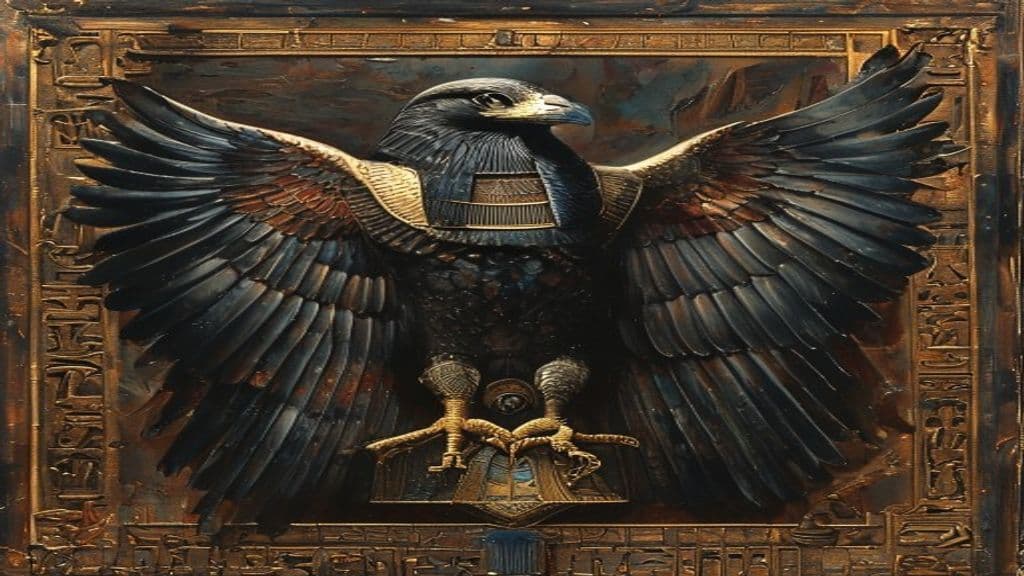
The Horus name is represented by a falcon symbol atop the serekh, which is a rectangular frame with a rounded top.
The Horus name holds symbolic significance and divine connection, as it represents the pharaoh's connection to the deity Horus. Its adoption by rulers during the Ptolemaic period may indicate some power associated with it.
Ammit
Ammit is an ancient Egyptian funerary guardian-demon of the Duat who stands at the Hall of Two Truths during the weighing of the heart. Feared and not worshipped, she awaits the verdict and consumes hearts judged impure, thereby preventing the deceased from joining the blessed dead.
Book of the Dead
A collection of magical spells and texts that assist a deceased person's journey through the Duat (underworld) into the afterlife. (Note: 1. Power tier: Reduce to Ancient (deity-level), as it's a collection of spells and texts that aid in the deceased person's journey, but not a cosmic entity itself. 2. Appearance: Remove or rephrase, a)
Menes
Historical figure and pharaoh of ancient Egypt, credited with unifying Upper and Lower Egypt. (Note: * Power tier: Should be Primordial, not Ancient (Historical figure and pharaoh, not a deity-level entity) * Abilities: The text does not support the claim that Menes' unification had a "profound impac)
Horned Serpent
A recurring mythic serpent-being attested across multiple cultures, typically depicted as a large horned snake associated with water, storms, fertility/regeneration, and sacred crystalline or iridescent bodily accoutrements that serve as ritual power-objects.
Horouta
A legendary canoe in Māori tradition, significant to the Polynesian migration to New Zealand. (Note: * Power tier should be Lesser (it's a historical canoe, not a deity-level entity) * Abilities section is incomplete and inaccurate; instead of supernatural abilities, describe its significance in the )
Horsemsu
Horsemsu is attested in a modern database entry (Wikidata) as an Egyptian deity. The supplied sources beyond that single label provide no additional attested information about its functions, attributes, iconography, or cult.
Hortdan
A Turkic folkloric figure denoting a troubled soul of the dead that rises from the grave; in older accounts a mournful grave-apparition, and in later popular retellings sometimes recast as a vampire- or zombie-like undead.
Horus
Horus (Ancient Egyptian ḥr.w) is a major Egyptian deity associated with the sky, the sun and moon, kingship, protection, and healing. He appears in multiple local and chronological manifestations (e.g., Horus the Elder, Horus the Younger) and serves as the divine model of the living pharaoh and avenger/heir of Osiris.
Hoturapa
A Māori chief from Hawaiki who is tricked by Kupe, leading to consequences. (Note: - Power tier should be Lesser or Minor Spirit, as there's no indication that Hoturapa has deity-level abilities. - Sensory cues are missing and should be added based on the source material (e.g., perh)
Hoturoa
In Māori tradition, Hoturoa is a founding ancestor and leader of the Tainui canoe during its migration to New Zealand around 1400. He holds significant cultural and spiritual importance as a figure of historical and genealogical significance. (Note: - Power tier should be Primordial, as Hoturoa's historical and cultural significance far exceeds regional or local spirit levels. - Origin story: Add that his origins are unclear and not explicitly st)
Hou Yi
Hou Yi (后羿) is a mythic Chinese culture‑hero famed as an extraordinary archer who, by commission of a sky/imperial authority in variant traditions, shot down multiple suns and slew dangerous monsters. He is associated with receiving an immortality elixir, the tragic separation from his wife Chang'e (linked to the Mid‑Autumn Festival), and with variable portrayals ranging from mortal tribal leader to semi‑divine xian or legendary king.
Houri
In the Islamic textual tradition, a houri (Arabic: ḥūri(yy)a) is a paradisiacal companion described in the Qurʾān and elaborated in hadith and tafsīr as part of the rewards of the afterlife. Sources present houris variously as a specially created class of beings resident in Jannah or (in some interpretations) as transformed inhabitants of Paradise; descriptions range from brief Qurʾānic epithets to detailed hadith imagery.
Community Record
- [1]Wikipediawiki