
In Turkic folk frameworks the term Hortdan (Turkish Hortlak; Azerbaijani Xortdan; Tuva Hortan/Aza-Hortan) derives from the verb hortlamak, 'to get out' and specifically 'get out of the grave.' Sources frame the entity as the troubled soul of the dead that returns from burial, most commonly connected to violent deaths: it is said to appear where the souls of murdered people departed or where human blood has been shed and is frequently encountered above the graves of the slain. Ethnographic and summary accounts preserved in the cited material emphasize that the figure originally functioned as a grave-bound, restless-dead apparition tied to disturbed burials and sites of violence, and that later oral and popular retellings transformed some portrayals into more aggressive vampire- or zombie-like forms.
Accounts in the available sources do not provide a stable corporeal description. Older traditional descriptions present the Hortdan as a ghostly manifestation: an apparition seen wandering or sitting above graves and emitting mournful sounds, implying a non-corporeal, sorrowful presence rather than a fleshy body. Later popular and genre-influenced descriptions, summarized in the sources, recast Hortdans as reanimated corpses or vampire-like beings with a hunger for blood and flesh; these later tellings emphasize a predatory, fleshy undead form but do not offer consistent visual detail such as clothing or coloration in the cited material.
The sources indicate variation over time and place. Traditional portrayals center on a spirit of the dead haunting sites of violent death rather than attacking the living. Later and derivative accounts attribute more active supernatural powers: the ability to transform into animals, to become invisible, and a propensity to drain the vitality of victims via blood loss; some summaries explicitly call Hortdans 'immortal vampires' or 'reanimated corpses with a hunger for human flesh.' The research notes stress that these aggressive, vampiric attributes appear in later oral/popular transformations and are not uniformly attested across all regional variants. A Tuva variant (Hortan/Aza-Hortan) is described in the sources as more poltergeist-like, indicating behavioral diversity among local forms.
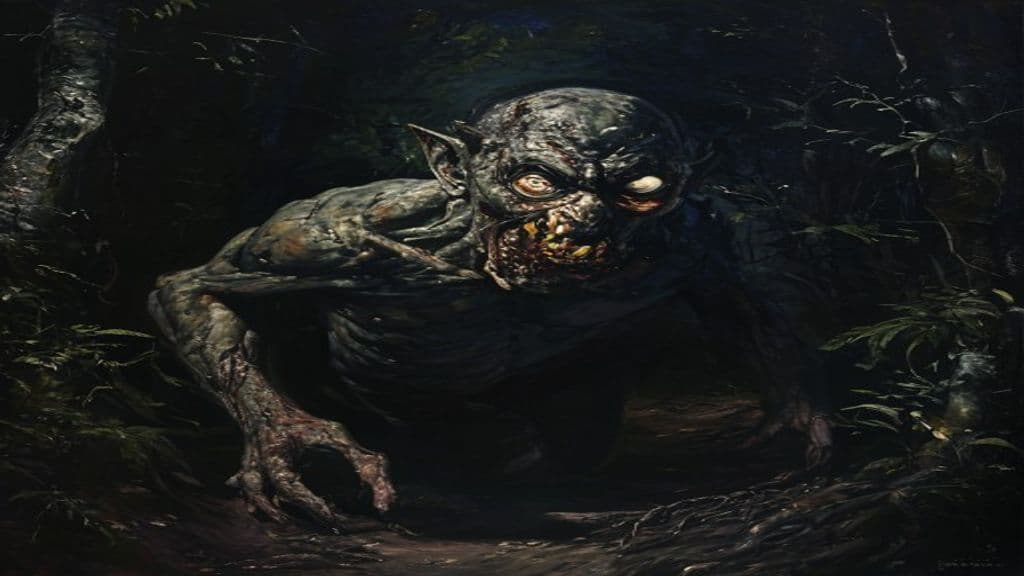
Pishacha
Flesh-eating spirits of Hindu mythology that haunt cremation grounds and are associated with disease, madness, and possession. The lowest class of demon in the Vedic hierarchy.
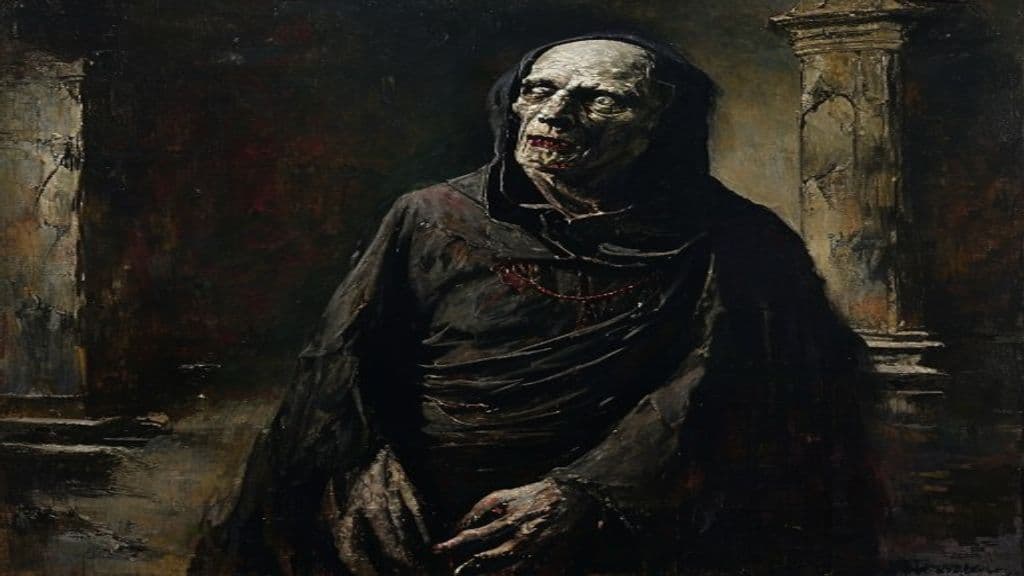
Vampire (tradition)
A class of revenant beings in southeastern and eastern European folk belief that subsist by feeding on the vital essence (generally blood) of the living. Recorded chiefly in early modern to modern oral traditions, these vampires are typically described as reanimated corpses whose presence explains unexplained illness, death, and post-mortem disturbances in their communities.

Ghoul
A ghoul is a demon-like or monstrous humanoid originating in pre-Islamic Arabian religion, traditionally associated with graveyards and the consumption of human flesh. The concept later entered broader folklore and has been widely reused and transformed in modern fiction and popular culture.
Archura
Archura (Arçura) is a Turkic woodland chura — a shapeshifting forest spirit associated with particular woodland tracts and wild animals. Traditions portray Archura as a protector of wildlife and a trickster-like figure that can be dangerous to humans.
Ay Ata
Ay Ata (Ay Dede) is the personified Moon in Turkic myth and traditional Tengrism, commonly glossed as 'Moon Father.' He is paired with the sun-being (Gun Ana / Kün Ana) in a layered sky cosmology and figures in folk tales, epic traditions, and shamanic prayer contexts.
Gulyabani
A Turkish folkloric figure described in modern sources as a large, ghoul-like nocturnal outsider associated with desolate places and with frightening people at night. Attested mainly in media descriptions (film entries and brief encyclopedia-style notes), the figure is represented both as a humongous bearded ghoul and, in at least one art-film description, as a restless spirit of a lonely place.
Od İyesi
Od İyesi is the Turkic and Mongolic guardian spirit (iye) of fire and hearth. Conceived as the 'possessor' or master of the element fire, it appears in male and female personifications (e.g., Od Ana, Od Ata/Od Khan) and as household-specific forms (Ocak iyesi — hearth spirit, Soba iyesi — stove spirit).
Ulukayın
Ulukayın is the sacred World Tree of Turkic mythology and shamanism, a cosmic Tree of Life that stands at the center of the world, links underworld, earth and sky, and functions as an axis of social origin, souls, and life-giving substances.
İye
İye are Turkic spiritual proprietors or tutelary spirits understood as the unseen 'owners' or guardians of particular places, natural phenomena, objects, animals, households, or concepts. They mediate human relations with domains of the world and respond to human conduct—offering blessing when respected and retribution when violated.
Horned Serpent
A recurring mythic serpent-being attested across multiple cultures, typically depicted as a large horned snake associated with water, storms, fertility/regeneration, and sacred crystalline or iridescent bodily accoutrements that serve as ritual power-objects.
Horouta
A legendary canoe in Māori tradition, significant to the Polynesian migration to New Zealand. (Note: * Power tier should be Lesser (it's a historical canoe, not a deity-level entity) * Abilities section is incomplete and inaccurate; instead of supernatural abilities, describe its significance in the )
Horsemsu
Horsemsu is attested in a modern database entry (Wikidata) as an Egyptian deity. The supplied sources beyond that single label provide no additional attested information about its functions, attributes, iconography, or cult.
Horus
Horus (Ancient Egyptian ḥr.w) is a major Egyptian deity associated with the sky, the sun and moon, kingship, protection, and healing. He appears in multiple local and chronological manifestations (e.g., Horus the Elder, Horus the Younger) and serves as the divine model of the living pharaoh and avenger/heir of Osiris.
Horus Name
Title or crest used by ancient Egyptian rulers, symbolizing divine connection and royal identity. (Note: - Power tier should be Ancient (deity-level) as it represents a connection to a deity and is used by rulers, not just regional spirits. - Summary: While accurate, could be rephrased for clarity: "Titl)
Hoturapa
A Māori chief from Hawaiki who is tricked by Kupe, leading to consequences. (Note: - Power tier should be Lesser or Minor Spirit, as there's no indication that Hoturapa has deity-level abilities. - Sensory cues are missing and should be added based on the source material (e.g., perh)
Community Record
- [1]Hortdan. Wikipedia contributors, 'Hortdan,' Wikipedia, The Free Encyclopedia.wiki
- [2]Hortdan (Wikidata). Wikidata entry Q6662567 for Hortdan.wiki
- [3]Upiór. Wikipedia contributors, 'Upiór,' Wikipedia, The Free Encyclopedia.wiki
- [4]TOP 11 Scariest Creatures in Turkic Mythology. ulukayin.org, 'Eleven Scariest Creatures in Turkish and Altaic Myths.'folk
- [5]Vampire | Historic Legends | Stories Preschool. StoriesPreschool.com, 'Vampire | Historic Legends'.other
- [6]Deities or Vampires? Hecate and other Blood-Drinking Spirits of Ancient Times. Ancient-Origins.net, 'Deities or Vampires? Hecate and other Blood-Drinking Spirits of Ancient Times.'other
- [7]Skin Horse comic (2013-12-31). Skin Horse webcomic strip, 2013-12-31.other