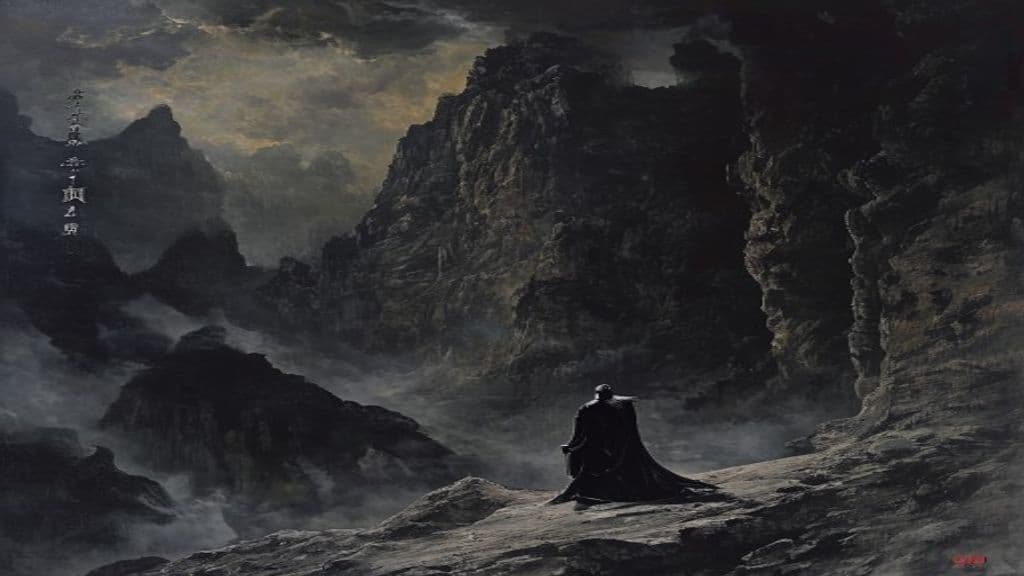
Huang Shigong is a semi-mythological figure who lived between the Qin dynasty and Han dynasty. His exact dates are unknown, but his significance reflects the worldview of ancient Chinese culture.
No physical description is provided in the source material.
Through written texts, Huang Shigong imparts knowledge and wisdom to those who seek it, as seen in his gift of a treatise on military strategy called Huang Shigong San Lue and the Lingqijing divination manual.
Chang'e
Chang'e (嫦娥), originally attested as Heng'e and linked to the older name Chang Xi, is the female lunar immortal of Chinese myth who resides in the Moon Palace (廣寒宮). Best known from the elixir-of-immortality tale in which she ascends to the Moon and is accompanied there by the Jade Rabbit, she functions across religious and literary contexts as a lunar goddess/immortal and a poetic symbol of solitude and longing.
Chinese gods and immortals (shenxian)
A heterogeneous corpus of deities (shen) and immortals (xian) in Chinese religious and mythic thought, understood as manifestations or localizations of the cosmic principle (Tian/Tao/qì). They include celestial gods, local tutelaries, deified culture-heroes, and Taoist immortals formed and sustained by temples, ancestral ritual, and popular cult.
Eight Immortals (八仙; Bā Xiān)
The Eight Immortals are a group of legendary xian (immortals) in Chinese mythology and popular Taoist-related religion, portrayed as once-human figures who attained transcendence. They function as exemplars of Taoist immortality, patrons of varied social roles, and popular auspicious figures in art, ritual cults, qigong, and martial arts.
Four Symbols (Sì Xiàng)
A set of four mythological creatures in Chinese cosmology—Azure Dragon, Vermilion Bird, White Tiger, and Black Tortoise‑Snake—serving as celestial asterisms and directional guardians integrated into ritual, astrological, and state symbolism.
Kitchen God (Zao Jun / Zao Shen)
The Kitchen God is a Chinese domestic deity associated with the household stove/hearth who monitors family conduct and annually reports that conduct to the Jade Emperor, influencing the household's fortunes. He is typically represented by a paper effigy or plaque kept above the stove and is the focal figure of year-end household rites around the Little New Year.
Mazu
Mazu (媽祖) is a deified female protector of seafarers originating in Fujianese popular religion as the historical/legendary Lin Moniang. Venerated across Chinese folk religion, Taoist and Buddhist registers, and in coastal and diasporic Chinese communities (notably Taiwan), she functions as a tutelary sea goddess whose cult includes temples, imperial honorific titles, and large popular pilgrimages.
Preta (Hungry Ghost)
A post-mortem supernatural being associated with extreme, unremitting hunger and thirst. In Hindu usage the Sanskrit term can mean a deceased person, while Buddhist traditions develop the category into a distinct realm of hungry spirits whose condition illustrates karmic consequences for demeritorious action.
Taishang Laojun
Taishang Laojun (also rendered Daode Tianzun) is a principal deity in the Taoist pantheon, identified in the sources as a deified form of the philosopher Laozi and as one of the Three Pure Ones (highest immortals) in Taoist cosmology. He is traditionally associated with moral teaching and is the legendary author-attributor of the didactic text 'Tai Shang’s Treatise on Action and Response.'
Ông Trời
In Vietnamese tradition, Ông Trời is a high-ranking deity associated with the divine realm and later merged with the Jade Emperor. (Note: 1. The power tier should be Primordial, not Ancient, since Ông Trời is described as one of the most important gods in Vietnamese cosmology. 2. Add information about Ông Trời's appearance, abilities, s)
Huacas (Mountain Deities)
In the Quechua mythology, Huacas are mountain deities revered as protectors of regional ethnicities and central figures in myths. (Note: 1. Power tier: Primordial seems too high given that Huacas are mountain deities and not cosmic entities. 2. Appearance: Should be added that there is no physical description provided for the Huacas, b)
Huanca
Huanca refers to two related Andean referents in the supplied sources: (A) an ethnonym for a Quechua people of the Junín region of central Peru, and (B) huanca/wanka, a sacred elongated vertical standing stone (monolith) in Andean ritual practice that is worshipped and given offerings and is believed to represent chiefs and ancestors.
Huangmei Dawang
A formidable supernatural being in the Buddhist tradition associated with immense power and strength. (Note: - Summary: Inaccurate. Huangmei Dawang is a major antagonist, not associated with "immense power and strength". - Power tier: Possibly incorrect. Although it has significant spiritual authority and ca)
Community Record
- [1]Huang Shigong. Wikipedia article on Huang Shigongwiki