
According to the tradition preserved in the sources, the figure worshipped as Mazu is the deified form of Lin Moniang (林默娘), a woman from a fishing village on Meizhou Island in Putian, Fujian, said to have lived in the late tenth century. Early records (an inscription dated to 1150) note that after her death people erected a temple on her home island and credited her with abilities such as foretelling a person's good and ill luck. Over subsequent centuries imperial courts conferred successive honorifics and celestial titles (examples in the corpus include Linghui Furen, Linghui Fei, and later titles such as Tianfei/Tianhou), which positioned the local heroine within formal heavenly nomenclature while popular devotion and miracle literature (e.g., accounts of the Princess of Heaven's blessings) circulated and expanded her cult.
The supplied sources do not record a single, immutable iconographic description, but they do attest that Mazu is commonly represented and enshrined as a female deity in temples and that a portable image or statue is used in major communal rites such as the Dajia Mazu Pilgrimage (in which a statue is placed in a litter and carried on a round‑trip procession between temples). Legend traditions describe Lin Moniang as a quiet, pensive child (her personal name glossed as 'Silent One'), and some later popular narratives include miraculous birth imagery and devotional associations with Guanyin; however, the notes emphasize that no single consistent bodily attributes (dress, facial type, standard pose) are fixed across the sources excerpted here.
Sources consistently describe Mazu as a protective tutelary figure for people who make their living from or travel by sea: traditionally she is believed to "roam the seas, safeguarding her devotees through miraculous interventions." An early inscription (1150) attributes to her divinatory capacity—she could "foretell a man's good and ill luck"—linking her to shamanic and prophetic roles. Popular narratives and cult practice credit her with responsive intervention in emergencies; ritual pragmatics recorded in the sources hold that invoking her familiar name (Mazu / A‑Ma / Mazupo) will elicit faster aid than using formal celestial titles. Later legends and devotional literature sometimes align her devotion to or identification with Guanyin, associating her cult with compassion and miraculous efficacy. Over time her remit has broadened from strictly maritime protection to wider social and communal roles, as reflected in temple patronage, imperial titles, and mass pilgrimages.
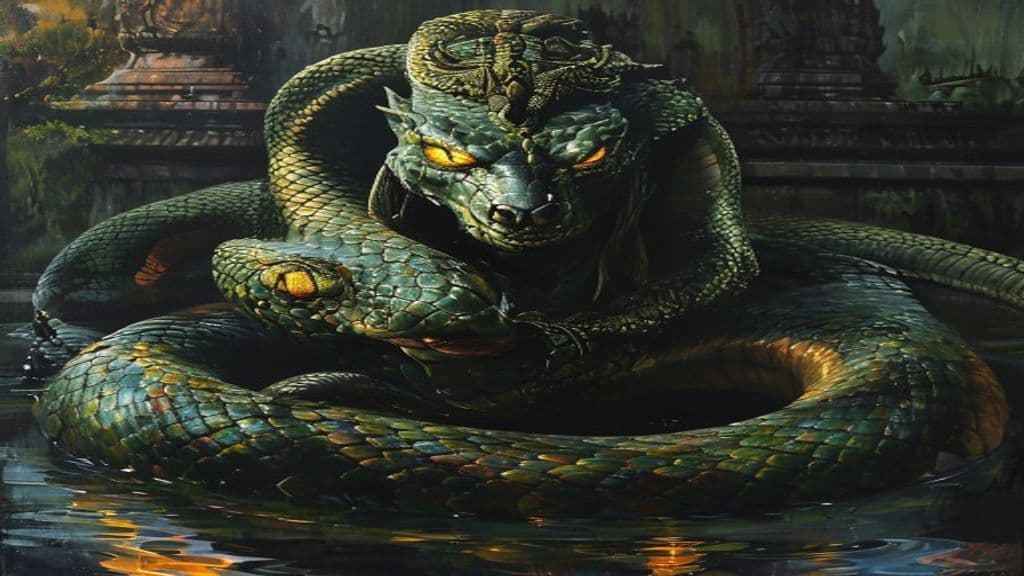
Naga
Divine serpent beings of Hindu, Buddhist, and Jain cosmology — powerful guardians of water, earth, and underground treasures. Revered as deities in South and Southeast Asia.
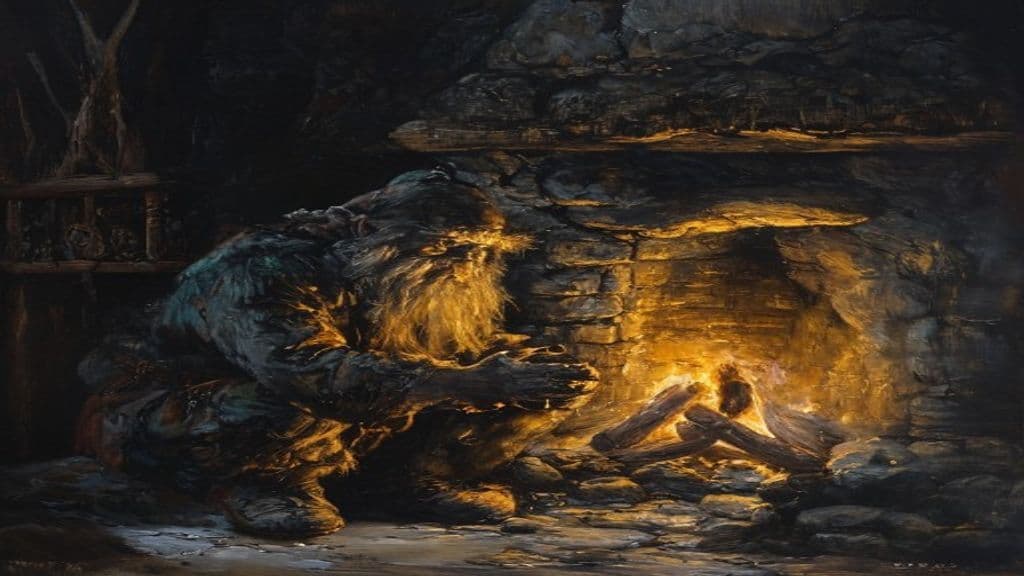
Domovoi
The house spirit of Slavic tradition — a small, invisible guardian of the home bound to a specific dwelling and its family. Protective when respected; dangerous when insulted or forgotten.
Ao Kuang
Ao Kuang (also attested as Ao Guang) is the Dragon King of the East Sea in Chinese mythology and folk religion, one of a quartet of sea-dragon sovereigns associated in folklore with the cardinal seas. He appears in classical literature and later popular media as a ruler of maritime waters whose favor or displeasure is connected to tides, rain, floods and storms.
Bai Ze
Bai Ze (白澤, Báizé; Japanese Hakutaku) is a legendary sacred creature in Chinese tradition famed as an authoritative recorder of ghosts and gods whose illustrated compendium (Bái Zé Tú) was employed as a household prophylactic against spirit-world harm. The creature’s image and diagrams were used in China and later Japan to identify, ward off, and prescribe avoidance of spectral calamities.
Bi'an
Bi'an is attested in the provided sources primarily as a named member of the traditional roster called the Nine Sons of the Dragon, appearing in catalogues of mythic names. The figure is also present as a name-form within the broader lexical field of Chinese folk religious beings (for example, appearing alongside death-escort deities in separate sources), but the supplied materials do not furnish an independent, detailed myth or cultic biography for Bi'an.
Chang'e
Chang'e (嫦娥), originally attested as Heng'e and linked to the older name Chang Xi, is the female lunar immortal of Chinese myth who resides in the Moon Palace (廣寒宮). Best known from the elixir-of-immortality tale in which she ascends to the Moon and is accompanied there by the Jade Rabbit, she functions across religious and literary contexts as a lunar goddess/immortal and a poetic symbol of solitude and longing.
Chenghuangshen (City God)
Chenghuangshen (城隍神), commonly called the City God, is a tutelary deity in Chinese folk religion tied to a specific settlement. Historically associated with a city's walls and moat, the deity functions as protector of local affairs and as a local official in the postmortem ordering of souls for that place.
Chinese dragon (long / loong)
A central legendary zoomorphic being in Chinese myth and culture (Chinese: long / loong), the dragon embodies auspicious cosmic and ancestral power, especially mastery over water and weather, and functions as an imperial and communal emblem across material culture, ritual performance, and state iconography.
Chinese ghosts
Spirits of deceased persons in Chinese folk belief, integrated with ancestor-worship and syncretic Buddhist ideas; often conceived as potentially malevolent if neglected or provoked, while some deceased become honored ancestral spirits through proper ritual care.
Chinese gods and immortals (shenxian)
A heterogeneous corpus of deities (shen) and immortals (xian) in Chinese religious and mythic thought, understood as manifestations or localizations of the cosmic principle (Tian/Tao/qì). They include celestial gods, local tutelaries, deified culture-heroes, and Taoist immortals formed and sustained by temples, ancestral ritual, and popular cult.
Chinese guardian lions (shī, 石獅)
Stone or metal sculptural guardian lions (Chinese: shī, often 石獅 shíshī "stone lion") placed in male–female pairs at thresholds to protect buildings and occupants. Originating in Chinese Buddhist and imperial symbolism, they function as apotropaic architectural emblems believed to ward off harmful spiritual influences and hostile humans when correctly placed.
Daji
Daji (妲己, Dájǐ) is a figure in Chinese narrative and popular religious-cultural materials who blurs human and spirit categories: historically remembered as the favorite consort of King Di Xin of Shang but in later legend and fiction identified as a fox‑spirit (often a nine‑tailed or thousand‑year fox) that possessed or impersonated the woman and precipitated moral and political decline.
Diting
Diting (Chinese: 谛听; pinyin: Dìtīng) is a divine mythical creature in Chinese Buddhist hagiography traditionally described as the steed and attendant guardian of the bodhisattva Kṣitigarbha (Dizang). Described as a composite beast with extraordinary hearing and discernment, Diting is associated in legend with guarding hell and distinguishing truth from falsehood in support of Kṣitigarbha's salvific activities.
Dragon King
A high-ranking serpent/dragon ruler associated with water, weather, and territorial guardianship across East, South and Southeast Asian folk-religious traditions. Treated as a divine or semi-divine authority (Nāgarāja / lóng / Ryū / Yongwang) who presides over seas, rivers, wells and rainfall and is an object of ritual supplication, especially in rainmaking and agricultural contexts.
Community Record
- [1]Mazu - Wikipedia. Wikipedia contributors, 'Mazu', Wikipedia, The Free Encyclopedia.wiki
- [2]Dajia Mazu Pilgrimage - Wikipedia. Wikipedia contributors, 'Dajia Mazu Pilgrimage', Wikipedia, The Free Encyclopedia.wiki
- [3]Rediffusion Singapore — The Legend of Mazu (Cantonese radio archive). Rediffusion Singapore archive, '媽祖传奇 (The Legend of Mazu)'.literary
- [4]‘She’s in our hearts’: Devotees from China and Taiwan come together to celebrate the goddess Mazu. The World from PRX, 'She’s in our hearts': Devotees from China and Taiwan come together to celebrate the goddess Mazu.other
- [5]Photographing the Mazu Maritime Pilgrimage. TaiwanQuest, 'Photographing the Mazu Maritime Pilgrimage'.other
- [6]Mazu and MAZU - Sam Matey‑Coste. Sam Matey‑Coste, 'Mazu and MAZU'.other