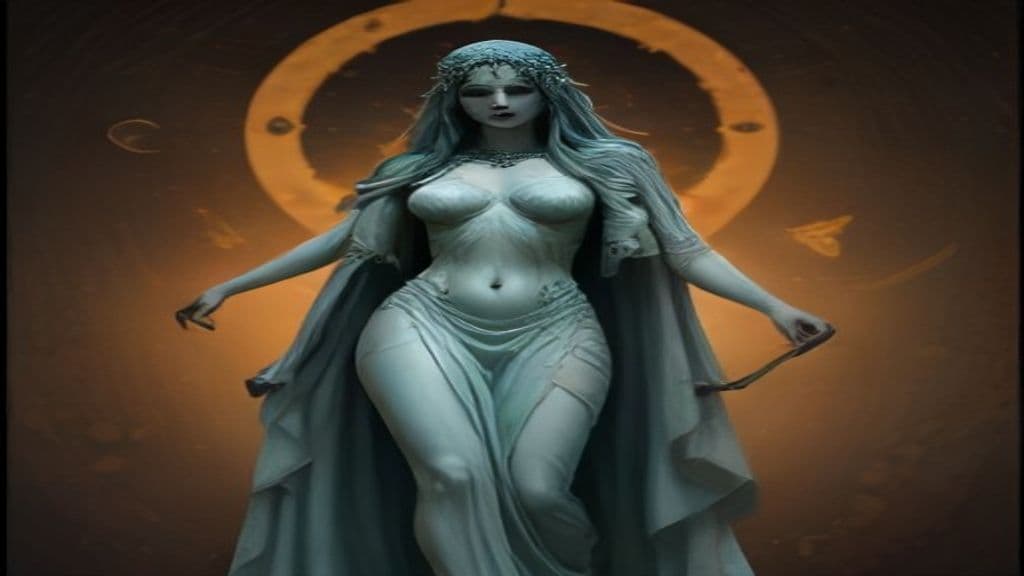
In Greek myth the Hyades are a group of sisters associated with the constellation Taurus and identified with a particular open star cluster. Classical lore treats them as daughters of Atlas (linked genealogically to other sister-groups such as the Pleiades) and as mythic kin who serve social functions in narrative—most notably as caretakers and escorts. The name Ὑάδες (Hyádes) is popularly etymologized from ὕω (hýō, 'I fall as rain') yielding the sense 'rain-makers' or 'the rainy ones'; an alternative etymology suggested in the sources connects the name to ὗς (hŷs, 'swine'), indicating etymological uncertainty in scholarship.
As mythic figures the Hyades are presented as a sisterhood (individual names such as Ambrosia are attested in the sources). Classical summaries identify them in narrative roles—nurses and escorts—rather than giving consistent anthropomorphic detail about clothing or stature. Astronomically they correspond to the Hyades open star cluster in Taurus; popular and scientific sky lore describe them as a nearby winter cluster in the constellation Taurus often discussed alongside the Pleiades and other Taurus features (e.g., Aldebaran). Thus they are represented both as mortal/immortal nymph-like sisters in myth and as identifiable stars in the night sky.
The primary attributed function in the provided material is meteorological association: the Hyades are popularly called 'rain-makers' or 'the rainy ones' because their rising and setting in the annual sky cycle were correlated with rainy seasons in Greek calendrical/meteorological lore. In mythic narrative they act as caretakers or escorts—one source states that Dionysus was entrusted as a child to Ambrosia and her sisters, the Hyades, and that the Hyades escorted the child during the episode in which Lycurgus assaulted Dionysus on Mount Nysa—indicating roles as guardians/nursemaids. The supplied sources do not ascribe specific magical spells, ritual powers, or detailed supernatural abilities beyond these seasonal and social functions.

Aconteus
Aconteus (Ancient Greek: Ἀκόντιος, Akóntios, lit. 'javelin') is a personal name borne by several distinct mortal figures in Greek myth: an Ethiopian chief turned to stone by Medusa's head at Cepheus' court, an Arcadian warrior killed in the Seven against Thebes, and Acontius of Ceos who used a trick with an apple to secure marriage to Cydippe. The name functions as a human actor across heroic-age narratives rather than a single supernatural class.
Amphitrite
Amphitrite is an ancient Greek sea-divinity, queen of the sea and consort of the sea-god Poseidon; in poetry her name is often used metonymically for the sea itself. She is counted among the daughters of Nereus and Doris in Hesiod and in some accounts is also listed among the Oceanids, and appears chiefly in mythic narrative and iconography rather than as an independent civic cult figure.
Andromeda
Andromeda is a mortal princess in ancient Greek myth, daughter of Cepheus and Cassiopeia, who is offered as a sacrificial victim to the sea monster Cetus and rescued by the hero Perseus. Her story links human hubris, divine punishment, heroic rescue, and catasterism—she is later placed among the stars as the constellation Andromeda in some accounts.
Ceto
Ceto (Ancient Greek: Κητώ, Kētṓ) is a primordial sea goddess in Greek mythic cosmology, daughter of Pontus and Gaia, primarily notable as the maternal progenitor of various named monstrous beings (e.g., the Graeae and Gorgons) by Phorcys. Her name is etymologically linked to the common Greek term for sea-monster (kētos), and she functions chiefly as a genealogical and cosmological figure rather than an active, individualized actor in surviving narratives.
Cyrene
Cyrene is an eponymous ancient Greek mythological heroine associated with the North African city of Cyrene and remembered chiefly as a mortal lover of the god Apollo and as an aetiological figure whose name is applied to place and artistic types in Greco-Roman culture.
Euphemus
Euphemus is a hero of ancient Greek mythic tradition, often counted among the Argonauts and Calydonian hunters, commonly described as a son of Poseidon and associated with seafaring, a miraculous clod-of-earth episode, and the foundation-ancestry of colonies such as Thera and Cyrene.
Heliades
In Greek myth, the Heliades are the daughters of the sun-god Helios (by the Oceanid Clymene) whose intense mourning for their brother Phaëthon leads to their metamorphosis into poplar trees; their tears are said in the tradition to become amber.
Lamia
In ancient Greek mythology, Lamia is described as a child-eating monster who, in later tradition, came to be regarded as a type of night-haunting spirit or 'daimon'. The supplied sources do not provide a full physical description or detailed mythic genealogy, and some modern fictional portrayals recast her with serpentine features which are not attested in the provided classical summary.
Piras
Piras (Ancient Greek: Πειρᾶς) is an Argive king in Greek mythic genealogies, known primarily by name and familial connections rather than by individual deeds or cult. He appears in variant forms (Piren, Peiren, Peirasus, Piranthus) and is attested as a son of Argus and Evadne.
Hwanung
Divine being in Korean tradition, son of Hwanin, Lord of Heaven. Associated with human development and progress. (Note: - Power tier: Primordial may be too high given the description of abilities (institution of laws, teaching arts and medicine) which more closely align with a Greater (deity-level, but not cosmic) or A)
Hwin
Hwin is a fictional talking mare from C. S. Lewis's The Chronicles of Narnia, prominently featured in The Horse and His Boy (1954). She is a Narnian free-talking beast characterized by humility, clear thinking, and gentle temperament, who was captured in Calormen as a foal and later escapes back to Narnia.
Hyakki Yagyō
An idiom and folkloric motif in Japanese tradition describing a mass nocturnal procession of supernatural creatures (yōkai and related beings) that march through human streets at night. Depictions and stories vary: sometimes an orderly parade, sometimes a chaotic riot, and encounters are commonly described as dangerous to humans.
Community Record
- [1]Hyades (mythology) — Wikipedia. Wikipedia contributors, 'Hyades (mythology),' Wikipedia, The Free Encyclopedia.wiki
- [2]Hyades — Wikipedia. Wikipedia contributors, 'Hyades,' Wikipedia, The Free Encyclopedia.wiki
- [3]Ambrosia (Hyades) — Wikipedia. Wikipedia contributors, 'Ambrosia (Hyades),' Wikipedia, The Free Encyclopedia.wiki
- [4]Taurus 2 — Star Tales (Ian Ridpath). Ridpath, Ian, 'Taurus 2,' Star Tales.other
- [5]Taurus — Star Tales (Ian Ridpath). Ridpath, Ian, 'Taurus,' Star Tales.other
- [6]SkyEye: Star Clusters (Hyades reference). SkyEye, 'Star Clusters,' site overview referencing Hyades cluster.other