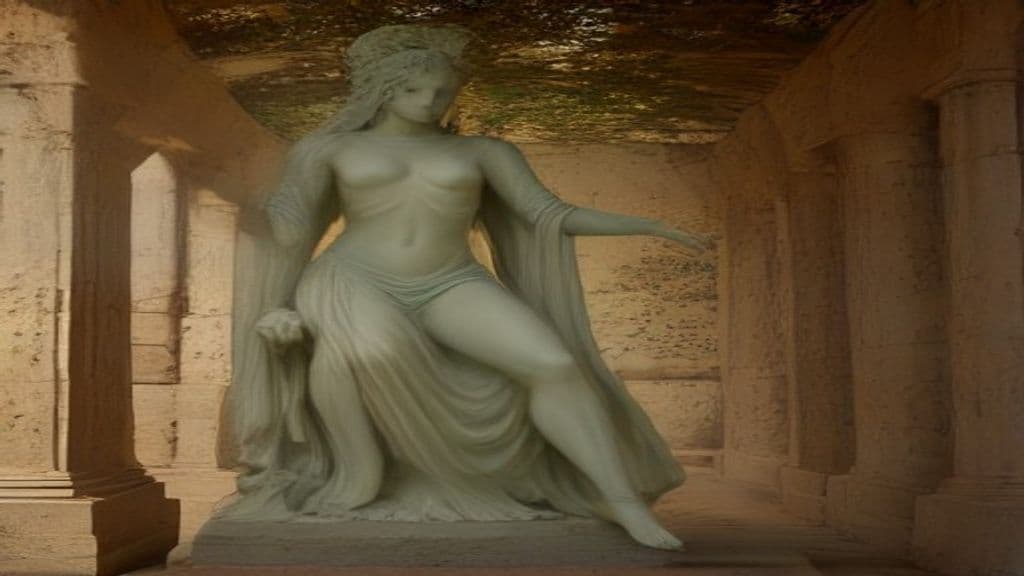
Hyrnetho is presented in the tradition as a daughter of King Temenus of the Temenid line and the wife of Deiphontes. When Temenus favored Deiphontes (and by marriage Hyrnetho) in questions of succession, Temenus' sons murdered him and attempted to deprive Deiphontes of his wife to weaken their rival. The brothers came to Epidaurus, attempted to persuade Hyrnetho to leave Deiphontes, then carried her off by force; in the ensuing struggle one brother was shot by Deiphontes and another dragged Hyrnetho back with such violence that she died while pregnant. Deiphontes carried her body back to Epidaurus and is said to have erected a sanctuary to her; a tomb, a heroum, and a sacred grove connected with her burial are attested at Epidaurus and Argos.
Sources do not provide a physical description of Hyrnetho. Material traces associated with her in the tradition are a tomb, a heroum (hero-shrine), and a sacred grove shown at Epidaurus and Argos; no clothing, stature, or portraitic details are preserved in the cited accounts.
Hyrnetho is a mortal human figure in the extant accounts; no supernatural powers or abilities are attributed to her. Her notable actions in the narratives are filial and marital fidelity and the passionate defense of her husband against her brothers' attempts to remove her. Her death is a mortal consequence of intra-family violence during a dynastic dispute.
Archander
Archander (Ancient Greek: Ἄρχανδρος; Latinized Archander/Archandrus) is a legendary human figure from Greek genealogical and migration myths, described as a son of Achaeus who fought with his brother, married Scaea (a daughter of Danaus), settled in Argos, and is linked in some traditions to an eponymous city in Egypt.
Budeia
Budeia is a lexical/onomastic term attested in two distinct registers: (1) an ancient Greek mytho-genealogical figure and an epithet of Athena meaning 'oxen-yoker', and (2) a modern Norwegian occupational noun (budeia) denoting the woman who tends the summer farm dairy. The term consistently occupies an agricultural/labor semantic field in both traditions rather than functioning as a singular supernatural entity.
Hegesandra
Hegesandra (Ancient Greek: Ήγησάνδρα or Ήγησάνδρη) is a mythological Spartan princess attested in Greek genealogical tradition. She is recorded as a daughter of King Amyclas of Sparta, wife of Argeius (son of Pelops of Pisa), and mother of three sons named Melanion, Alector, and Boethoos/Boethous. Surviving references present her only as a genealogical figure linking Lacedaemonian and Pelopid lineages.
Hellen
Hellen (Ancient Greek: Ἕλλην, Héllēn) is the eponymous mortal ancestor of the Hellenes in Greek myth. Presented in genealogical traditions as a son (in most accounts) of Deucalion and Pyrrha and as father of Dorus, Xuthus, and Aeolus, Hellen functions as the mythic pivot by which the collective name 'Hellas' and major tribal divisions of Greeks are explained.
Polymede
Polymede (Ancient Greek Πολυμήδη, Polymēdē) is a mortal woman attested in Greek mythic genealogies. She is named in some traditions as the daughter of Autolycus and as a possible mother of the hero Jason by Aeson, and in other lists as a mother of Nestor by Neleus; her role is primarily genealogical rather than active or divine.
Hypnos
Hypnos is the ancient Greek personification and god of sleep who induces slumber in mortals and gods. Son of Night (Nyx) and twin brother of Thanatos (Death), he dwells in liminal places associated with dreams and the underworld and appears in myth as a gentle, intervening deity.
Hypsenor
Hypsenor (Ancient Greek: Ὑψήνωρ) is a personal name borne by multiple human figures in the Homeric and related Greek genealogical tradition. The attested bearers are identified by parentage and social role — a Trojan priest, a warrior under Antilochus, and a son of Neleus and Chloris — and are recorded mainly by their fates in battle.
Hypsistos (Theos Hypsistos)
Hypsistos (Θεός Ὑψιστος) is an ancient divine epithet and cultic designation meaning "God Most High" attested in inscriptions, votive altars, and occasional temple dedications in Asia Minor, the Black Sea region, and the eastern Mediterranean from the Hellenistic period into late antiquity. It functions as a titulary focus of worship — sometimes attached to established gods (e.g., Zeus Hypsistos) and sometimes invoked more abstractly by groups later called Hypsistarians in fourth‑century Christian writings.
Hyrmine (Hyrmina)
Hyrmine (Greek: Ὑρμίνη, Hyrmínē) is an eponymous Elean princess in Greek myth whose name is given to the town of Hyrmine (Hyrmina) in Elis. She appears in genealogical and local-foundation traditions as a daughter, wife, and mother whose main mythic function is to explain the origin and identity of a place rather than to act as a supernatural agent.
Hyōsube
A child-sized river yōkai from Kyūshū folklore (notably Saga and Miyazaki) associated with underwater caves and rivers; known for fouling household baths, raiding eggplant crops, and sometimes causing mysterious fevers. Often treated as a kappa-cousin within regional river-yōkai traditions.
Háma (Hama / Heime / Heimir)
Háma (also rendered Hama, Heime, Heimir) is a named figure of the Germanic heroic-legend tradition attested in Anglo‑Saxon and continental Germanic sources. He appears as a legendary warrior or retainer — often associated with the companion Witige — in poems such as Beowulf and Widsith and in later Germanic epic material (Alpharts Tod, Þiðreks saga). A single secondary source records a variant identification of the name with a mythic watchman figure linked to Heimdallr and the Bifrost; this identification is presented in the available material as a distinct, unverified tradition.
Högne
Högne is a legendary human king of Östergötland attested in Old Norse sources (Heimskringla, the Volsunga saga, and the Poetic Edda). He appears in cycles of dynastic conflict, marriage-alliance narratives, and blood-feud where he fights, raids, and is ultimately slain in battle in some versions.
Community Record
- [1]Hyrnetho (Wikipedia). Hyrnetho. Wikipedia.wiki
- [2]Deiphontes (Wikipedia). Deiphontes. Wikipedia.wiki
- [3]PAUSANIAS, DESCRIPTION OF GREECE 2.15-28 - Theoi Classical Texts Library. Pausanias, Description of Greece (passages cited regarding tomb and heroum).literary
- [4]Two Tombs for Hyrnetho: A Case Study in Localism and Mythographic Topography. Research Bulletin, Harvard: discussion of competing local claims and topography.academic
- [5]Hyrnetho | Facts, Information, and Mythology (Pantheon). Pantheon article summarizing tradition and cultic claims.other
- [6]Person: Hyrnetho (Myths.UVic). Myth compendium entry summarizing accounts.other