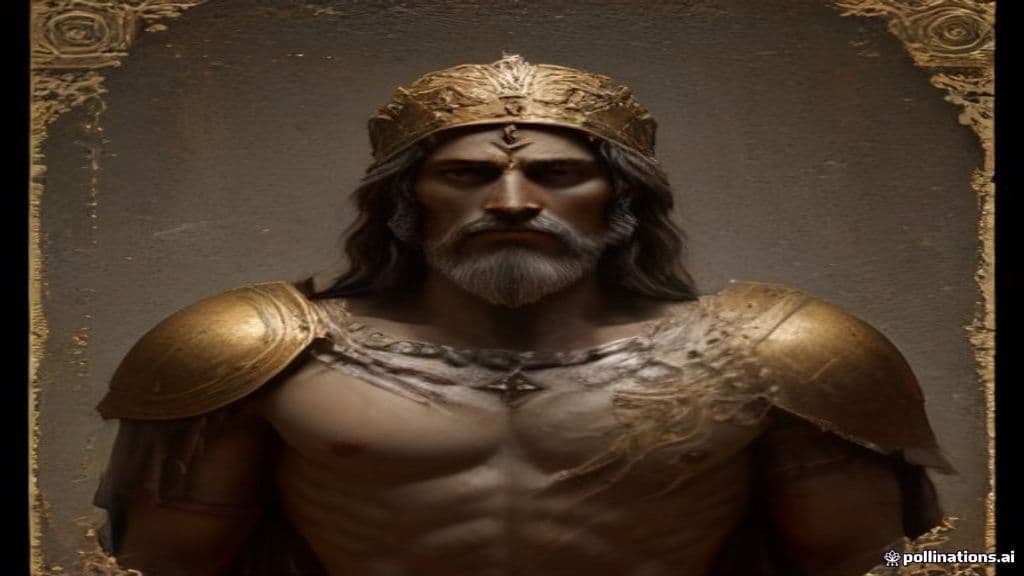
In Homeric and later genealogical traditions Icarius is presented as a Spartan royal figure whose principal narrative function is familial: he is the father of Penelope. Genealogical accounts place him among Spartan royal kin, frequently alongside figures such as Tyndareus and Hippocoon in lists of siblings or near-relatives. Some later or regional traditions elsewhere in Greek lore attach the name Icarius to other narratives (for example, an Icarius taught winemaking by Dionysus), but the Homeric/Ithacan-connected Icarius is chiefly the Spartan patriarch invoked to ground Penelope’s origins.
Ancient sources do not provide a physical portrait of Icarius beyond his social status as a Spartan king or prince. In Homeric usage he is referenced by patronymic designation (e.g., “Penelope, daughter of Icarius”) and appears as an elder patriarch in domestic and genealogical contexts; no sustained descriptive attributes (clothing, height, facial features) are recorded in the cited material. Later emblematic and secondary sources sometimes discuss name-variants of Icarius in iconographic or moralizing contexts (e.g., French emblem commentary distinguishing Icarius from Icarus and noting wine-related motifs), but these do not supply a consistent visual depiction of the Spartan Icarius himself.
Icarius is attested as an active paternal figure within narrative accounts rather than as a supernatural agent. Behaviors recorded in the sources include his role as father of Penelope and an episode in which he attempted to persuade Odysseus to remain in Sparta and implored his daughter Penelope to stay after her marriage (as reported in secondary summaries of the tradition). Some other Greek traditions employ the same personal name in tales of a different Icarius associated with Dionysus and the introduction of wine to Greece; where attested these are cultural motifs (hospitality, reception of divine gifts) rather than supernatural powers attributed to the Spartan Icarius. The cited sources do not ascribe magical abilities, prophetic gifts, or divine status to Icarius of Sparta.

Odysseus
Odysseus is a legendary mortal king of Ithaca from ancient Greek epic tradition, best known as the protagonist of Homer's Odyssey. Celebrated for his intellect, craft (mêtis), and long nostos (homecoming), he functions as an exemplar of heroic cunning rather than a supernatural being.

Typhon
The last great monster of Greek mythology — a vast, fire-breathing giant whose shoulders sprouted a hundred serpent heads, nearly toppling Zeus from Olympus.
Abas
Abas (Ancient Greek: Ἄβας, gen.: Ἄβαντος) is not a single mythic being but a recurring personal name borne by multiple mortals and minor mythic figures in Greek epic and genealogical traditions — kings, founders, seers, warriors, attendants, a centaur, and a youth transformed by a goddess. The name is glossed in the sources as 'guileless' or 'good-hearted' and appears across Argive, Theban, Trojan, Euboean, and other local cycles.
Adrastus
Adrastus (Ancient Greek: Ἄδραστος or Ἄδρηστος) is a legendary king of Argos in the Greek mythic-historical tradition, best known as the leader of the expedition of the Seven against Thebes and as a figure tied to oracular counsel, dynastic marriages, and local hero cults.
Ajax (Aias)
Ajax (Ancient Greek: Aias) is a human heroic figure of the Trojan-cycle tradition and the tragic protagonist of Sophocles' play Ajax. In the surviving tradition he is a mortal Salaminian warrior celebrated for physical strength and martial reputation whose wounded honor, rage, and resulting suicide are the focus of Sophocles' drama.
Ajax the Great
Ajax the Great (Ancient Greek: Αἴας, Aíās) is a mortal heroic figure of the Trojan War cycle, famed as a towering, steadfast Greek champion and defender of the Achaean ships. Prominent in Homer’s Iliad, he is portrayed as second only to Achilles in martial standing and as a paragon of defensive strength and reliability.
Alcinous
Alcinous (Ancient Greek: Ἀλκίνοος, Alkínoos, "mighty mind") is a legendary human king of the Phaeacians in Greek epic tradition. He is portrayed as an ideal hospitable monarch who receives wandering heroes (notably Odysseus and the Argonauts), presides over feasts and games, adjudicates disputes, and provides ships, gifts, and safe passage. Variant genealogies and island-identifications appear across sources, but his role as a beneficent royal host is consistent.
Alcmeonis
A lost early Greek epic poem (Ancient Greek: Ἀλκμεωνίς / Ἀλκμαιωνίς) traditionally counted among the Theban cycle; known only from a small number of fragmentary references, it narrated the story of Alcmaeon’s killing of his mother Eriphyle in vengeance for the death of his father Amphiaraus.
Amphialus (Amphialos)
Amphialus (Ancient Greek: Άμφίαλος, Amphialus/Amphialos, lit. 'of two seas') is a recurring personal name in classical Greek epic, genealogical tradition, and later pastoral/romance literature. The name is applied to several distinct mortal figures — a Phaeacian athlete in the Odyssey, various seafaring companions and suitors in Homeric summaries, a son of Neoptolemus and Andromache in genealogical accounts, and a noble/warrior character in early modern Arcadian romances — rather than to a single supernatural being.
Amphinomus
Amphinomus (Ἀμφίνομος) is a personal name borne by several human figures in Greek tradition, most notably a princely suitor of Penelope in Homer's Odyssey; other bearers appear in local genealogies, a Catanian civic legend, and a later historical record as a geometer. The sources treat Amphinomus as mortal personages rather than a supernatural being.
Andromache
Andromache (Ancient Greek Ἀνδρομάχη) is a human figure of ancient Greek literary tradition: the wife of Hector of Troy who exemplifies virtuous fidelity, ritual mourning, and the losses suffered by women in war. She appears in Homeric epic and later classical sources as grieving spouse, captive concubine after Troy's fall, and later queen in post-war narratives.
Antimachus of Teos
Antimachus of Teos (Greek: Ἀντίμαχος ὁ Τήϊος) is an early Greco-Ionian epic poet cited in later antiquity as the putative author or ascription-anchor for fragmentary Theban-cycle material (notably sometimes the Epigoni). Later authors quote or reference him for sententiae and as a chronological marker; his identity is contested and sometimes conflated with the much later Antimachus of Colophon.
Antiphus
Antiphus (Ancient Greek Ἄντιφος) is a personal name borne by several mortal men in Greek myth and epic traditions rather than a single supernatural being. Multiple figures named Antiphus appear in genealogies and narratives as princes, warriors, companions of heroes, colonists, and victims in the heroic age (generation of Heracles, the Trojan War, and the Odyssey).
Argos
Argos is the loyal hunting dog of Odysseus in Homer's Odyssey, remembered for recognizing his master upon Odysseus's covert return to Ithaca after a twenty-year absence. Presented as a domesticated, neglected animal, Argos functions as a moral and emotional emblem of fidelity and the effects of prolonged absence in the epic.
Community Record
- [1]Icarius (Spartan) — Wikipedia. Wikipedia, 'Icarius (Spartan)'wiki
- [2]Icarius (Spartan) — Wikipedia (main page). Wikipedia, 'Icarius (Spartan)'wiki
- [3]The Odyssey, by Homer (Project Gutenberg edition). Homer, Odyssey (Project Gutenberg eBook)literary
- [4]Icarius - in ancient sources @ attalus.org. Attalus: 'Icarius - in ancient sources'other
- [5]French Emblems: Emblem Page (Icarius/Icarus discussion). French Emblems commentary distinguishing Icarius traditionsother
- [6]Hippocoon (king of Sparta) — Wikipedia. Wikipedia, 'Hippocoon (king of Sparta)' (genealogical context)wiki
- [7]The Odyssey, Book II (online translation). Homer, Odyssey, Book II (online translation)literary