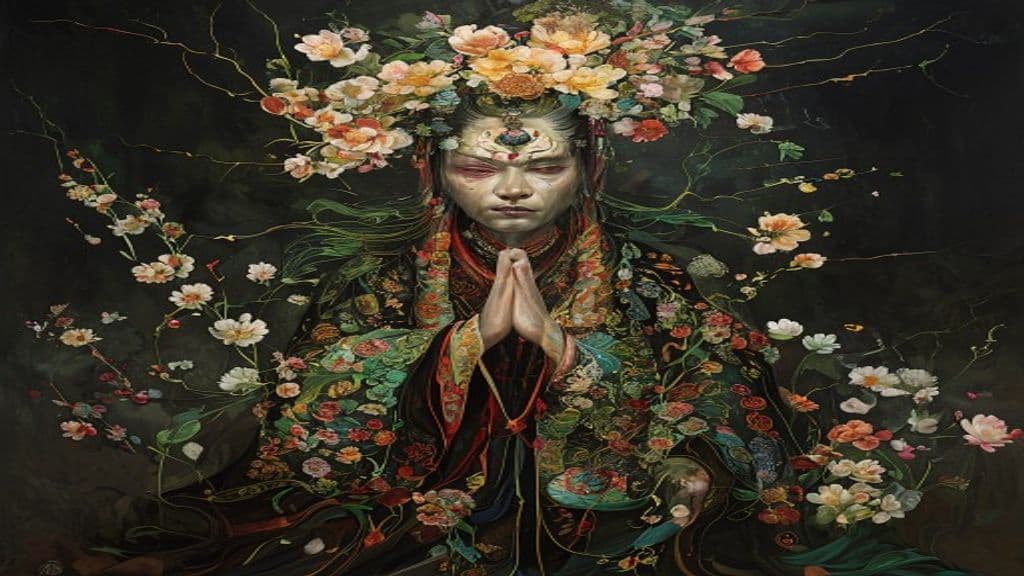
In Korean shamanism, the Igong god is a deity associated with flowers and natural cycles.
The Igong Maji ritual is performed as part of larger gut rituals on Jeju Island, suggesting that the Igong god may be involved in or related to these ceremonies.
Weaknesses
None recorded.
Wards
- ritualIgong Maji ritual
Korean Creation Narratives
A category of shamanic stories that recount the mythological beginnings of the universe, including tales from mainland Korea and Jeju Island. (Note: - Power tier should be Ancient (deity-level), as the creation narratives describe mythological beginnings of the universe. - Origin story is not entirely unclear; specific stories from various regions)
Semin-hwangje bon-puri
A shamanic narrative associated with funeral ceremonies on southern Jeju Island, classified as one of the special bon-puri in Korean tradition. (Note: - The power tier should be adjusted to Lesser (local spirit) based on the source material, which describes a narrative associated with a specific geographic location and ceremonial context, rather tha)
Song of Dorang-seonbi and Cheongjeong-gaksi
A Korean shamanic narrative about two supernatural entities associated with the natural world and fertility. (Note: 1. Power tier should be "Minor Spirit" -> not supported (based on lack of information about powers/abilities) 2. Remove power_tier as it's unclear 3. Add sensory_cues, wards, and weaknesses sections w)
Ifrit
One of the most powerful classes of jinn in Islamic and pre-Islamic Arab tradition — a fire-born being of immense strength and cunning, capable of great works of engineering and terrible violence.
Igalim
Igalim is a named divine figure in the Lagashite pantheon of southern Mesopotamia, conventionally understood as the personification of a temple door and a cultic gatekeeper/bailiff associated with Ningirsu's temple, the E-ninnu at Girsu. He appears in Early Dynastic through Ur III inscriptions in offering lists, dedicatory texts, and temple records; later attestations preserve his name in god lists but indicate a diminished cult presence.
Iggwilv
Iggwilv is a fictional human arch‑mage from the Greyhawk campaign setting for Dungeons & Dragons, presented across editions as a powerful practitioner of arcane magic, author of in‑setting treatises on demons (the Demonomicon/Nethertome) and a manipulator of Abyssal/demonic politics. She is identified with other personas such as Tasha and Natasha in various sources and has a mutable biography across publications.
Igigi
A class of younger heavenly beings in ancient Mesopotamian myth, the Igigi are attested chiefly as a subordinate, laboring cohort of gods contrasted with the higher-ranking Anunnaki; in the Atrahasis narrative they perform manual tasks for senior deities and at one point rebel from forced toil. The name is attested in Sumerian orthography (i-gi4-gi4, later í-gì-gì) and its ultimate lexical origin is unknown, though scribal spellings invite numerical wordplay.
Igong Bonpuri
A supernatural being described in traditional shamanic narratives from Jejudo, Korea. Similarities with Buddhist mythology suggest it may be a type of Korean cultural cosmological entity. (Note: 1. Remove "Similarities with Buddhist mythology suggest it may be a type of Korean cultural cosmological entity" from summary as it's not directly supported by source material. 2. Power tier is Minor )
Igopogo
Igopogo is a modern Canadian lake‑monster legend said to dwell in Lake Simcoe, Ontario. Presented in popular folklore and cryptozoological sources, it is a place‑bound mysterious aquatic creature variously reported by witnesses, invoked in local media, and represented in civic art.
Ihy
Ihy is an ancient Egyptian child-god associated with the sistrum, ritual music, joy, and fertility. Centered on the Dendera (Iunet) cult, he appears in temple art and fertility 'mystery plays' connected to Hathor and Horus and is depicted as the youthful divine offspring bound to Hathor's cultic roles.
Ijana (Ijana Otta) / Onijana
Ijana is attested in the provided sources as a place-name (Ijana Otta) and as the basis of a traditional chiefly title, Onijana, within the Awori/Ota sociopolitical landscape in southwestern Nigeria. The term appears in civic and ceremonial contexts rather than as a supernatural being.
Ijiraq
In Inuit folklore the ijiraq is a shapeshifting supernatural being associated with abducting or misleading children and causing loss or disorientation in the Arctic landscape. Stories link the phenomenon of getting lost to cultural navigation practices such as inuksuk; detailed origins, appearance, and ritual countermeasures are not extensively recorded in the supplied sources.
Community Record
- [1]