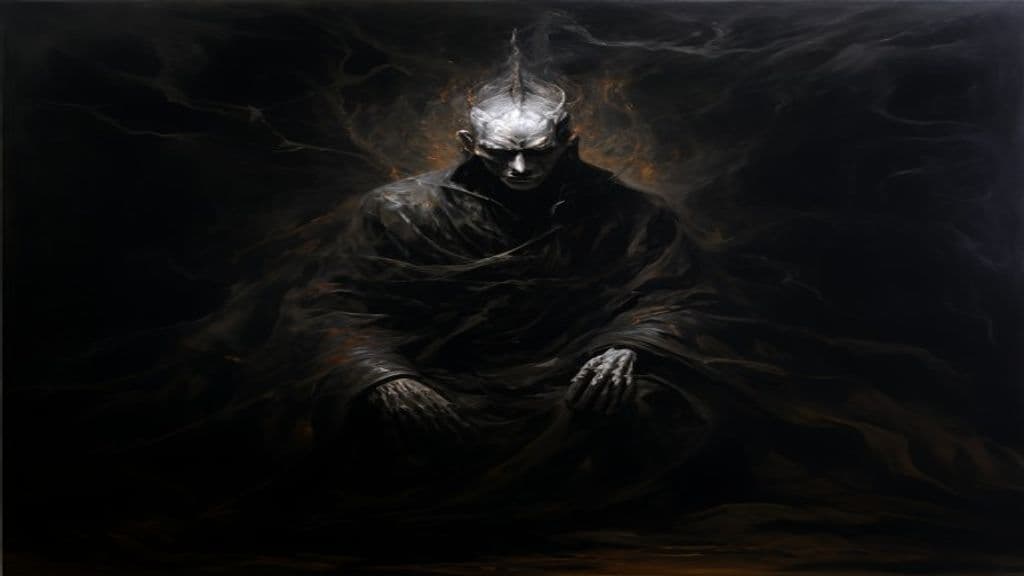
The Igong Bonpuri is described in traditional shamanic narratives from Jejudo, Korea. Its relation to the Korean cultural cosmology suggests it may be a type of supernatural being existing within this context.
No physical description is provided for the Igong Bonpuri in the source material.
No information on the abilities or behaviors of the Igong Bonpuri is available from the source.
Gumiho (Nine‑tailed fox)
A fox‑spirit in Korean storytelling derived from wider East Asian nine‑tailed‑fox motifs. Traditionally depicted as a shapeshifting fox that can take human form (commonly female in many stories), the gumiho appears across older folktales and numerous contemporary Korean media where it functions variously as trickster, predator, or sympathetic protagonist.
Household deity
A household deity is a deity or spirit that protects the home and its members, cared for inside domestic spaces and integrated into everyday household ritual. The category spans distinct cultural instantiations — hearth goddesses, ancestral family kami, and animistic house-spirits — and is characterized by reciprocal relations of offering and protection rather than cosmic sovereignty.
Kinnaree
A benevolent hybrid figure from Hindu-Buddhist myth, presented in Thai tradition as a part-human, part-bird being closely associated with music, love, beauty, and the protection of humans. The motif persists in modern Thai cultural life as decorative and symbolic imagery.
Liminal deity (category)
A scholarly category of gods and divine figures whose proper sphere is thresholds, borders, and transitions — places and moments where one state gives way to another. The term aggregates culturally specific deities (e.g., Janus, Hecate, Charon, Cheng'huang, Menshen, Jangseung, Bes) that function as guardians, psychopomps, or mediators at crossings of space, time, or condition.
Little people
A cross-cultural folkloric category of diminutive supernatural or semi-supernatural beings found worldwide. They occupy liminal places near humans (woods, mounds, anthills, mines, shorelines) and range from helpful household spirits to mischievous tricksters or dangerous guardians of places and resources.
Manohara
In Indonesian tradition, Manohara is a kinnari heroine, a supernatural being with characteristics from both humans and birds. Her story appears in Southeast Asian countries and East Asia. (Note: 1. The power tier should be changed to Lesser (local spirit), as being mentioned in a Buddhist scripture and stone reliefs suggests a more significant level of influence or worship. 2. There is no inf)
Moon Rabbit (Maya Tradition)
A mythical figure associated with lunar mythology, said to pound elixir or medicine for mortals and occasionally foodstuffs. (Note: 1. Power tier: Downgrade to Ancient, as while it's associated with lunar mythology, its abilities are not cosmic in scope. 2. Abilities: Add that the contents of the mortar differ among cultural tradi)
Personifications of Death
Named, often anthropomorphic figures across cultures that embody, govern, or mediate death and the realm of the dead. Roles vary from psychopomp guide to judge or sovereign of an underworld, and forms range from skeletal reapers to regal underworld rulers and spirit families.
Qilin
A legendary hooved chimerical creature of Chinese literary tradition (麒麟, qílín) whose appearances in classical accounts function as auspicious omens tied to the birth, arrival, or death of sages and illustrious rulers. The creature is part of a broader East Asian set of correspondents (Japanese kirin, Korean girin) and was historically conflated with the real giraffe in Ming-dynasty court encounters.
Iggwilv
Iggwilv is a fictional human arch‑mage from the Greyhawk campaign setting for Dungeons & Dragons, presented across editions as a powerful practitioner of arcane magic, author of in‑setting treatises on demons (the Demonomicon/Nethertome) and a manipulator of Abyssal/demonic politics. She is identified with other personas such as Tasha and Natasha in various sources and has a mutable biography across publications.
Igigi
A class of younger heavenly beings in ancient Mesopotamian myth, the Igigi are attested chiefly as a subordinate, laboring cohort of gods contrasted with the higher-ranking Anunnaki; in the Atrahasis narrative they perform manual tasks for senior deities and at one point rebel from forced toil. The name is attested in Sumerian orthography (i-gi4-gi4, later í-gì-gì) and its ultimate lexical origin is unknown, though scribal spellings invite numerical wordplay.
Igong Maji (Korean tradition)
A god of flowers in Korean shamanism, associated with natural cycles and fertility. (Note: 1. Power tier should be Ancient (deity-level) instead of Primordial, since it's described as "the god of flowers" and has a significant role in specific rituals. 2. The origin story is too vague; the )
Community Record
- [1]Igong Bonpuriwiki