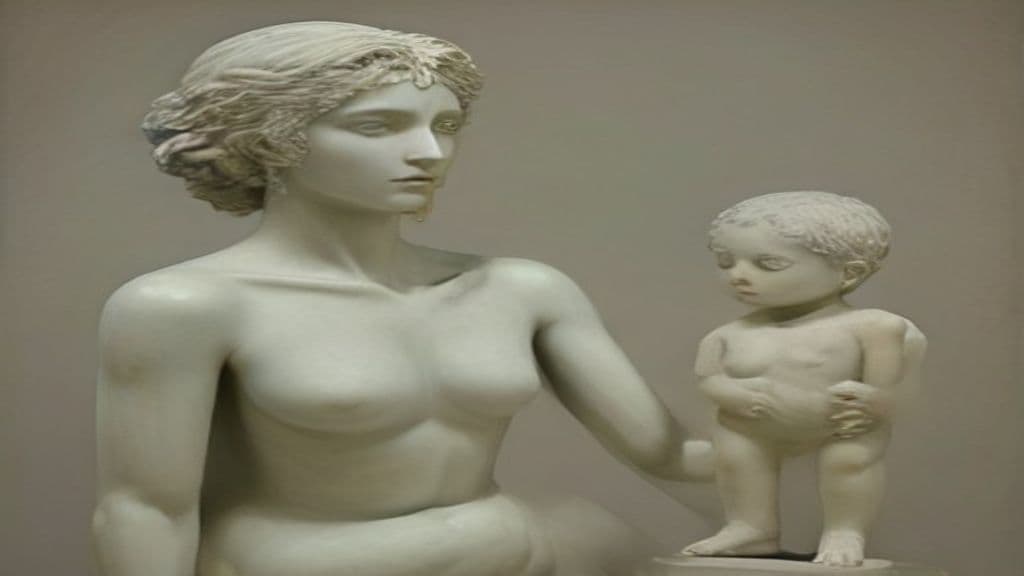
In the mythic narrative preserved in Ovid's Metamorphoses, Telethusa gives birth to a female child in Phaistos, Crete, at a time when her husband Ligdus has declared that a daughter would be killed because they cannot afford a dowry. Advised in a dream by the goddess Isis to spare the child, Telethusa conceals the infant's sex and raises the child as a son, giving the child the name Iphis (a name treated in the tale as gender-neutral). As an adolescent Iphis is contracted to marry Ianthe; fearing exposure, Telethusa and Iphis make offerings and pray at the temple of Isis the day before the wedding. In response the altar moves and the temple doors shake, and Isis effects a physical transformation: Iphis's body becomes that of a man. Afterward Telethusa and Iphis erect a tablet at the temple to commemorate the miracle.
Ovid's poetic description after the transformation emphasizes a change in physiognomy rather than anatomical detail: a darker hue to the face, greater strength, sterner features, and shorter, unadorned hair compared with the former appearance as a girl. No detailed account of infant appearance is provided beyond the mother's concealment of the child's sex during upbringing.
Iphis possesses no supernatural powers in the sources; the narrative portrays social disguise and living in a male role during upbringing. Behaviorally, Iphis experiences romantic desire for Ianthe and anguished inward conflict about that desire. The only supernatural agency in the story is Isis, who responds to petition and effects the bodily transformation that resolves the social crisis.
Weaknesses
- conditionmortality and exposure to familial authority
- conditionsocial vulnerability to discovery and economic pressures (dowry concerns)
Wards
- ritualsupplication and offering to Isis (temple prayer and jewelry offering)
Ascanius
Ascanius is a legendary Trojan prince in Greco‑Roman mytho-historical tradition, presented as the son of Aeneas and a dynastic founder who links the Trojan past to Italic and Roman genealogies (notably the Julian gens). He appears in literary and historiographical sources as a youthful warrior in Virgil's Aeneid and as a founder-king of Lavinium and Alba Longa in Roman tradition.
Baucis and Philemon
An elderly, impoverished married couple from Ovid’s Metamorphoses who exemplify ritual hospitality (xenia) by welcoming disguised gods; as a divine reward they are granted guardianship of a temple and, at death, are transformed into an intertwined oak and linden.
Giasone
Giasone is the Italian form of the mythic Greek hero Jason, presented in a 17th-century Italian opera (Cavalli's Giasone) and in retellings of the Jason and Medea cycle. He is a mortal leader of the Argonauts whose success in the quest for the Golden Fleece depends on martial courage and the active intervention of supernatural agents—most notably Medea's sorcery and chthonic powers.
Iphiclus
Iphiclus (Ancient Greek: Ἰφικλῆς; Latinized Iphiclus) is an anthroponym in Greek mythology borne by several distinct mortal figures — notably a Phylacian associated with the seer Melampus, the father of Protesilaus described as a 'lord of many sheep,' and a Pleuronian prince, son of Thestius, linked to the Calydonian narratives. The name recurs across genealogical lists and rosters of heroes rather than denoting a single supernatural being.
Iphiloche
Iphiloche is a named mortal woman in Greek mythic genealogies, attested as the bride of Megapenthes (an illegitimate son of Menelaus). She functions as a genealogical connector in classical sources and later scholia, with variant name-forms attested in the manuscript tradition.
Iphimedeia
Iphimedeia is a Thessalian princess of Greek heroic tradition whose role links mortal lineages with divine power and chthonic memory. She is best known as lover of Poseidon and mother (in some accounts) of the twin giants Otus and Ephialtes (the Aloadae), and she appears both in epic underworld catalogues and as a named focus of local cultic remembrance (tombs, paintings, honors).
Iphimedon
Iphimedon is a minor mythological mortal attested as a son of King Eurystheus of Tiryns (by Antimache) in Greek genealogical and heroic-cycle sources. He appears only in lists of the royal household and has no surviving independent myths or consistent narrative role beyond genealogical notice; one fragmentary source hints he 'fell in battle' but gives no context.
Iphinoe
Iphinoe is a personal name borne by multiple female figures in Greek myth: attested as one of the Proetid daughters afflicted with madness, as a herald who announces the Argonauts' arrival to Hypsipyle on Lemnos, and cited in modern taxonomy as the name of a nymph associated with the cave Kastria. The name therefore denotes several narrative personae rather than a single, coherent supernatural class.
Iphitus of Oechalia
Iphitus (Iphitos) of Oechalia is a mortal prince in Greek myth, son of King Eurytus and brother of Iole, sometimes counted among the Argonauts. He is best known as the named victim whom Heracles kills during a fit of madness, an act that precipitates Heracles' search for purification and eventual servitude to Omphale.
Ipos
Ipos is a named spirit from Western grimoire/demonological tradition (the Goetia, Lesser Key of Solomon) described as a titled infernal officer—variously Prince, Earl, or Duke—who commands thirty-six legions of demons and is credited with revealing knowledge of times and making men witty and valiant.
Iraj (son of Fereydun)
Iraj is the youngest son of the mythical king Fereydun and the eponymous ancestral figure of the Iranians in Avestan, Middle Persian and epic Persian literature. He receives a portion of the world in his father's division, is murdered by his brothers, and his line (through Manuchehr) exacts vengeance, establishing dynastic legitimacy in Iranian legendary history.
Iram of the Pillars
A supernatural place mentioned in the Quran, associated with punishment on Judgment Day. (Note: - Power tier should be Lesser (local spirit) as Iram of the Pillars is described as a lost city, not a cosmic entity. - There's no mention of punishment on Judgment Day as its primary association; it')
Community Record
- [1]Iphis (Wikipedia). Wikipedia: Iphis (summary of Ovid's Metamorphoses narrative)wiki
- [2]Iphis (mythology) (Wikipedia). Wikipedia: Iphis (mythology), summary of the Ovidian accountwiki
- [3]Ovid, Metamorphoses (summary and Brookes More translation referenced). Ovid, Metamorphoses (as summarized and translated in the sources cited by Wikipedia; Brookes More translation referenced in summaries)literary
- [4]Alchetron: Iphis. Alchetron summary of the Iphis narrativeother
- [5]Iphis & Ianthe, full stop. | Lugubelinus (blog). Modern commentary and interpretation of the Iphis storyother
- [6]Same Sex Desire: Women – UnRoman Romans. Teaching resource discussing Iphis in context of female same-sex desire in antiquityother