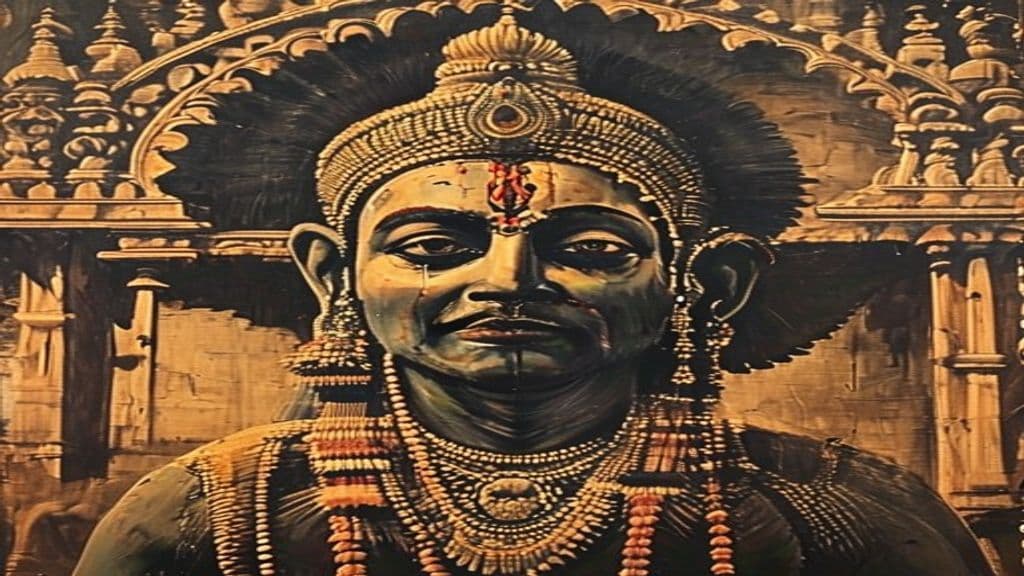
In the Mahabharata Iravan is introduced as the son of the Pandava prince Arjuna and the Naga princess Ulupi; he fights in the Kurukshetra war and is described as falling in battle on the eighth day of the war. In South Indian ritual narrative streams this epic figure becomes localized: stories emphasize his Naga lineage through Ulupi, his voluntary/self-sacrificial death connected to cultic efficacy (including narratives in which he offers himself to the goddess Kali), and a boon episode in which Krishna (or Krishna in Mohini form) grants him a marriage prior to his death. These elements—his martyr-like death, the preserved severed head, and the Mohini-marriage boon—become foundational for the Koovagam marriage-and-widowhood rites and for the Draupadi cult practice of hoisting his head to 'witness' ritual re-enactments of the Mahabharata.
As a Mahabharata character Iravan is narrated as a warrior without extensive physical description in the supplied battle account. In Tamil cult iconography Aravan is almost always represented and venerated in the form of his severed head. Typical features recorded include a painted or stone head with pronounced eyes, a mustache, large ears, a conical crown often bearing a Vaishnava tilak on the forehead, earrings, and frequent serpent (Naga/cobra) motifs (for example, cobra hoods or cobra heads associated with the crown) signaling his maternal Naga lineage. Some Draupadi-cult images emphasise demonic canine teeth; color and material vary regionally (red-painted portable heads in some sites; unpainted black stone heads in others). Some ritual paintings show the moment of sacrifice, including Aravan bowing to Kali or depicted holding his severed head and sword as an offering.
In the epic Mahabharata account Iravan is a mortal warrior who fights valiantly and dies on the eighth day of combat; that narrative does not attribute supernatural powers. In Tamil cult belief the severed head of Aravan is ascribed efficacious powers: it is ritually propitiated as a healer (credited with curing disease) and as a fertility-bestower (believed to induce pregnancy in childless women). Narrative boons preserved in ritual lore include the head’s extraordinary agency—most notably the Draupadi-tradition boon that the head was permitted to 'witness' the entire war, and the Mohini-marriage boon central to Koovagam’s reenactments. His cult role is primarily propitiatory, protective (head used as a guardian motif), and socially transformative (patronage of transgender devotees) rather than described as a wide-ranging supernatural combatant after death.
Weaknesses
- otherNo specific weaknesses recorded in provided sources; cult literature frames Aravan’s agency around his severed head and votive efficacy rather than describable vulnerabilities.
Wards
- ritualPlacement and display of Aravan’s severed head as apotropaic motif (portable heads, temple-head icons, and hoisted heads) — the head itself functions as a protective/guardian emblem on temple roofs and in procession.
Krishna
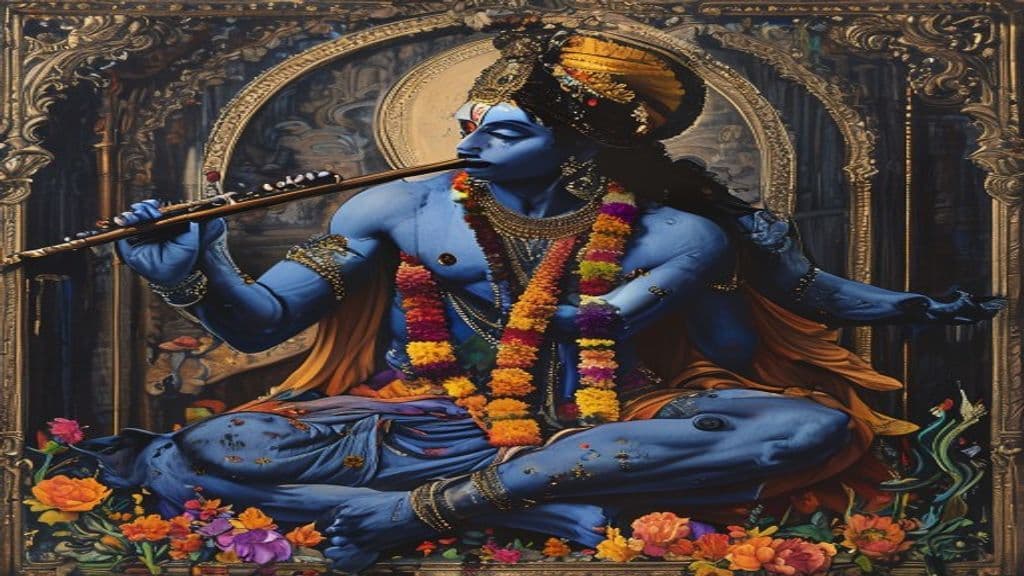
Krishna (Sanskrit: Kṛṣṇa) is a major Hindu deity presented in the supplied sources both as the eighth avatāra of Vishnu and, in many traditions, as the Supreme Being (Svayam Bhagavān). He appears in a range of roles—child, cowherd, lover, charioteer, teacher and divine hero—and his life episodes (Krishna-līlā) are central to bhakti devotion, performance arts, and pilgrimage traditions.

Draupadi
Draupadi is a central figure of the Indian epic Mahabharata: princess of Panchala born from a royal yajna, the common wife of the five Pandava brothers, and in many accounts a partial incarnation of the goddess Shri and close friend (sakhi) of Krishna. Her narrative role includes the public humiliation in the Kuru court, exile, participation in the events leading to the Kurukshetra War, later queenship of Indraprastha, and final ascent toward heaven in which she falls first.
Naga
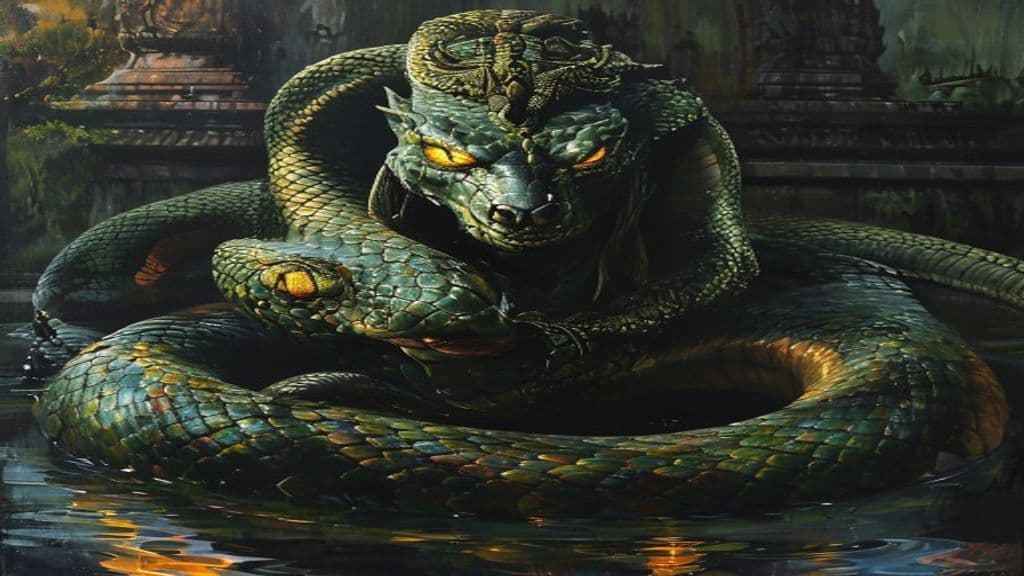
Divine serpent beings of Hindu, Buddhist, and Jain cosmology — powerful guardians of water, earth, and underground treasures. Revered as deities in South and Southeast Asia.
Iphis
Iphis is a mythological person from a Cretan tale preserved most fully in Ovid's Metamorphoses: born female and secretly raised as male, Iphis is transformed into a man by the goddess Isis so that he may lawfully marry his beloved Ianthe. The narrative functions as a mythic exemplum addressing gender, social expectations, and divine intervention.
Iphitus of Oechalia
Iphitus (Iphitos) of Oechalia is a mortal prince in Greek myth, son of King Eurytus and brother of Iole, sometimes counted among the Argonauts. He is best known as the named victim whom Heracles kills during a fit of madness, an act that precipitates Heracles' search for purification and eventual servitude to Omphale.
Ipos
Ipos is a named spirit from Western grimoire/demonological tradition (the Goetia, Lesser Key of Solomon) described as a titled infernal officer—variously Prince, Earl, or Duke—who commands thirty-six legions of demons and is credited with revealing knowledge of times and making men witty and valiant.
Iraj (son of Fereydun)
Iraj is the youngest son of the mythical king Fereydun and the eponymous ancestral figure of the Iranians in Avestan, Middle Persian and epic Persian literature. He receives a portion of the world in his father's division, is murdered by his brothers, and his line (through Manuchehr) exacts vengeance, establishing dynastic legitimacy in Iranian legendary history.
Iram of the Pillars
A supernatural place mentioned in the Quran, associated with punishment on Judgment Day. (Note: - Power tier should be Lesser (local spirit) as Iram of the Pillars is described as a lost city, not a cosmic entity. - There's no mention of punishment on Judgment Day as its primary association; it')
Iratxoak
In Basque mythology, benevolent imps that assist with farm labor at night if treated kindly. (Note: - Power tier: Lesser (not Ancient), as Iratxoak assist with farm labor, but do not seem to have cosmic or deity-level abilities. - Appearance: The article contradicts itself by stating that the appear)
Iravati
Hindu goddess associated with the sacred river Ravi, connected to cosmological narratives. (Note: 1. Power tier should be Primordial (agreed) but the draft article does not provide a compelling argument to justify it; provide source material supporting Iravati's cosmic-level abilities. 2. The desc)
Irawaru
Figure in Māori mythology transformed into a dog by his brother-in-law Māui. (Note: 1. Power tier: Based on the source material, Irawaru's transformation is a result of Māui's supernatural powers, but there is no indication that he was a powerful regional figure (Greater) before bein)
Irbis Seguy
Irbis Shekui Khagan (Irbis Seguy) was a historical ruler (khagan) of the Western Turkic Khaganate who reigned circa 642–651 CE. Linked to the Nushibi faction, his rule involved alliance with and conflict against the Tang dynasty and rival Duolu leaders, culminating in his overthrow by Ashina Helu.
Irmi
No evidence in the provided sources supports the existence of a folkloric or supernatural entity named Irmi. The supplied materials only reference modern personal names and unrelated archival items; therefore no folkloric profile can be reliably constructed from them.
Irnina
Irnina (dir-ni-na / dir-ni-ni) is a Mesopotamian divine personification of victory attested both as an independent goddess and as an epithet applied to other deities (notably Ishtar). She appears in god lists, royal campaign literature, and syncretistic hymnody and is placed in some sources near underworld deities.
Iroko
In Yoruba tradition, Iroko is associated with the sacred hardwood tree of the same name. (Note: 1. Remove Power tier: Minor Spirit as it's not supported by source material. 2. Add origin story: The Iroko is associated with the sacred hardwood tree of the same name in Yoruba tradition. 3. Under A)
Community Record
- [1]Iravan — Wikipedia. Wikipedia contributors, 'Iravan', Wikipedia, The Free Encyclopedia.wiki
- [2]Mahabharata Episode 58: The Battle Of Kurukshetra Days Seven And Eight (Archive). Archive.org: Mahabharata Episode 58 (Battle of Kurukshetra days seven and eight)literary
- [3]Irawan (Javanese Wayang traditions) — summary in research notes. Summary of Javanese Wayang Irawan traditions as noted in provided research materials.other