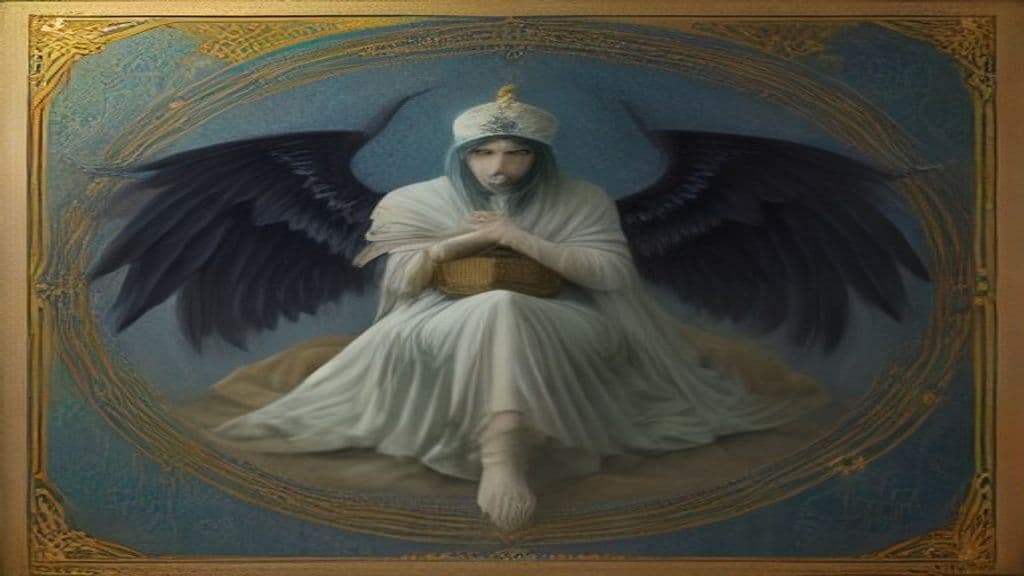
The Quranic text alludes to the trumpet-blower at the end of time but does not name this figure; later Islamic tradition and secondary works identify that trumpet-blower as Israfil. Traditional compilations (including the Kitab Aḥwāl al-Qiyāma and hadith summaries cited in the assembled sources) place Israfil among the principal archangels (alongside Jibril, Mikail and the Angel of Death) and present him as the angel who awaits God's command to enact the eschatological trumpet blast.
Traditional accounts provide several descriptive motifs. A quoted passage from Kitab Aḥwāl al-Qiyāma describes Israfil as bearing four wings—"one in the East, one in the West, one covering his legs and one shielding his head and face in fear of God"—and inclining his head toward the Throne; other variant narrations in the collected material record twelve wings. These sources depict him standing with the trumpet (ṣūr) placed on his right thigh and its head at his mouth until God commands him to bring it to his face, fold his wings, and blow. Some traditions add that he carries a pen (qalam) with a wing and covers his face with another wing when before God.
In the assembled traditions Israfil's primary function is eschatological: he will blow the trumpet that precipitates resurrection and judgment. Secondary traditional attributions include mediating divine commands to other archangels (a status described in hadith/traditional summaries) and, in some accounts, serving as a scribe who carries a pen and writes divine commands or destiny. He is also described in the sources as having a notably beautiful voice and serving as the Muʾadhdhin for the inhabitants of Heaven. Variant traditions (not uniform across sources) sometimes ascribe other episodic acts to him, such as a role in certain creation narratives, but these are recorded as less widely attested variants.
Jann
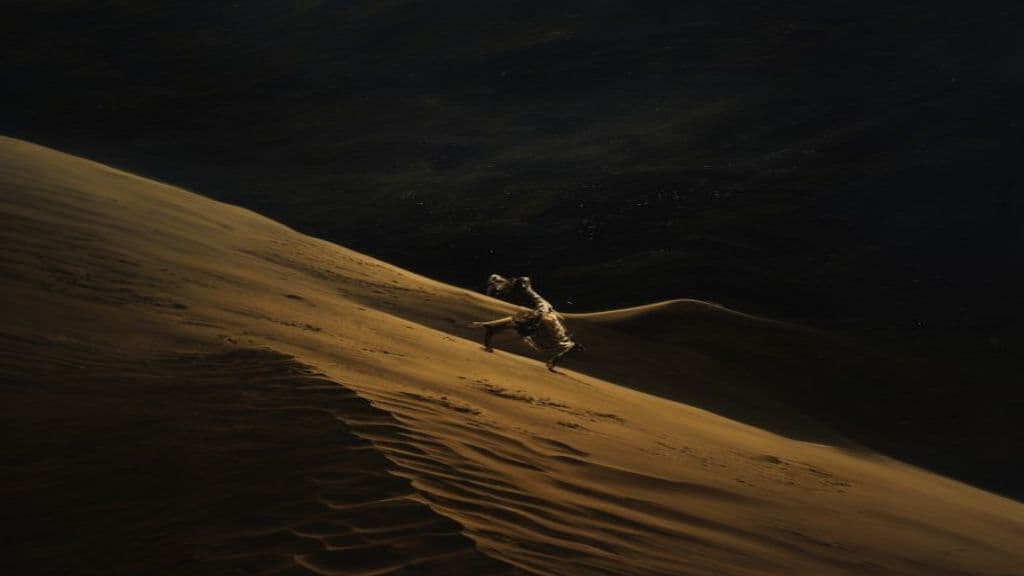
The weakest class of djinn in Islamic tradition, associated with desert winds and taking the form of snakes or whirlwinds, dwelling in empty wilderness and posing little threat to those who know the proper invocations.
Jann
The weakest class of djinn in Islamic tradition, associated with desert winds and taking the form of snakes or whirlwinds, dwelling in empty wilderness and posing little threat to those who know the proper invocations.
Isimud
Isimud (Akkadian Usmû; Hurrian Izzummi) is a minor Mesopotamian deity who functions as the sukkal (personal attendant, messenger, and doorkeeper) of the god Enki (Ea). Attested in mythic and ritual texts from the Early Dynastic through the Late Assyrian periods and adopted into Hurrian and Hittite contexts, he is best known for his distinctive two-faced iconography and his role conveying messages and performing household duties for Enki.
Isis
Isis is a major goddess of ancient Egyptian religion, a member of the Heliopolitan Ennead who functions as sister and consort of Osiris, mother and protector of Horus, a funerary and royal protector, and a locus of potent magic whose cult spread through the Hellenistic and Roman Mediterranean.
Ismene (Asopid)
Ismene is a mortal Theban princess in the Oedipus/Seven Against Thebes cycle of Greek myth and tragedy, usually presented as a daughter (and half‑sister) of Oedipus and sister of Antigone, Eteocles, and Polynices. In classical tragedy she functions as a ritual participant and a cautionary, law‑respecting foil to Antigone; earlier poetic and iconographic traditions record divergent, often violent fates.
Ismenis
Ismenis (Ancient Greek Ἰσμηνίς) is a naiad — a freshwater nymph — associated with the Boeotian river Ismenus. In the surviving literary tradition (notably Statius' Thebaid as summarized in modern reference works) she is named as the mother, by Pan, of Crenaeus and is described searching for and lamenting his body after he is slain in the war of the Seven against Thebes.
Ismenus
Ismenus is the personified river (potamos) of the Boeotian stream Ismenus/Ismenos, both a geographical river of Thebes and a mythic river-god whose genealogy and episodic agency appear in Greek epic and mythographic traditions (notably Statius' Thebaid and later summaries).
Isonade
A large, shark-like sea monster from Japanese regional folklore (notably Matsuura and other parts of western Japan). Its body is said to remain hidden beneath the waves, with only a huge, barbed tail fin visible; it approaches boats stealthily, can snare sailors with its hooked tail, capsize vessels, strike beaches, and is associated with fierce winds when it appears.
Issitoq
Issitoq is an Inuit supernatural being described in the cited sources as a deity that punishes those who break taboos. The same sources state that he usually takes the form of a giant flying eye.
Issun-bōshi
Issun-bōshi (一寸法師, "One-sun Boy") is the protagonist of a Japanese folktale: a human child born the size of one sun (about 3 cm) who travels to the capital, serves in a noble household, defeats an oni by bravery and craft, and— in some variants—acquires a magic mallet that enlarges him. The figure is principally a miraculous or abnormal human hero in premodern tale cycles, later sometimes mentioned in Edo-period popular culture as a label for very small people or as a yōkai-type motif.
Istrus
Istrus is not attested in the provided sources as a mythological being; the only direct occurrence in the corpus is a 1932 auction catalogue phrase referring to "Istrus Münzen" (a find of Istrus coins), suggesting a toponymic or numismatic usage rather than a spirit or creature. Possible connections to classical place-names (e.g., Histria/Ister) are explicitly uncertain given the available material.
Istämi
Istämi was a 6th-century Turkic ruler who governed the western portion of the Göktürk realm as a yabghu and is retrospectively referred to as a khagan. He exercised de facto sovereignty in the west, dominated Sogdian subjects there, defeated the Hephthalites, and engaged in high-level diplomacy with Sassanid Persia and Byzantium (including sanctioning a Sogdian embassy to Constantinople in 568).
It! The Living Colossus
It! The Living Colossus is a fictional 100-foot stone humanoid statue from Marvel Comics (originally Atlas) that becomes animate when inhabited or controlled by transferred minds (a stranded alien Kigor or human Bob O'Bryan). Functioning as a monumental constructed object rather than an indigenous supernatural being, it has been used alternately as a rampaging weapon and as a vehicle of human agency across multiple comic-storyline revivals.
Itonus
Itonus is an eponymous figure in Greek myth, appearing in two distinct genealogical traditions as a king and ancestor tied to the settlement Iton in Phthiotis and to a local sanctuary of Athena. The name is glossed in modern summaries as Ἴτωνος (romanized Itonos / Itonus) and has been interpreted as having willow associations in some scholarly reconstructions, but classical sources present him primarily as a mortal founder/ancestor rather than an independent supernatural spirit.
Community Record
- [1]Israfil. Wikipedia, 'Israfil' entry (summary of traditional accounts)wiki
- [2]Kitab Aḥwāl al-Qiyāma (quoted). Quoted passage reproduced in assembled source summaries (Kitab Aḥwāl al-Qiyāma: description of Israfil, wings, trumpet, lawh al-mahfuz and veils)other
- [3]Israfil - imaginova/glossary entry. Popular reference summarizing traditional attributes (voice, trumpet, eschatological role)other