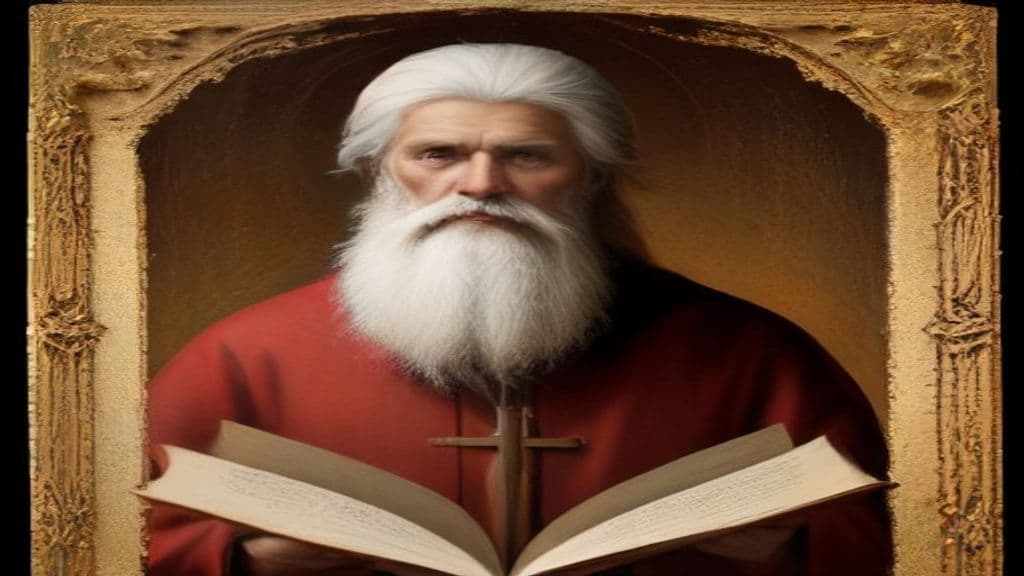
Within Christian tradition, John is presented as one of the circle around Jesus and as the figure traditionally named author of the Gospel of John and the Johannine epistles; later tradition and some communities also identified him with the author of Revelation (John of Patmos) and with an early church leader called John the Presbyter. Sources place his life roughly c. 6 AD–c. 101 AD in conventional accounts and localize Johannine composition in Ephesus (c. 90–110) and the exile to Patmos (c. 95) for Revelation, while noting that many modern scholars separate the authorship of Revelation from the Gospel and epistles.
Descriptions derive from iconographic and hagiographic tradition rather than eyewitness accounts. Two standard artistic types recur: an aged man with white or gray beard common in Byzantine imagery, and a beardless youthful figure frequent in medieval Western art with roots traced by art historians to early Roman representation. Medieval art sometimes presents him with feminized or androgynous features. Common attributes in art and devotion include a chalice (often shown with a serpent emerging, referencing medieval legend), a book or scroll (signifying his writings), and the eagle as his symbolic creature.
John is represented principally as an author, theological interpreter, apostolic witness, and liturgical patron rather than a supernatural agent. Hagiographic legend attributes miraculous preservations—most notably a cup of poison rendered harmless and survival of boiling oil—motifs found in medieval accounts (e.g., Acts of John) and later devotional literature. His 'power' in tradition is doctrinal authority conveyed through the Gospel and epistles and his role as a commemorated saint rather than ongoing uncanny agency.
Weaknesses
- otherHuman mortality and susceptibility to trials (sources portray him as a historical/saintly figure subject to exile, trials, and legendary tests such as poison or boiling oil)
Wards
None recorded.
Johanan (High Priest) (tradition)
The supplied sources do not document a supernatural or priestly entity named Johanan; instead they treat Yohanan/Johanan as a Hebrew male given name (יוֹחָנָן / יְהוֹחָנָן) meaning "YHWH is gracious." Modern media references to individuals named Johanan (e.g., Johanan Diaz) appear in archive listings but do not present the name as a mythic being.
Johann Georg Faust
Johann Georg Faust is a historically attested itinerant early modern practitioner — variously an alchemist, astrologer, physician, teacher and performer — whose life and unusual death were rapidly mythologized in chapbooks and later literature (notably Marlowe and Goethe). Documentary records show a learned background and contested reputation; later pamphlet tradition transformed him into the legendary 'Faust' figure associated with diabolism.
John Dough
John Dough is a fictional life-sized gingerbread man created by L. Frank Baum in his 1906 children's fantasy novel John Dough and the Cherub. Brought to life when an immortality elixir is accidentally mixed into his batter, he functions as an animate confection with social agency who travels, befriends companions, sacrifices for others, and ultimately becomes a king within Baum's Oz-adjacent imagined world.
John Fare
John Fare is a modern art‑world legend: a fictional or legendary performance‑artist figure whose circulated narrative depicts staged robotic surgery and progressive self‑amputation as artworks. The tale originated in late‑1960s print, was heavily embellished in early‑1970s retellings, and has since been reused by artists, galleries, and subcultural publications as a conceptual device to probe bodily sacrifice, authenticity, and martyrdom in avant‑garde practice.
John Hyrcanus
John Hyrcanus (Yoḥānān Hurqanos) was a historical Jewish high priest and Hasmonean ruler of Judea (born c.164 BCE; reigned 134–104 BCE) who combined religious and secular authority, expanded Hasmonean territory, and negotiated with Hellenistic powers. He is presented in the sources as a human political and cultic leader rather than a supernatural being.
John Ryker
John Ryker is a fictional, non‑superpowered antagonist in Marvel Comics who functions as a high‑ranking U.S. Army general and later corporate executive. He uses military, scientific, and corporate resources to hunt, experiment on, and attempt to weaponize gamma‑irradiated individuals (notably the Hulk and related subjects).
Johnny Cage
Johnny Cage (Jonathan "John" Carlton) is a fictional character from the Mortal Kombat video game franchise: a Hollywood action-film star and skilled martial artist who serves as one of Earthrealm's champions in inter-realm tournaments and wars. Though a mortal human in the fiction, his narrative repeatedly intersects with supernatural forces that kill, resurrect, or manipulate him.
Jokhini
A female supernatural predator of Assamese folklore — the Jokhini appears as a beautiful woman to lure men, but also as a hideous crone to devour them. She is associated with the dense forests of the Brahmaputra valley and is one of the most feared night entities in Assamese village belief.
Jonakr's sons (Hamdir, Sörli, Erpr)
Three brothers—Hamdir (Hamðr), Sörli (Sǫrli), and Erpr—of the Völsung lineage in Germanic heroic legend who, at their mother Guðrún's urging, attempt to avenge their half‑sister Svanhildr by attacking King Jörmunrekr/Ermanaric. Their deed and tragic deaths are attested across Norse poetic and saga sources and continental chronicles.
Jophiel
An archangel in Jewish and Christian angelology, Jophiel is depicted in mystical, liturgical, and occult sources as a high-ranking celestial guardian associated with wisdom, Torah-reading, beauty, and certain Kabbalistic/ceremonial correspondences. Sources place Jophiel among the highest heavens and in roles supervising scripture, teaching languages, and serving in angelic command.
Jorōgumo
A yōkai of Japanese folklore depicted as a spider-associated shapeshifter that can take the form of a woman to lure, entangle, and sometimes devour humans. Tales place it in liminal natural sites (waterfalls, abysses) and domestic edges (eaves, attics), and local practices sometimes worship or ritually counter it.
Joulupukki
A Finnish Christmas figure representing the spirit of Yule and winter solstice, often conflated with Santa Claus. (Note: * Power tier should be Lesser or Minor Spirit, as there is no indication in the source material that Joulupukki is a powerful regional or deity-level entity. * Abilities are not described, but it's st)
Community Record
- [1]John the Evangelist — Wikipedia. Wikipedia entry 'John the Evangelist'.wiki
- [2]John the Evangelist — Wikidata. Wikidata item Q328804 summary.other
- [3]Archive audio items referencing Johannine texts (examples). Recorded sermons/performances that reference Johannine material; cited as modern uses of Johannine texts in preaching context.other
- [4]Archive audio items referencing Johannine texts (examples). Recorded sermons/performances that reference Johannine material; cited as modern uses of Johannine texts in preaching context.other
- [5]Archive audio items referencing Johannine texts (examples). Recorded sermons/performances that reference Johannine material; cited as modern uses of Johannine texts in preaching context.other