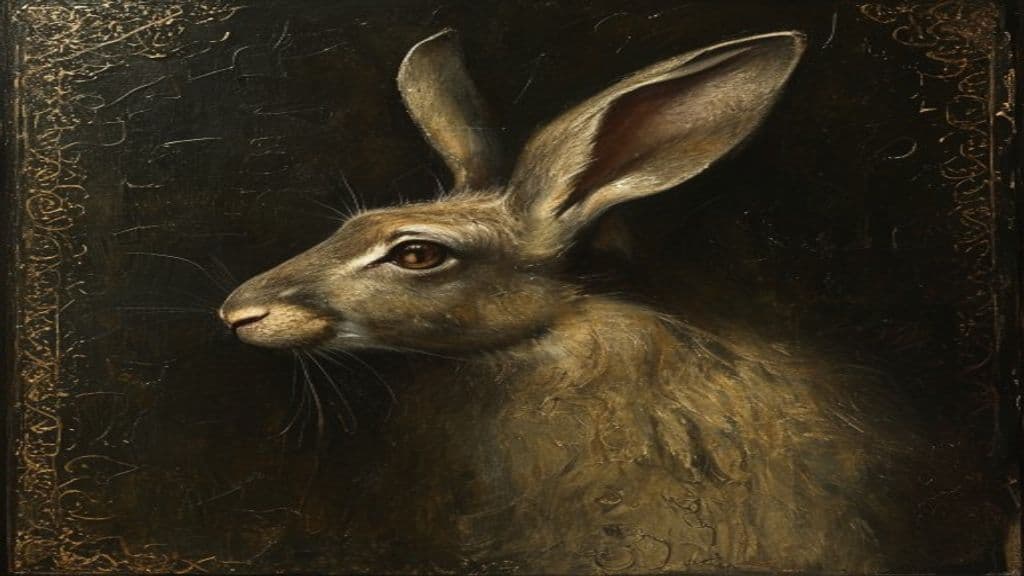
The origin story of Al-Mi'raj is unknown.
Al-Mi'raj resembles a one-horned hare or rabbit, but no further details are provided on its size, color, or other distinctive features.
No information is available about Al-Mi'raj's abilities, behaviors, powers, or interactions with humans.
Al-Jānn
Al-Jānn (jann) is a pre-Adamite, ancestral category invoked in Arabic-Islamic exegetical, hadithic, mystical, and folkloric materials to designate an earlier class of sentient beings—progenitors of later jinn—said to be created of fire, to have once inhabited and sometimes ruled the earth, and to stand in a liminal ontological position between angels and humans.
Hantu
Hantu is a Malay and Indonesian lexical and conceptual category for spirits and invisible beings that includes ancestral souls, animistic nature spirits, and, in modern usage, ghosts or demons. The term covers many named subtypes (e.g., Hantu Raya, Hantu Tinggi) whose forms and roles vary across local traditions.
Hatif
Hatif (Arabic: هَاتِف, hātif) is an auditory phenomenon in Arabic and Bedouin traditions described as a voice heard without discovering the body that made it. Sources record multiple, sometimes conflicting explanations: an unseen communicator such as a jinn, the voice of the dead near graves, or a psychological hallucination arising from loneliness.
Qutrub
A qutrub (قُطْرُب) in Arabian folklore is described in secondary sources as a type of jinn or demon associated with graveyards and corpse‑eating; it is variously likened to an 'Arabian werewolf' or a ghoul and appears in Arabic literary and manuscript references.
Shamshir-e Zomorrodnegār
A sacred sword in the Persian legend Shahnameh, capable of piercing the invulnerability of Fulad-zereh, a demonic entity created by a witch mother's charm. (Note: 1. Remove Power tier: Primordial as it is likely Greater (powerful regional) given its ability to counter a demonic entity. 2. Add sensory cues from Source 1: mention of King Solomon's ownership could)
Sheshe
The Sheshe is a malevolent being in Persian mythology that targets newborn babies on their 6th day of life, strangling them during the night. (Note: * Power tier: Incorrect, should be "Ancient" as it demonstrates deity-level powers to kill newborns. * Abilities: Should mention the Sheshe's supernatural nature and connection to infant mortality fea)
Shiqq
A jinn-like monstrous being from Arabic folklore, described in available sources as a lower-ranked, 'half-formed' creature with a monstrous appearance. Attested in references to pre-Islamic Arabian belief and retained in later Bedouin folklore with conceptual overlap with ghouls and other malformed entities.
The Magic Jinn
A magical jinn from Arabian tradition with the ability to grant wishes, but at a cost. (Note: 1. Power tier: Primordial is not plausible given that granting wishes and providing assistance are abilities typically attributed to lower-tier entities (Greater or Lesser). 2. Origin story: Since The)
Al-Jann
Al-Jann (Jann) is a primordial, pre‑Adamite class of beings in Islamic/Arab folkloric tradition presented as the ancestor or earlier population from which the jinn derive. They are said to have inhabited the earth before Adam and in at least one account were ruled by a king named Jann ibn Jann; some folkloric variants describe them as punished and turned into the weakest class of jinn.
Al-Kuz
Al-Kuz is not attested in the supplied corpus as a supernatural being; the name appears as the designation of an impact crater on Saturn's moon Enceladus and as the name of a literary character (one of the barber’s six brothers) in "The Hunchback's Tale" from The Book of One Thousand and One Nights.
Al-Wakwak
Al-Wakwak is a geographic entity in medieval Arabic literature, possibly described as an island or group of islands. (Note: * Power tier should be Primordial (cosmic) given it's mentioned as a geographic entity in medieval Arabic literature. * Origin story section is missing, which would typically include how Al-Wakwak was)
Al-ʻUzzā
Al-ʻUzzā was a principal female deity of pre-Islamic Arabian religion, widely venerated by tribes such as the Quraysh. She formed a triad with al-Lāt and Manāt, had a prominent shrine at Nakhlah (near Mecca) with sacred trees and a stone cube, and was invoked for protection, intercession and oracular consultation in late medieval Islamic sources that record pre-Islamic cult practice.
Community Record
- [1]Al-Mi'raj. Wikipediawiki