
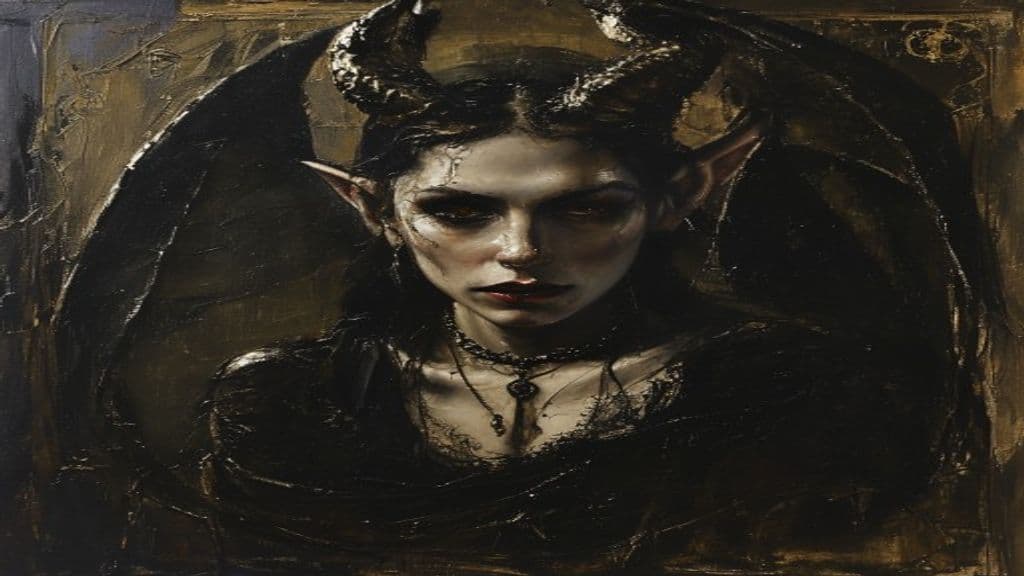
The Sila (Si'la or Si'lat) are documented in pre-Islamic Arabic poetry and persist strongly into Islamic folk tradition. Al-Jahiz (9th century) and other classical Arab scholars placed them at the apex of shapeshifting ability — unlike other djinn who transform with effort, the Sila assumes any form perfectly, including the forms of specific known people. They are predominantly female in classical accounts and use their shapeshifting to infiltrate households, seduce men, and steal children.
The Arab poet Al-Shanfara referenced the sila in desert poetry as beings that would take the form of a lost wife or a beloved to lure a traveler to his death. They differ from other djinn in their patience — a sila may maintain a disguise for years.
Sila are described as talented shapeshifters who most commonly appear in human (female) form but betray themselves by hybrid or animalizing features. The Arabic glosses include meanings like "hag" or "treacherous spirits of invariable form," reflecting portrayals that combine feminine guise, treachery, and an identifiable folk category. While usually depicted as female and sexually alluring, sources note that not every member of the class is female or strictly a succubus-type.
Classified among the malicious class of jinn, Sila are credited with skilled shapeshifting, the capacity to seduce and marry men, and to produce offspring from unions between human and jinn. They are also said to lead travellers and nomads astray in desolate desert places, sometimes resulting in death. Early genealogical and ethnographic commentary emphasizes their deceptive nature and dangerous interactions with isolated humans.
Succubus (Jewish Tradition)
Female demon that seduces male humans through dreams, potentially leading to a hybrid child and the man's decline. (Note: 1. Power tier should be Ancient, not Primordial (Primordial powers are cosmic, while Ancient powers are deity-level). 2. No information on physical appearance is missing because it's simply not mentio)

Churel (Chudail)
A South Asian female revenant or vengeful ghost associated with women who die cruelly or unpurified; often said to target male relatives and sometimes described as latching onto trees, producing a tree‑attached tree‑spirit variant in local tales.

Ghoul
A ghoul is a demon-like or monstrous humanoid originating in pre-Islamic Arabian religion, traditionally associated with graveyards and the consumption of human flesh. The concept later entered broader folklore and has been widely reused and transformed in modern fiction and popular culture.
Bhoot (bhoota)
A bhoot (also bhoota, bhoot, bhut) is the culturally specific term across parts of the Indian subcontinent for a perturbed, restless spirit generally understood to be the ghost of a deceased person. Sources describe bhoots as arising when a person's death or post-death circumstances prevent them from moving on — for example violent death, unresolved affairs, or failures in funerary rites — and the term appears frequently in modern South Asian media and discussions.
Churel (Chudail)
A South Asian female revenant or vengeful ghost associated with women who die cruelly or unpurified; often said to target male relatives and sometimes described as latching onto trees, producing a tree‑attached tree‑spirit variant in local tales.
Djinn
The class of supernatural beings created from smokeless fire in Islamic cosmology — a parallel civilization to humanity, capable of belief or unbelief, with their own prophets, society, and judgment before God.
Elisha
Elisha is a Hebrew Bible prophet, successor and disciple of Elijah, portrayed as a divinely appointed intermediary who performs miracles, advises rulers in narrative episodes, and acts within a prophetic guild known as the "sons of the prophets." His story appears in 1 Kings 19 and 2 Kings 2–14 and he is venerated in Jewish, Christian, and Islamic traditions.
Evil eye
A cross-cultural folkloric belief in a harmful influence cast by a person's gaze or look, usually motivated by envy or ill will. Treated as a transmissible curse or force rather than a corporeal being, it is countered by apotropaic objects, formulas, plants, and gestures in many traditions.
Fatimah
Fatimah (also spelled Fatima) in the provided sources is presented as a female personal name and as the historical figure Fatima bint Muhammad (Fatima al‑Zahra), daughter of the Islamic prophet Muhammad, wife of Ali, and mother of Hasan and Husayn. The corpus contains biographical and onomastic information only and does not treat Fatimah as a supernatural entity.
Ghoul
A ghoul is a demon-like or monstrous humanoid originating in pre-Islamic Arabian religion, traditionally associated with graveyards and the consumption of human flesh. The concept later entered broader folklore and has been widely reused and transformed in modern fiction and popular culture.
Iblis
The primordial deceiver in Islamic theology; a jinn who refused God's command to bow before Adam and was expelled from heaven. The source of all temptation and whispered suggestion.
Ifrit
One of the most powerful classes of jinn in Islamic and pre-Islamic Arab tradition — a fire-born being of immense strength and cunning, capable of great works of engineering and terrible violence.
Jann
The weakest class of djinn in Islamic tradition, associated with desert winds and taking the form of snakes or whirlwinds, dwelling in empty wilderness and posing little threat to those who know the proper invocations.
Marid
The most powerful class of jinn in Islamic tradition — beings of the sea, associated with the deep ocean, storms, and the granting of wishes at terrible cost. The classic genie of the Arabian Nights.
Mellified Man
A medicinal substance created by steeping a human cadaver in honey. (Note: * Power tier should be Lesser (given it's a medicinal substance created by humans) rather than Primordial. * Abilities should reflect that Mellified Man has no supernatural or paranormal abilities, bu)
Community Record
- [1]Sila (mythology) — Wikipedia. Wikipedia contributors, "Sila (mythology)," Wikipedia, The Free Encyclopedia.wiki
- [2]Sila — Wikipedia (alternate). Wikipedia contributors, "Sila," Wikipedia, The Free Encyclopedia.wiki
- [3]Wikidata: Sila. Wikidata entry Q9336871 for Silaother
- [4]Quoted summary and ethnographic notes (provided research excerpt). Compiled research notes supplied with quotations from Arabic forms and commentary including Mahmud Shukri al-Alusi on Banu Si'lat.folk
- [5]Kitab al-Hayawan. Al-Jahiz. Kitab al-Hayawan (Book of Animals), Vol. 6. c. 847 CE. Cairo: Mustafa al-Babi al-Halabi.academic
- [6]The World of the Jinn. El-Zein, Amira. 2009. Islam, Arabs, and the Intelligent World of the Jinn. Syracuse University Press.academic