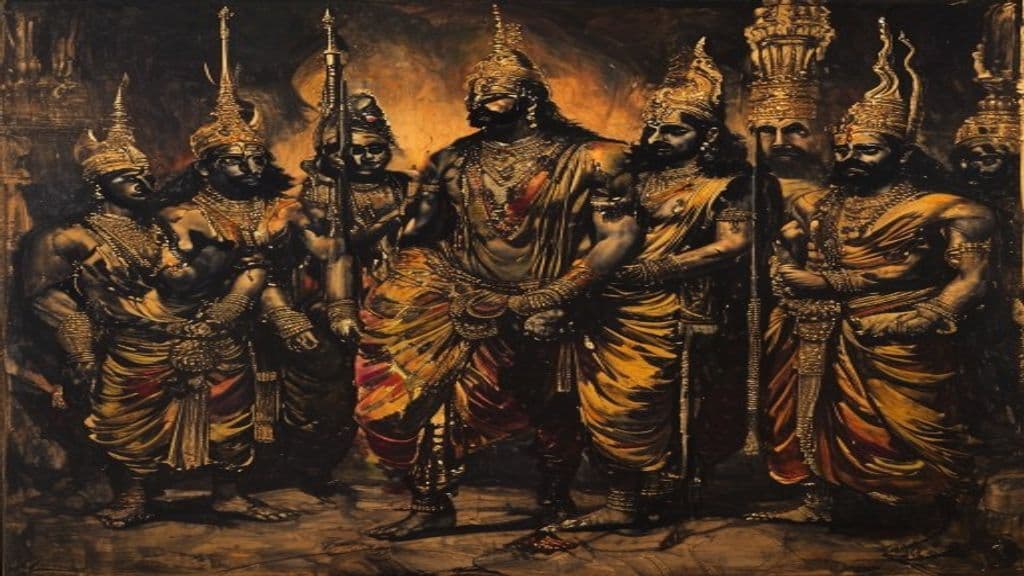
According to the epic-material summarized in the supplied sources, Gandhārī carried an abnormal pregnancy that produced a hard lump of flesh. The rishi Vyāsa advised that the piece be divided into one hundred and one parts, each placed into a jar filled with ghee; after incubation in the jars for two years they matured and were born as Dhṛtarāṣṭra's children. This mythic birth narrative is presented in the sources as the origin of the Kauravas and figures in later disputes over succession to the Kuru throne.
The sources describe the Kauravas as human princes and members of the royal family of Kuru. Individual brothers are named in the epic tradition (notably Duryodhana, Dushasana, Vikarna, Chitrasena) and the family also includes a sister, Dussala, and a half-brother, Yuyutsu. No unified supernatural or non-human physical description is provided in the supplied material; they are presented as ordinary human characters of princely status.
Within the narrative the Kauravas function as political and martial actors: claimants to the throne, leaders of the Kaurava forces in the Kurukṣetra war, and central agents in the epic's moral and dynastic conflicts. The supplied sources emphasize their role in succession disputes and warfare; most of Dhṛtarāṣṭra's sons (excluding Yuyutsu) are reported to have been killed in the Battle of Kurukṣetra. The sources do not attribute magical powers to them.
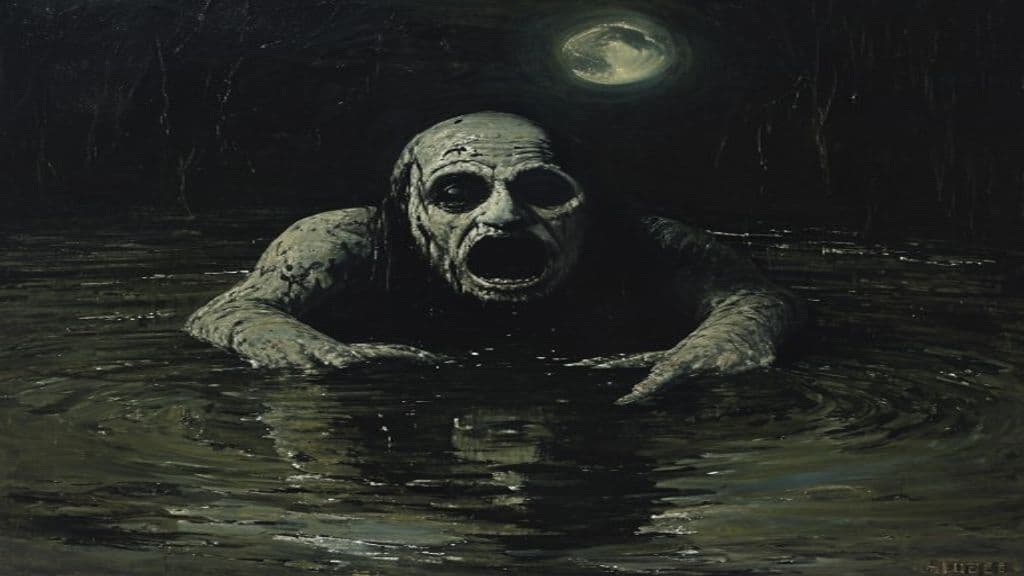
Pandubba
The 'water-drowner' of UP and Bihar — a jal pret (water ghost) that lurks in wells, ponds, and river bends, grabbing the ankles of swimmers and washing those who lean over still water. The most feared water-edge presence in Bhojpuri folk belief.

Pandava
The Pandavas are five legendary royal brothers who are central protagonists of the Indian epic the Mahabharata. They are mortal princes of the Kuru line whose births are supernaturally sanctioned by different gods and whose lives (education, exile, war, and rule) illustrate dilemmas of dharma, kinship, and kingship.
Kassite deities
Kassite deities are the named divine figures attested in Kassite-language and Mesopotamian sources of the second and first millennia BCE. They appear mainly as onomastic elements and occasional cult figures (notably Šuqamuna and Šumaliya), occupying a liminal position between Kassite ethnic identity and the Mesopotamian religious landscape.
Kataw
Kataw is a Visayan class of merfolk in Philippine folklore closely associated with sirena/sireno traditions. Some secondary sources and local summaries describe Kataw as occupying a higher social rank among aquatic beings and as associated with the rulership of an aquatic realm called Bantay Tubig, though detailed primary legends and ritual material are scarce in the supplied sources.
Katie King
A named spirit persona in Victorian Spiritualism (1870s) presented by Spiritualist mediums — most famously Florence Cook — as a materialized female spirit figure during physical séances; the manifestations provoked high‑profile investigations and public controversy over whether they were genuine spirit materializations or deliberate fraud.
Kauket
Kauket (also Keket, Kaukēt, Keku) is the feminine member of the Hermopolitan Ogdoad who personifies primordial darkness, especially the darkness associated with sunset and the unformed condition preceding creation. She is paired with the male Kek and is attested in traditions tied to Hermopolis and later funerary/ western symbolism.
Kaukė (mask)
Lithuanian term literally meaning 'mask' (kaukė), attested in Sudovian/East Baltic lexical material and in archival song titles. The supplied sources do not present Kaukė as an autonomous mythic being; instead the word functions as a cultural-linguistic token for masks and masking practices, with lexical links to a verbal root kauk- ('to howl').
Kaulu (Hawaiian Trickster God)
A complex entity in Hawaiian mythology, Kaulu is a trickster god with extraordinary physical strength and magical abilities. (Note: 1. In the Abilities section, "extraordinary physical strength" should be linked to a specific source or explicitly stated as a characteristic unique to Kaulu. 2. Power tier: Downgrade to Ancient (deit)
Kausalyā
Kausalyā is a human royal figure in the Ramayana tradition: the senior queen consort of King Daśaratha of Kosala and the mother of Rāma. In the Ayodhyā Kāṇḍa episodes cited she appears as a ritual participant and as a mother whose emotional speech and lamentation shape courtly responses to calamity.
Kaushiki
Kaushiki is a theophanic śakti in Hindu literature who issues from the sheath (kosha) of Parvati/Uma/Gauri and manifests as an independent warrior-mother deity to slay the asura kings Shumbha and Nishumbha. The same name appears in Jain literature as Kauśikīvidyā, a named vidyā (supernatural power) associated with certain Vidyadharas whose abilities are ethically conditioned.
Kaustubha
Divine gemstone associated with Vishnu's power, granted to him during the churning of the ocean, acting as a symbol of his divine authority. (Note: * The power tier should be Primordial (not Ancient) since it's a divine gemstone with cosmic significance. * The origin story could be more specific, mentioning that Kaustubha was granted to Vishnu du)
Kaval Deivam
Kaval Deivam (Tamil: guardian deity/spirit) is a category of village guardian spirits in Tamil folk religion charged with protecting village boundaries, people, cattle, fields and communal order. They are indigenous, non‑Agamic figures whose cults include fierce iconography, community festivals and offerings to secure protection and avert misfortune.
Kave
Kave (also attested as Kavet, Kaave, Kaveh; class-name Luonnotar/luonnottaret) is a polyvalent female spirit figure in Finnish and Karelian traditional belief, functioning both as an individual primordial woman and as a class of nature-women invoked in childbirth, healing, and cosmogonic accounts. Regional traditions vary: in some songs kapeet are lunar eaters, in others Kave frees or restores the sun and moon; she is commonly engaged through runic song and spells rather than fixed material cult.
Kaveh the Blacksmith
Mortal hero from Iranian mythology, leading an uprising against Zahāk, a tyrannical ruler. (Note: - Power tier: Primordial (since Kaveh is considered a mortal hero and does not demonstrate deity-level abilities) - Abilities: Add a specific description of how his leadership skills are presented in )
Community Record
- [1]Kaurava — Wikipedia. Wikipedia, 'Kaurava' entry (accessed via provided research notes)wiki
- [2]Kaurava — Wikidata Q13900078. Wikidata entry noting homonymous insect genus usageother
- [3]Vikranta Kaurava (archive). Archive listing referencing modern literary use of the term 'Kaurava'other
- [4]CBFC entry: ONCE MORE KAURAVA trailer (archive). Archive item showing modern cultural reuse of the name 'Kaurava' in mediaother
- [5]CBFC entry: SONG 1 KUKKU KUKKU MALE BILLU (ONCE MORE KAURAVA) (archive). Archive item showing modern cultural reuse of the name 'Kaurava' in mediaother