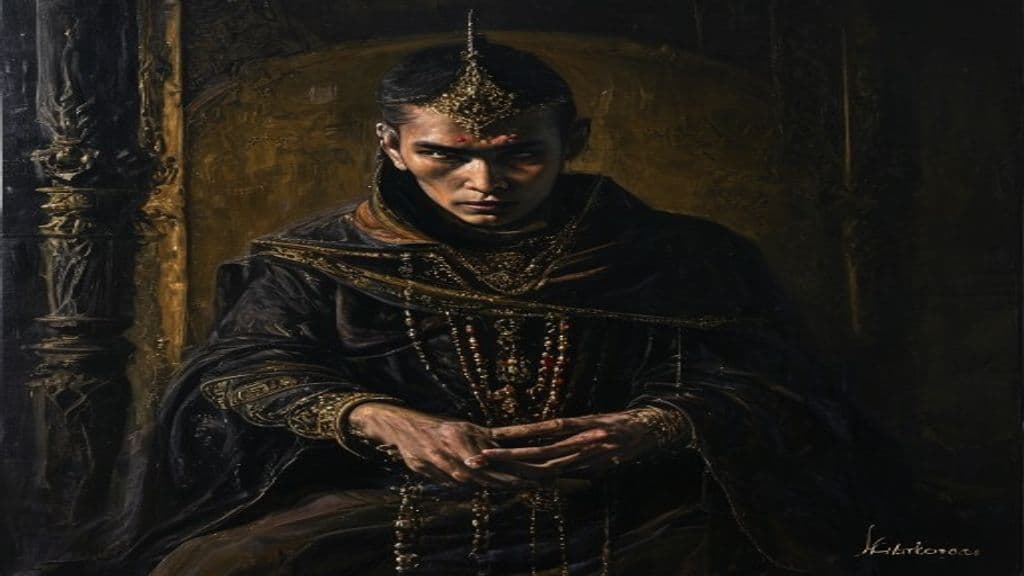
In the Thai tradition, Khun Borom is considered a legendary ancestor and cultural founder of the Southwestern Tai-speaking peoples. His role in establishing the foundations of Thai culture is deeply revered.
No physical description is provided in the source, leaving this aspect uncertain.
Khun Borom's abilities and behaviors are not described in the source, making this section uncertain.
Khita
Khita (also attested Hita) is attested in the supplied sources as an historical/political referent from late third‑millennium BCE Elam — a governor/king of the Awan dynasty and an ethnonym for a people. The provided materials do not treat Khita as a supernatural being and offer no folkloric descriptions, powers, or ritual responses.
Khnum
Khnum is an ancient Egyptian deity associated with the Nile cataract(s), the regulation of the annual inundation, and the crafting of human bodies and life‑force using a potter's‑wheel metaphor. He was principally worshipped at Elephantine and Esna from the Early Dynastic period into the Greco‑Roman era and was integrated into local temple triads and wider syncretic identities (e.g., Khnum‑Ra).
Khonsu
Khonsu is an ancient Egyptian lunar deity, member of the Theban Triad (son of Amun and Mut), associated with the nightly passage of the Moon, protection during the night, healing, fertility, and certain fierce underworld roles attested in funerary texts.
Khopesh (khepesh)
The khopesh (also spelled khepesh) is a sickle-shaped sword from the Bronze Age that was adopted into ancient Egyptian military and royal iconography. It is a material weapon type and emblem frequently depicted with kings in New Kingdom statuary and later appears as a decorative/ornamental motif (e.g., a "khepesh crown") in Late Period and Ptolemaic votive reliefs.
Khor-akhti (Ra‑Horakhty / Re‑Horakhte)
Khor-akhti is an aspectual, syncretic solar deity of ancient Egyptian religion, formed by the fusion of the sun‑god Re/Ra and the horizon aspect of Horus (Horakhty). Representing the sun at the horizon (dawn and/or the west horizon in some contexts), this composite bears solar iconography and royal sky symbolism and appears in temple, funerary, and amuletic contexts across multiple pharaonic periods.
Khosrow and Shirin
Human protagonists of a romantic epic poem in the Persian tradition, reflecting cultural values of ancient Persia. (Note: 1. Power tier: Should be adjusted to Primordial (as they are historical figures in a cultural context that predates modern power tiers). 2. Summary: Should include more information about their cultura)
Khyah
Khyah is attested in a single data point as a 'newari mythical creature' in an online linked-data entry. The available source corpus for this dossier contains no descriptive ethnographic, ritual, or narrative material about the entity; other provided materials with the same lexical form refer to a contemporary person (Khyah Harper) and are unrelated to Newar folklore.
Khyati
In Hindu tradition, Khyati is a divine figure and one of Daksha's 86 daughters, married to the sage Bhrigu and mother to three children. Her significance lies in her mythological role within the narrative of Daksha's family. (Note: - Power tier: Ancient (she's a divine figure with deity-level family connections) - Abilities: Remove "supernatural powers or behaviors" claim; instead note that abilities are not described in the sou)
Ki
Ki is the Sumerian personification of the Earth, the terrestrial consort of the sky god An (Anu) and mother in theogonic genealogies whose relationship with An and the birth of Enlil underpins the separation of heaven and earth.
Kichwa-Lamista tradition
The Kichwa-Lamista tradition refers to the cultural, linguistic, ritual, and spiritual lifeways of the Kichwa-speaking people of Lamas (San Martín Region, Peru). Their worldview combines Catholic practice with indigenous shamanic practices, is deeply embedded in forest-based subsistence (healing, farming, fishing, hunting), and preserves specialist esoteric registers and ritual knowledge within community life.
Kidōmaru
Kidōmaru (鬼童丸 / 鬼同丸) is an oni-class antagonist appearing in Kamakura-period and later Japanese setsuwa and warrior-cycle narratives. He functions as a cunning ambusher and bandit opposite Minamoto no Yorimitsu and his retainers in tales that place him in mountain caves, fields, and occasional domestic intrusions.
Kigatilik
Kigatilik is an entity in Inuit religion commonly described in sources as a "demon" and reported as a fanged being that kills angakkuit (shamans). The available attestations are very brief and do not provide detailed mythology or rituals.
Community Record
- [1]Wikipediawiki