
Multiple, alternative etiologies appear in the sources rather than a single unified origin. In Kokon Chomonjū Kidōmaru is presented as an oni who ambushes Yorimitsu (textual episode focused on the ambush rather than a natal origin). Local oral tradition of Kumohara relates that a woman taken by Shuten-dōji bore a child who grew to be Kidōmaru ('the child of Shuten-dōji'). The medieval war chronicle Zentaiheiki offers a different account, describing Kidōmaru as an abandoned or ruined child associated with Mount Hiei who later migrated to a mountain cave and became a bandit. These accounts are treated in the literature as alternative narrative explanations connecting Kidōmaru to the Shuten-dōji cycle or to banditry in marginal landscapes.
Textual sources provide sparse anatomical description; narrative emphasis is on concealment and action. Kokon Chomonjū relates Kidōmaru hiding inside a slain cow; Toriyama Sekien's Konjaku Hyakki Shūi image (titled 'Kidō') depicts him in snow wearing the skin of a cattle while waiting for Yorimitsu. Beyond these motifs (cow carcass concealment, cattle-skin clothing in Sekien's print), classical setsuwa do not supply a consistent catalog of physical features.
Sources record cunning, ambush tactics, great physical strength, and banditry. In Kokon Chomonjū he kills a free-ranging cow and conceals himself within its body as a trap; he is able to tear off chains when bound at Yorinobu's house, indicating exceptional strength. Zentaiheiki and related accounts describe him living as a mountain bandit operating from caves. Edo-period literary/print treatments (e.g., Takizawa Bakin's Shitennō Shōtō Iroku and related ukiyo-e) portray scenes of skill-contests between Kidōmaru and bandit figures like Hakamadare, framing him as a notable antagonist within a roster of brigand-supernatural figures. Modern fictional usages (e.g., Naruto) rework the name and add shinobi/web abilities, but these are derivative and not part of the classical setsuwa descriptions.
Weaknesses
- conditionexposure by vigilant retainers/archery
- conditionlethal force by warrior-hero (struck down by Yorimitsu in the Kokon Chomonjū episode)
Wards
- conditionvigilant guarding and supervision of households/guests
- othermartial preparedness and deployment of skilled retainers (e.g., Watanabe no Tsuna shooting to expose ambush)
- otherphysical restraint (chains used in narratives, though sources record Kidōmaru breaking them)
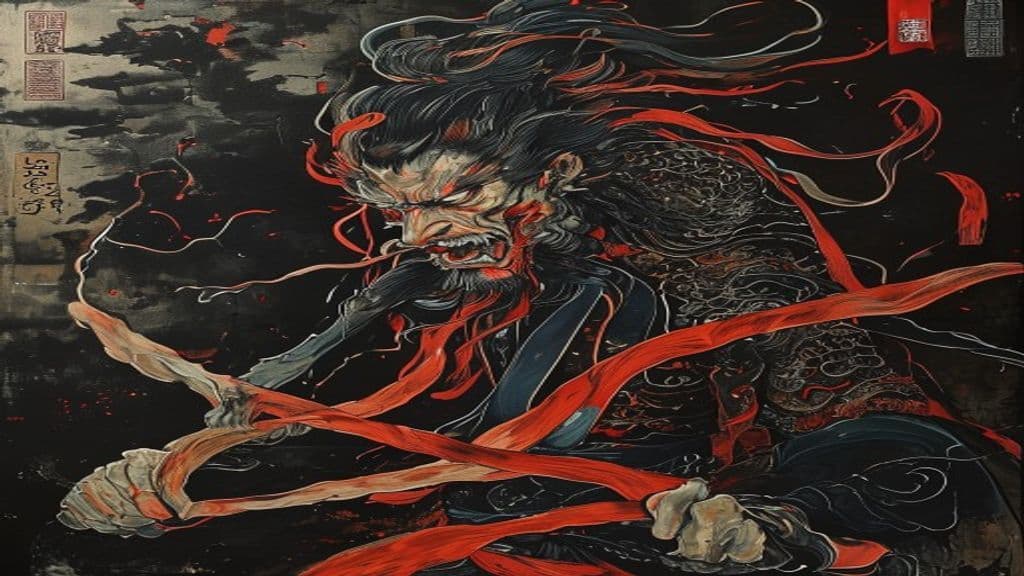
Shuten-dōji
Shuten-dōji is a legendary oni described in Japanese sources as the 'Demon King of Mt. Oe' who terrorized the region in folklore and was slain by the hero Minamoto no Raikō and his companions. In the best-known episode the demon is decapitated, yet the detached head remained animate and attempted to bite the hero, who survived by wearing multiple helmets stacked on his head.
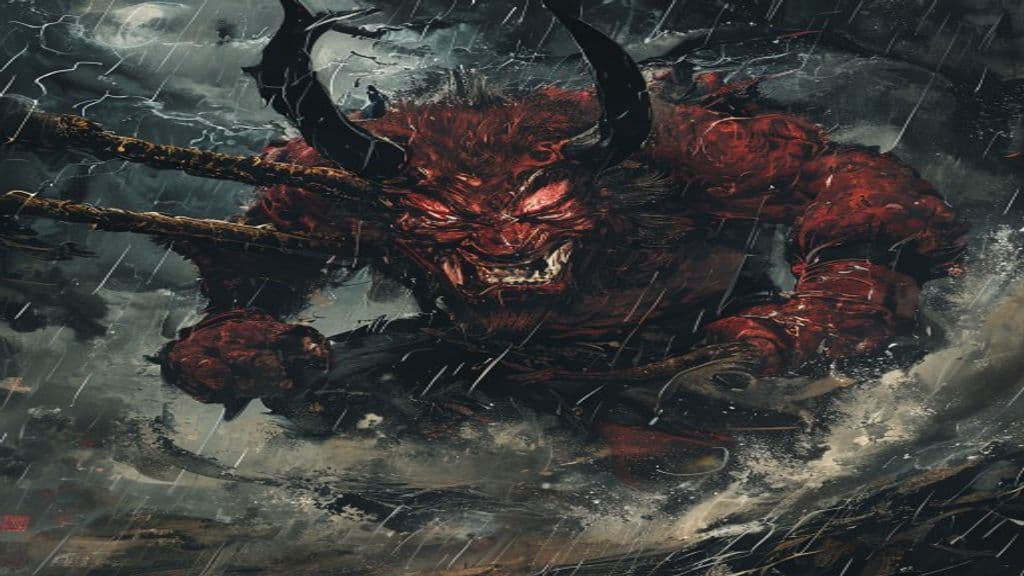
Oni
Powerful supernatural beings of Japanese folklore — associated with misfortune, disease, and the punishment of sinners in hell. Fearsome, often depicted as guardians of the underworld.
Onihitokuchi
Onihitokuchi (鬼一口) is a setsuwa motif in classical Japanese literature in which an oni (demon/ogre) instantly eats a human in one mouthful. The term functions both as a narrative episode in Heian-era tale collections and as a lexicalized metaphor for something extremely dangerous or for swift, decisive action.
Khosrow and Shirin
Human protagonists of a romantic epic poem in the Persian tradition, reflecting cultural values of ancient Persia. (Note: 1. Power tier: Should be adjusted to Primordial (as they are historical figures in a cultural context that predates modern power tiers). 2. Summary: Should include more information about their cultura)
Khun Borom
Legendary ancestor and cultural founder of the Southwestern Tai-speaking peoples, revered for establishing the foundations of Thai culture. (Note: * Power tier: Should be "Ancient" as there's no mention of cosmic or deity-level powers. * Abilities and sensory cues: Since they're not described in the source, it would be best to rephrase these sec)
Khyah
Khyah is attested in a single data point as a 'newari mythical creature' in an online linked-data entry. The available source corpus for this dossier contains no descriptive ethnographic, ritual, or narrative material about the entity; other provided materials with the same lexical form refer to a contemporary person (Khyah Harper) and are unrelated to Newar folklore.
Khyati
In Hindu tradition, Khyati is a divine figure and one of Daksha's 86 daughters, married to the sage Bhrigu and mother to three children. Her significance lies in her mythological role within the narrative of Daksha's family. (Note: - Power tier: Ancient (she's a divine figure with deity-level family connections) - Abilities: Remove "supernatural powers or behaviors" claim; instead note that abilities are not described in the sou)
Ki
Ki is the Sumerian personification of the Earth, the terrestrial consort of the sky god An (Anu) and mother in theogonic genealogies whose relationship with An and the birth of Enlil underpins the separation of heaven and earth.
Kichwa-Lamista tradition
The Kichwa-Lamista tradition refers to the cultural, linguistic, ritual, and spiritual lifeways of the Kichwa-speaking people of Lamas (San Martín Region, Peru). Their worldview combines Catholic practice with indigenous shamanic practices, is deeply embedded in forest-based subsistence (healing, farming, fishing, hunting), and preserves specialist esoteric registers and ritual knowledge within community life.
Kigatilik
Kigatilik is an entity in Inuit religion commonly described in sources as a "demon" and reported as a fanged being that kills angakkuit (shamans). The available attestations are very brief and do not provide detailed mythology or rituals.
Kihovauhkonen
A seer or prophet in Finnish mythology, tasked with foreseeing and warning of impending cataclysmic events. (Note: 1. Power tier: should be Lesser (local spirit) based on typical depiction in folklore. 2. Ability description: while it makes prophecies, there's no indication of a Primordial power level for such abi)
Kikimora
A female house spirit in Slavic folklore that functions as a domestic agent: helpful in well-kept homes and disruptive or dangerous where household morals or order fail. Variants include a domestic (house) kikimora paired with the domovoy and a swamp (bolotnaya) kikimora associated with marshland spirits.
Kikituk
A kikituk is an Inuit shamanic animal effigy or carving that is invested with spirit-force by a shaman and used as a spiritual weapon; the shaman brings the effigy to life, casts it toward a target where it is said to destroy the opponent's heart, and then retrieves it. Sources present the kikituk as a spirit-infused object functioning as the material focal point of a shaman's animalistic power in Inuit practice.
Kikokiko (Kikokikoog)
The provided source materials do not contain information about an entity called Kikokiko or Kikokikoog. The name string "kikokiko" appears incidentally in a Māori translation in one supplied source, but there is no evidence in the supplied materials linking this string to an Algonquin supernatural being, nor are there descriptions, origin stories, abilities, or rituals for such an entity in the provided texts.
Community Record
- [1]Kidōmaru (Wikipedia). Wikipedia entry summarizing Kokon Chomonjū episode, Sekien image, Kumohara oral tradition, Zentaiheiki account, and later literary pairings.wiki
- [2]Konjaku Hyakki Shūi (Toriyama Sekien) — image summary referenced on Wikipedia. Summary of Sekien's 'Kidō' depiction (Konjaku Hyakki Shūi): shown in the snow wearing the skin of a cattle.literary
- [3]Shitennō Shōtō Iroku (Takizawa Bakin) and ukiyo-e depictions. Accounts and prints depicting Kidōmaru meeting Hakamadare and scenes of skill-contest in later literary/visual tradition.literary
- [4]Warriors of Old Japan, and Other Stories (archive edition). English translations/retellings of warrior-legends featuring Minamoto no Yorimitsu and supernatural adversaries (used as a modern published retelling source referenced in research notes).literary
- [5]Narutopedia / Villains Wiki entries (modern derivative usage). Modern fictional appropriation of the name Kidōmaru in the Naruto franchise (derivative character with shinobi/web abilities); cited in the research notes as distinct from classical setsuwa material.wiki