
The primary narrative source for Kṣitigarbha is the Kṣitigarbha Bodhisattva Pūrvapraṇidhāna Sūtra, which presents Kṣitigarbha as a vow-bound bodhisattva whose compassionate resolves arise from past-life narratives (for example, stories of filial devotion such as a Brahmin maiden) and who pledges to take responsibility for instructing all sentient beings across the six realms during the interval between Gautama Buddha's death and the arising of Maitreya. Traditional accounts report the sutra was translated into Chinese by Śikṣānanda between 695 and 700 CE; modern scholarship notes uncertainty about the sutra's Indian versus Chinese origin, including the absence of known Sanskrit manuscript witnesses, but the sutra nevertheless functions as the doctrinal foundation for the Kṣitigarbha tradition in East Asia.
Kṣitigarbha is most commonly depicted as a shaven-headed Buddhist monk clad in simple monastic robes, frequently shown standing on a lotus base; he may also appear seated in some material cultures. Standard iconographic attributes are a khakkhara (monastic staff; Chinese 錫杖 Xīzhàng; Japanese shakujō) held in the right hand and a tear-shaped cintāmaṇi (wish‑fulfilling jewel, 如意寶珠) in the left. Some East Asian images include a Five Buddha crown (五佛冠 Wǔfó Guān), elongated ears or a third eye in the assimilated buddha-like iconography, and regional accretions such as an attendant dog in certain Chinese legends. In Japan, votive and folk practice frequently adorn statues with bibs, kerchiefs, kasa hats or haori and involve petitionary interaction such as tying ropes about statues.
Sources frame Kṣitigarbha's agency primarily as vow-driven salvific activity rather than supernatural combat: his central commitment is to instruct and liberate beings in the six realms during the post‑Gautama, pre‑Maitreya interval and to defer his own buddhahood until hells are emptied. Iconographic elements express symbolic capacities: the cintāmaṇi signifies illumination, wish‑fulfillment, and the potential to grant salvation; the khakkhara is described both as a compassionate monastic implement (used to warn small animals so they are not harmed) and, in tradition, as a device said to 'open the gates of Hell.' Practically, Kṣitigarbha functions as a protector invoked for the welfare of the dead, memorial relief for beings believed to be suffering in lower realms, and—as a regional adaptation in Japan—guardian or patron of children and deceased/aborted fetuses. Devotees petition him through sutra recitation, offerings, and localized acts of devotion (e.g., tying ropes to statues).
Weaknesses
None recorded.
Wards
- ritualRecitation of the Kṣitigarbha Bodhisattva Pūrvapraṇidhāna Sūtra
- ritualDevotional petitions and votive actions (offerings, tying ropes to statues, adorning statues with bibs/kerchiefs)
- otherFilial piety and merit-making (moral conduct and memorial practices to mitigate posthumous suffering)

Maitreya
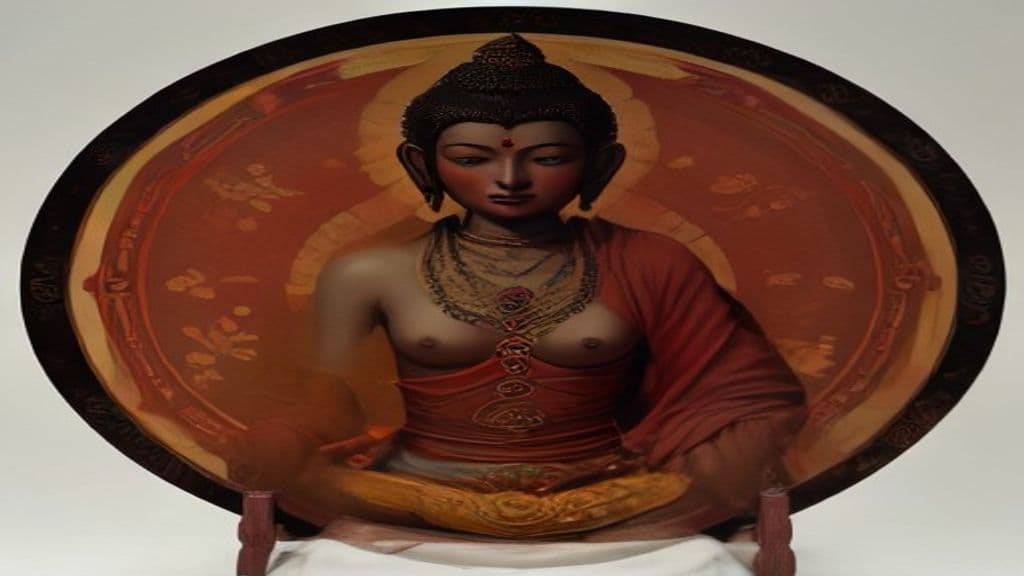
Maitreya (Pali: Metteyya) is the bodhisattva prophesied in Buddhist traditions to be the next fully awakened Buddha who currently resides in Tushita heaven and will be reborn on earth to re-establish the Dharma. In modern esoteric/Theosophical literature he is also depicted as an advanced spiritual teacher in a hidden hierarchy, a distinct framing from the classical Buddhist accounts.
Samantabhadra
Samantabhadra is a sacred name used across Indian-origin traditions. In Mahāyāna Buddhism it denotes a major bodhisattva associated with practice, vows, and the transfer of merit; in Tibetan Buddhism the name (Tibetan: Kuntu Zangpo) is also used for an Adi‑Buddha or primordial principle in Dzogchen contexts; separately, Samantabhadra is the name of a historical second‑century Digambara Jain monk and author of works such as the Ratnakaranda Gaurav.
Kim Gyo-gak
A historical Silla prince who became a Buddhist monk and is believed by Mount Jiuhua monks to have been the terrestrial manifestation (reincarnation) of the bodhisattva Ksitigarbha (Chinese: Jijang). His life at Mount Jiuhua is credited with transforming the mountain into a major Ksitigarbha sacred site.
Kōtuku
Kōtuku is the Māori name for the white heron (the eastern great egret, Ardea alba modesta) in New Zealand. The provided sources identify the term as the local name for this bird species but do not document mythological narratives or supernatural attributes in the cited material.
Kʼakʼ Tiliw Chan Yopaat
Kʼakʼ Tiliw Chan Yopaat was the ajaw (ruler) of the ancient Maya city-state Quiriguá who reigned in the 8th century AD. He is documented as having declared Quiriguá's independence from Copán, receiving the K'awiil sceptre at accession (734 AD), defeating Copán and capturing its ruler in 738 AD, and presiding over a prolific period of monumental sculpture at Quiriguá.
Kʼawiil
Kʼawiil is a named Maya deity personifying lightning, generative power, and political/ancestral potency. He appears in Classic and Post‑Classic iconography and codices connected with cosmogony, the release of maize and cacao seeds, and the legitimization of rulers.
Kʼinich Ahau
Kʼinich Ahau is the Classic and post‑Classic Maya sun deity — a personified solar force associated with the day, calendrical patronage, rulership/apotheosis, and a set of iconographic types (monumental stucco masks, codex imagery of 'God G', and aquatic/eastern sunrise scenes). He appears in epigraphic, colonial, and modern Lacandon traditions with overlapping cosmological roles rather than a single fixed persona.
Kʼinich Yax Kʼukʼ Moʼ
Kʼinich Yax Kʼukʼ Moʼ is the historically attested dynastic founder and first ruling kʼul ajaw of the Classic-period Maya polity centered at Copán (ruled 426–c.437 CE). He functions in the Copán inscriptional and monumental program as the sacred legitimizing ancestor of the dynasty; archaeological remains attributed to him were recovered from the Hunal tomb in Temple 16.
Kʼinich Yoʼnal Ahk I
Kʼinich Yoʼnal Ahk I was a historical ajaw (king) of the Classic Maya polity Piedras Negras who reigned from 603–639 CE. Monumental inscriptions and stelae portray him with royal solar titulary and record military victories, ritualized destruction of prior monuments, and his association with a mortuary pyramid identified as his burial (muk).
LGBTQ Themes in Hindu Mythology
Hindu mythology represents a diverse range of entities and themes that challenge traditional binary notions of sex and gender, reflecting the tradition's emphasis on diversity, inclusivity, and acceptance. (Note: - Power tier: Primordial is likely an overestimation; given that the sources describe LGBTQ themes as "not a distinct category" but rather a spectrum within Hindu mythology, it's unclear if these enti)
La Cegua
La Cegua is a Central American folkloric shapeshifting female apparition, commonly told in Nicaraguan and wider Mesoamerican oral traditions. She appears as an attractive woman from behind to lure certain men (notably drunk men and womanizers) along lonely roads at night, then reveals a horrifying true face—often described as a horse head or a skull—preceding harm or dire consequences. The figure functions primarily as a moral cautionary tale enforcing social norms around intoxication and sexual conduct.
La Chasse-galerie (The Flying Canoe)
A French-Canadian folktale about a bewitched or enchanted bark canoe that flies through the night after men make a pact with a malign supernatural agent (often identified as the Devil). The story functions as a Wild Hunt–type narrative fused with Indigenous legends of a flying canoe and serves as a moral test about taboos, sobriety, and bargaining with otherworldly powers.
La Condená
A sparsely documented feminine-named restless spirit attested in a small set of tertiary sources. The only clear descriptive line in the supplied corpus calls her a "ghost doomed to walk the earth in penance for carnal sins." Other claims about regional rooting or attributes come from a single unverified fandom entry and are not corroborated in the provided materials.
La Galigo
Supernatural being central to the Bugis creation myth, holding significant importance in their cosmology. (Note: - Summary is vague; more specific information about La Galigo's role in the creation myth would improve accuracy. - Power tier: Since there is no mention of "Primordial" abilities, it's unclear what t)
Community Record
- [1]Kṣitigarbha (Wikipedia). Wikipedia: Kṣitigarbha article (overview, iconography, sutra provenance, devotional practice)wiki
- [2]Earth Store (Kṣitigarbha) Sutra lecture series (YongHua 2009). Lecture series on the Kṣitigarbha Bodhisattva Pūrvapraṇidhāna Sūtra (used to document contemporary recitation and doctrinal emphasis)other
- [3]Kṣitigarbha Hall (Wikipedia). Wikipedia: Kṣitigarbha Hall (temple placement and funerary/memorial function)wiki
- [4]Xuanfa Institute — Ksitigarbha Sutra (text and chapter materials). Online sutra text and chapter materials (reference to the sutra as primary doctrinal source)literary
- [5]Reflections on the Ksitigarbha Sutra (ShapesInTheFog, parts 1 & 2). Contemporary reflections and commentary summarizing themes such as filial piety and the sutra's narrativeother
- [6]WorldWidePanorama — Pray to Ksitigarbha Bless for Family Peace. Temple/practice-focused page referencing devotional petitions to Kṣitigarbha for family peaceother
- [7]Buddha Museum — Vintage Chinese Gilt Bronze Ksitigarbha Ti-tsang Statue (object description). Material culture and iconographic description (statue attributes, regional variants)other
- [8]Archive: The 18 Root Bodhisattva Vows, Part 4 (video). Teaching material that references bodhisattva vows and their place in practice (context for vow language)other