
La Cegua is attested in regional oral tradition rather than a single codified origin myth. Sources present her as part of a family of Mesoamerican cautionary female apparitions (variants named Sihuanaba/Siguanaba/Sihuehuet and related figures like Xtabay) that recur across countries such as Nicaragua, El Salvador, Guatemala and Mexico. The collected materials emphasize the tale form and social function—stories passed in communities to deter risky male behavior—rather than a singular creation narrative or a fixed cosmological genealogy. Specific localized versions vary, and the assembled sources do not provide a consistent origin account beyond her embeddedness in oral moral instruction across the region.
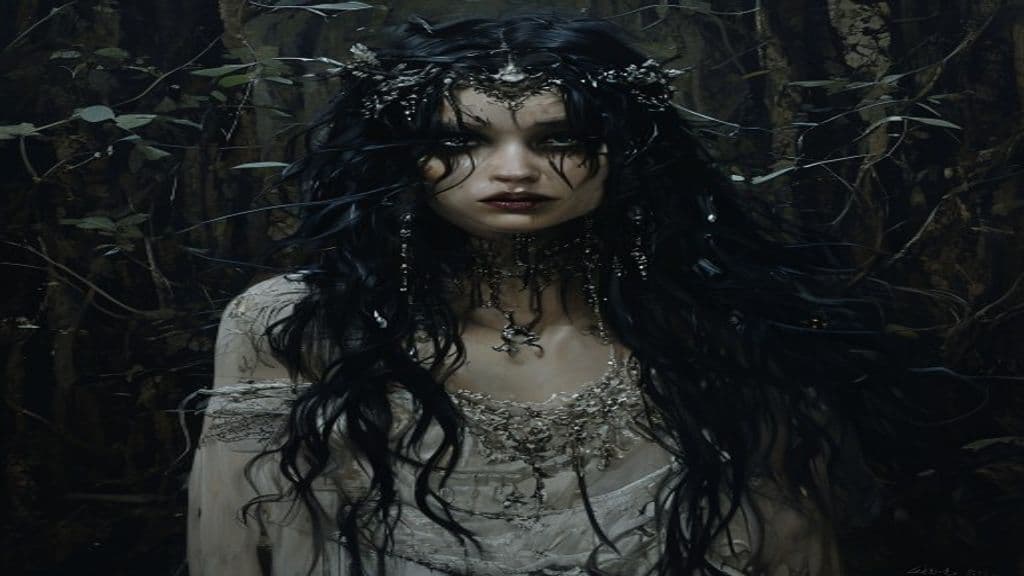
In the consistent motif reported across sources, La Cegua initially appears to a passerby as an alluring, long-haired woman—often described as very beautiful and commonly noticed from behind. When a victim approaches or follows, her true visage is revealed: accounts variously describe the face as that of a horse (sometimes specifically a horse skull) or alternately as a human skull. Modern retellings and contemporary cultural references sometimes emphasize the 'horse skull' image, but both horse-head and skeletal variants are recorded in the folkloric record. The dramatic transformation from feminine beauty (especially seen from behind) to a non-human or dead visage is the central visual hallmark.
Sources describe La Cegua primarily as a shapeshifting apparition whose salient behaviors are luring and exposing. She attracts certain men—notably those who are drunk or habitually womanizing—by appearing beautiful or by seeking their help, guides them along lonely roads at night, and then reveals her true face (horse head or skull). After the revelation the tale typically implies danger, harm, or death for the victim; the sources record the punitive, cautionary function more than detailed mechanics of assault or killing. The figure's power set in the cited materials is therefore limited to deceptive appearance, targeted luring, and the narrative consequence of dire outcomes for transgressing men.
Weaknesses
- conditionAvoidance by not walking alone at night
- conditionAvoidance by not being intoxicated (not walking drunk)
- conditionAvoidance by abstaining from mujeriego (womanizing) behavior
Wards
- conditionSocial/practical precautions (do not walk alone at night; avoid intoxication)
Xtabay
A supernatural being in Maya tradition, described as a 'demonic femme fatale' who preys upon men in the Yucatán Peninsula. (Note: 1. Power tier should be Primordial, as Xtabay's described abilities have no clear limits in the region and imply an otherworldly power. 2. Origin story: add that it is inferred from the context of May)

Sihuanaba
A Central American shapeshifting female spirit from regional oral tradition that lures solitary travelers—often portrayed as beautiful and long‑haired—into isolated or hazardous places before revealing a grotesque true form; the motif functions as a cautionary legend enforcing social norms.
Sihuanaba
A Central American shapeshifting female spirit from regional oral tradition that lures solitary travelers—often portrayed as beautiful and long‑haired—into isolated or hazardous places before revealing a grotesque true form; the motif functions as a cautionary legend enforcing social norms.
Kʼawiil
Kʼawiil is a named Maya deity personifying lightning, generative power, and political/ancestral potency. He appears in Classic and Post‑Classic iconography and codices connected with cosmogony, the release of maize and cacao seeds, and the legitimization of rulers.
Kʼinich Ahau
Kʼinich Ahau is the Classic and post‑Classic Maya sun deity — a personified solar force associated with the day, calendrical patronage, rulership/apotheosis, and a set of iconographic types (monumental stucco masks, codex imagery of 'God G', and aquatic/eastern sunrise scenes). He appears in epigraphic, colonial, and modern Lacandon traditions with overlapping cosmological roles rather than a single fixed persona.
Kʼinich Yax Kʼukʼ Moʼ
Kʼinich Yax Kʼukʼ Moʼ is the historically attested dynastic founder and first ruling kʼul ajaw of the Classic-period Maya polity centered at Copán (ruled 426–c.437 CE). He functions in the Copán inscriptional and monumental program as the sacred legitimizing ancestor of the dynasty; archaeological remains attributed to him were recovered from the Hunal tomb in Temple 16.
Kʼinich Yoʼnal Ahk I
Kʼinich Yoʼnal Ahk I was a historical ajaw (king) of the Classic Maya polity Piedras Negras who reigned from 603–639 CE. Monumental inscriptions and stelae portray him with royal solar titulary and record military victories, ritualized destruction of prior monuments, and his association with a mortuary pyramid identified as his burial (muk).
Kṣitigarbha
Kṣitigarbha (Sanskrit: क्षितिगर्भ; Chinese 地藏 Dìzàng; Japanese 地蔵 Jizō) is a Mahāyāna bodhisattva primarily venerated in East Asian Buddhism, known for a great vow to instruct and liberate beings in the six realms after the historical Buddha's parinirvāṇa and to postpone his own Buddhahood until all hells are emptied. He is central to funerary and memorial practice in East Asian temples and, in some regional adaptations, a guardian of children and deceased or aborted fetuses.
LGBTQ Themes in Hindu Mythology
Hindu mythology represents a diverse range of entities and themes that challenge traditional binary notions of sex and gender, reflecting the tradition's emphasis on diversity, inclusivity, and acceptance. (Note: - Power tier: Primordial is likely an overestimation; given that the sources describe LGBTQ themes as "not a distinct category" but rather a spectrum within Hindu mythology, it's unclear if these enti)
La Chasse-galerie (The Flying Canoe)
A French-Canadian folktale about a bewitched or enchanted bark canoe that flies through the night after men make a pact with a malign supernatural agent (often identified as the Devil). The story functions as a Wild Hunt–type narrative fused with Indigenous legends of a flying canoe and serves as a moral test about taboos, sobriety, and bargaining with otherworldly powers.
La Condená
A sparsely documented feminine-named restless spirit attested in a small set of tertiary sources. The only clear descriptive line in the supplied corpus calls her a "ghost doomed to walk the earth in penance for carnal sins." Other claims about regional rooting or attributes come from a single unverified fandom entry and are not corroborated in the provided materials.
La Galigo
Supernatural being central to the Bugis creation myth, holding significant importance in their cosmology. (Note: - Summary is vague; more specific information about La Galigo's role in the creation myth would improve accuracy. - Power tier: Since there is no mention of "Primordial" abilities, it's unclear what t)
La Guita Xica
La Guita Xica is a Catalan mule–dragon figure tied to the Patum de Berga Corpus Christi festivities. Historically described as threatening or demonic, twentieth-century traditions reframe it as a protective festival spirit embodied by large effigies that parade and theatrically spit fireworks.
La Llorona
The Weeping Woman of Mexican folklore — the ghost of a mother who drowned her children and now wanders rivers and lakes, weeping for them and taking other children she finds at night.
Community Record
- [1]Sihuanaba (Wikipedia: Cegua/Sihuanaba article). Wikipedia, 'Sihuanaba' / 'Cegua' entry — summary of shapeshifting woman who reveals horse or skull facewiki
- [2]La Cegua | USC Digital Folklore Archives. USC Digital Folklore Archives informant summary (La Cegua / Sophia Guzman) — notes appearance to drunk men and mujeriegos, night roads, moral functionfolk
- [3]The Enchanted Orchard, and Other Folktales of Central America. Folktale anthology listing 'The Cegua' and other Central American tales, providing regional tale contextfolk
- [4]Wikidata: Xtabay. Wikidata entry for 'Xtabay' — related Mesoamerican figure described as a beautiful woman who reveals true appearance and kills men (used for comparative context)wiki
- [5]La Cegua | Villains Wiki (Fandom). Villains Wiki (Fandom) entry synthesizing motif details (used cautiously alongside archival sources)other
- [6]These Vengeful Wishes (contemporary cultural reference mentioning horse skull motif). Publisher and event materials referencing 'La Cegua, a vengeful female spirit with the face of a horse skull' — evidence of motif persistence in modern retellingsliterary
- [7]Culture of Nicaragua (contextual background). Wikipedia: Culture of Nicaragua — background on blended cultural influences in regional folklorewiki