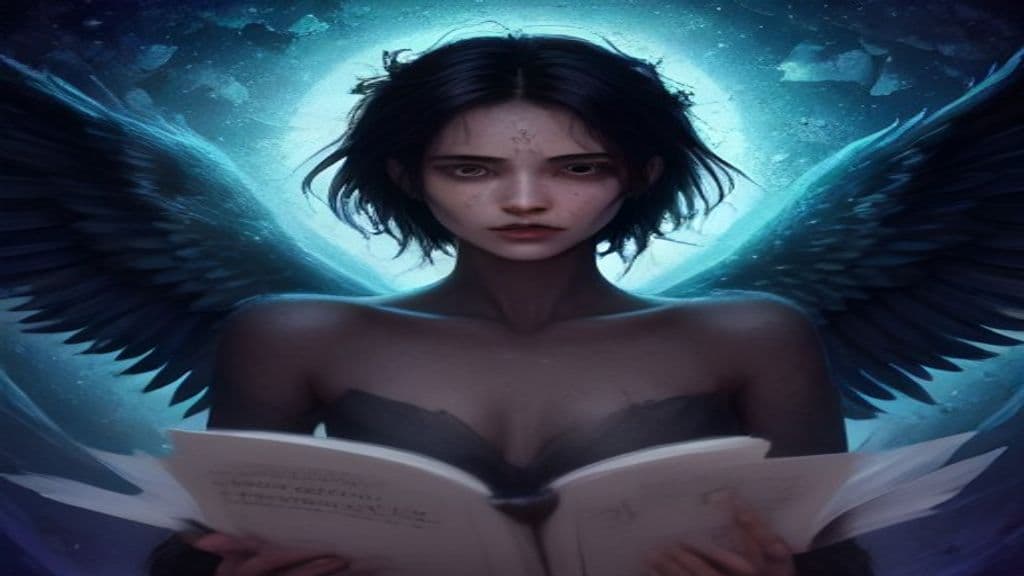
In the Book of Enoch tradition Kokabiel appears as one of the leaders of the two hundred Watchers who "descended... in the days of Jared on the summit of Mount Hermon" and there "swore and bound themselves by mutual imprecations." That collective descent and oath is narrated etiologically as the origin of transgressive revelation (including instruction in hidden arts) and of the demoralisation of humankind prior to the Flood. Later angelological summaries and modern compilations preserve his name and associate him with teachings about the heavens, but the primary Enochic attestation is the roster and the Mount Hermon episode.
The primary Enochic fragment supplied lists Kokabiel among named leaders but does not provide a physical description. No consistent traditional bodily form or characteristic appearance is recorded in the provided Enochic excerpt. Modern artistic and fictional treatments (e.g., Angelarium concept art, fandom reuses) portray Kokabiel imaginatively (sometimes as a radiant or star‑themed angelic figure), but those are contemporary reinterpretations and not descriptions attested in the supplied ancient text.
Within the supplied sources Kokabiel's primary attributed agency is the revelation or teaching of celestial knowledge: modern summaries and glossaries describe him as the teacher of constellations/astrology. The Book of Enoch context places him among the Watchers who disclosed forbidden arts and thereby contributed to human corruption. Some modern reference summaries (reported in Wikipedia and later catalogues) additionally state that Kokabiel is called the "angel of the stars" and report claims such as commanding large numbers of spirits; such numeric or command‑of‑hosts details are present in modern summaries but are not attested in the supplied Enochic excerpt itself.

Kneph
Egyptian god and motif of divinity, representing creation, fertility, and spiritual growth. (Note: - Power tier: Reduce to Greater, as there's no indication of cosmic or deity-level power. - Abilities: Remove mention of specific abilities and behaviors, as source does not support this claim. - Weak)
Knocker
A small mine-associated spirit from British and American mining folklore, known for producing knocking sounds in underground workings that miners interpreted as warnings or communications. Variants and cognates appear across Cornwall, Devon, Wales, Staffordshire and in American mining communities (Tommyknockers).
Knucker
A type of water dragon in Germanic tradition, said to inhabit knuckerholes in Sussex, England. (Note: 1. Power tier should be changed to Lesser, as the Knucker is described as a local water spirit. 2. Add sensory cues from knuckerholes in Sussex, England (e.g., strange noises, eerie feelings). 3. Note)
Knull
Knull is a primordial godlike being from Marvel Comics who predates the current (seventh) iteration of the universe, creator and would-be sovereign of the symbiote race known as the Klyntar, and wielder of the ancient weapon All-Black the Necrosword. He functions as a cosmic antagonist whose aims center on darkness and the destruction or domination of created light.
Kobold
The German household and mine spirit — a mischievous but potentially helpful small being who attaches to a household, bringing luck or disaster depending on how it is treated.
Koka and Vikoka (Hindu tradition)
Asura brothers, twin generals serving their brother Kali in battle against the 10th avatar of Vishnu, Kalki. (Note: - Power tier should be Greater (deity-level strength as twin generals supporting their brother, a powerful deity) - No information about sensory cues or wards and weaknesses; these should be removed -)
Kokko
Kokko is an item name that appears in discussions of Finnish mythology but is not described in the single provided source. The available material situates Kokko within the broader corpus of Finnish pagan folklore without providing specific details about its nature, appearance, or associated practices.
Kokum (Grandmother spirit)
No information about Kokum (a grandmother spirit in Algonquin tradition) is present in the single provided source. The supplied source (a Wikipedia entry for Joshua Whitehead's novel Jonny Appleseed) does not mention Kokum, Algonquin beliefs, or any grandmother spirit, so no factual claims about Kokum can be drawn from it.
Kola Sanni Yaka (Sanni yakuma / Daha ata sanniyas)
A set of ritual spirits invoked in the Sinhalese Sanni yakuma (Daha ata sanniyas) exorcism; understood as spirit-beings responsible for specific illnesses and addressed through a sequence of 18 masked dances that identify, confront, and banish the afflicting spirits.
Kola kanda
Kola kanda is a traditional Sri Lankan herbal congee (porridge) used as a breakfast food and in folk medicinal practice. Sources provided do not support treating 'Kalu Kandha' as a supernatural being; instead the documented term in the sources is the culinary/medicinal preparation 'Kola kanda'.
Kolanthes (Kolanthes the Child)
Kolanthes is a late‑period Egyptian local child deity documented in the Akhmim/Athribis circle (ninth Upper Egyptian nome). Attested in Greek, Demotic and hieroglyphic inscriptions and a hymn, he appears as a member of a local patron triad and is identified with the divine child motif (Horus) and called 'the child of Osiris and Isis'.
Komainu
Komainu (狛犬) are paired lion- or dog-like guardian statues placed at thresholds of Shinto shrines (and sometimes temples, noble residences, or private homes) in Japan. As apotropaic architectural figures they ward off evil and mark liminal boundaries; their paired 'a-un' mouths symbolize beginning and end.
Community Record
- [1]Kokabiel — Wikipedia. Wikipedia entry 'Kokabiel' (summarizes name etymology, 'angel of the stars', teaching of constellations, and modern attributions)wiki
- [2]Wikidata: Kokabiel. Wikidata item for Kokabiel (identifier and cross‑references)wiki
- [3]The Book of Enoch (excerpt: Mount Hermon roster of Watchers). Enochic fragment listing Kokabiel (Kôkabîêl) among the leaders and narrating the descent on Mount Hermon and the mutual imprecation (source excerpt supplied in research notes)literary
- [4]Kokabiel — Imaginova Glossary entry. Glossary summary describing Kokabiel as associated with stars and teaching constellationsother
- [5]Kokabiel — HellHorror demon name entry. Modern demonology catalog entry repeating name, star association, and later demonological attributionsother
- [6]Angelarium: Kokabiel, the Burning Light (concept art / modern reinterpretation). Contemporary artistic reinterpretation that depicts Kokabiel with astral/light motifs (creative modern source)other