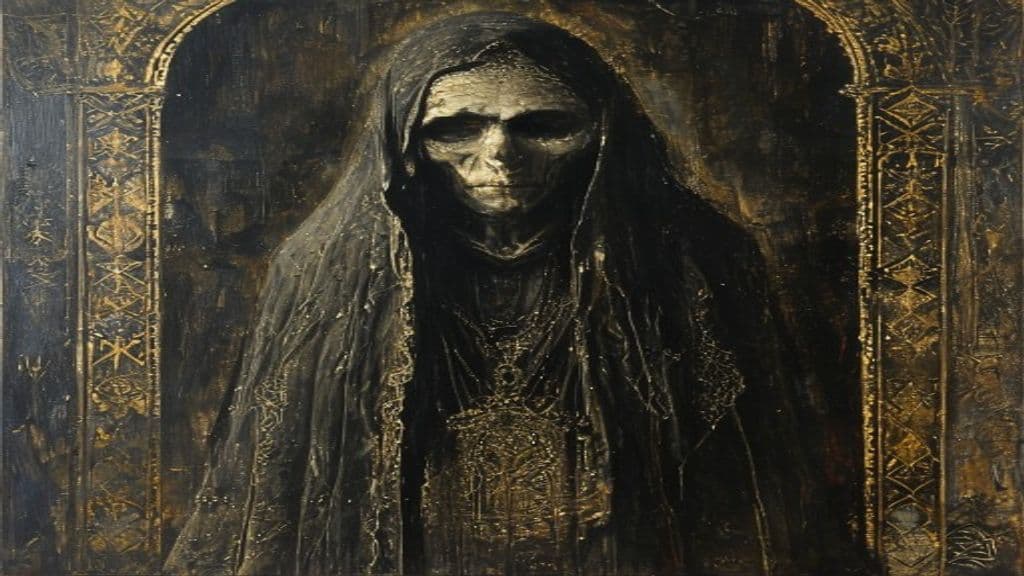
The Kriwe is associated with the old Baltic religion and was later adopted by the neo-pagan movement Romuva, suggesting a connection to pre-Christian Lithuanian culture.
No physical description is available due to the lack of reliable written evidence.
As a title or role, abilities and behaviors are not explicitly stated in the source material. The Kriwe would likely possess significant authority and influence within the region as a chief priest.
Weaknesses
- unknownUnknown
Wards
- unknownUnknown
Koyash
Koyash is the personified Sun and a solar deity in Turkic and related Turco‑Mongolian cosmologies. Regarded as one of the visible Tenger (heavenly beings), Koyash functions as a life‑giving intermediary whose rays connect Tengri to living spirits and who participates in cosmic creation.
Kraken
A legendary enormous sea monster from northern European (particularly Norwegian) maritime tradition, conceived as a deep‑water, tentacled hazard blamed for pulling down ships; later writers and naturalists often equated it with very large cephalopods (giant squid) or with other medieval sea‑monster names such as the hafgufa.
Krampus
Krampus is a horned, hairy, anthropomorphic figure from Central and Eastern Alpine folk practice who serves as the punitive companion to Saint Nicholas during the winter festival cycle; he appears on Krampusnacht (5 December) and in public Krampuslauf/Perchtenlauf processions to threaten or punish badly behaved children.
Krasue
A nocturnal Southeast Asian female spirit typically depicted as a floating, disembodied woman's head with internal organs trailing beneath the neck. The figure forms part of a regional cluster of related body-detaching female spirits and is presented in local traditions as a transformed or cursed human who leaves the living body by night to seek food.
Kreios
Kreios (also attested Crius or Krios) is a figure in classical Greek mythology identified in the supplied sources as one of the Titans, offspring of Uranus (Sky) and Gaia (Earth). The available material provides only genealogical identification and an etymological gloss that the name means "ram."
Krishna
Krishna (Sanskrit: Kṛṣṇa) is a major Hindu deity presented in the supplied sources both as the eighth avatāra of Vishnu and, in many traditions, as the Supreme Being (Svayam Bhagavān). He appears in a range of roles—child, cowherd, lover, charioteer, teacher and divine hero—and his life episodes (Krishna-līlā) are central to bhakti devotion, performance arts, and pilgrimage traditions.
Krodhavasa
Krodhavasa (Sanskrit: Krodhavaśā) is a mythological ancestress in the Puranic/Daksha–Kashyapa genealogies, wife of the sage Kasyapa and mother of a class of ferocious creatures called the Krodhavashas. Her name, derived from krodha (anger, wrath), is used etiologically to explain the ferocious temperament and sharp-toothed nature of certain animals, birds, and fish in epic–Puranic literature.
Kroni
In Ayyavazhi scripture Kroni (Tamil: குறோணி) is the primordial manifestation of evil: a first-born, cosmic antagonist who is fragmented into six pieces that reappear across successive yukams (ages) as principal evils opposed by the god Mayon (Vishnu) and his avatars.
Kshetrapala
Fierce guardian deity of fields, village boundaries, and agricultural territory — an aspect of Shiva or Bhairava who punishes trespass with epidemic illness and crop failure. Every North Indian village once had a Kshetrapala shrine at its boundary stone; his is the first rite performed before plowing season.
Kuafu (夸父)
Kuafu is a mythic giant in Chinese tradition known for attempting to chase and capture the Sun; his pursuit is used etiologically to explain landscape features (drained rivers, a peach forest, and in some versions a mountain range) and proverbially as an emblem of audacious but ultimately futile striving.
Kubai (Kübey)
Kubai (Turkish: Kübey) is a maternal birth and child-protecting figure in Turkic mythology. Traditionally described as a daughter of Kayra who lives in the Ulukayın (world tree) and draws life-water (Bengisu), she bestows souls, gives healing milk to newborns, eases birth pains, and guards infants until key developmental milestones.
Kubera
Kubera is the Hindu deity associated with wealth and the lord-king of the semi-divine yakshas, serving as the regent (dikpala) of the north and a protector of the world. His character evolves in textual history from a chief of evil spirits in Vedic sources to a respected lokapala and patron of wealth in later Puranic and epic literature.
Community Record
- [1]Wikipedia: Kriwewiki