
Kunekune originated as a short horror story posted on Japanese Internet message boards (notably 2channel) in 2001 and spread through first-person eyewitness-style retellings and online discussion. Rather than deriving from premodern Shintō or Buddhist cosmologies, the being was created and propagated within online communities and later referenced in lists of Japanese urban legends and in popular-media adaptations.
Consistently described as a slender, white humanoid shape resembling paper or fine fabric (often rendered as a "paper mannequin" or piece of cloth). Its materiality is likened to paper or fabric, and its defining visual trait is continuous, wind-defying wriggling or twisting of limbs and body, giving the impression of perpetual motion even on still days.
Primary behavior is constant writhing or twisting motion; it is said to linger in wide rice fields and open agricultural expanses during hot summer midday hours. Sources do not document consistent canonical supernatural powers, aggression, possession, or ritualized effects; many treatments emphasize sightings and atmosphere. Alternative, non-supernatural explanations proposed in sources include misidentification of scarecrows or textiles, wick drains, thick fog over paddies, or hallucinations from heat stroke and dehydration.

Slender Man
The Slender Man is an internet-created fictional supernatural figure (a creepypasta/Internet meme) originating on the Something Awful forum in June 2009. Within online participatory horror culture he functions as a tall, unnaturally thin humanoid associated with liminal spaces, stalking and traumatizing victims—especially children—and whose attributes and motives remain deliberately vague and collaboratively expanded.
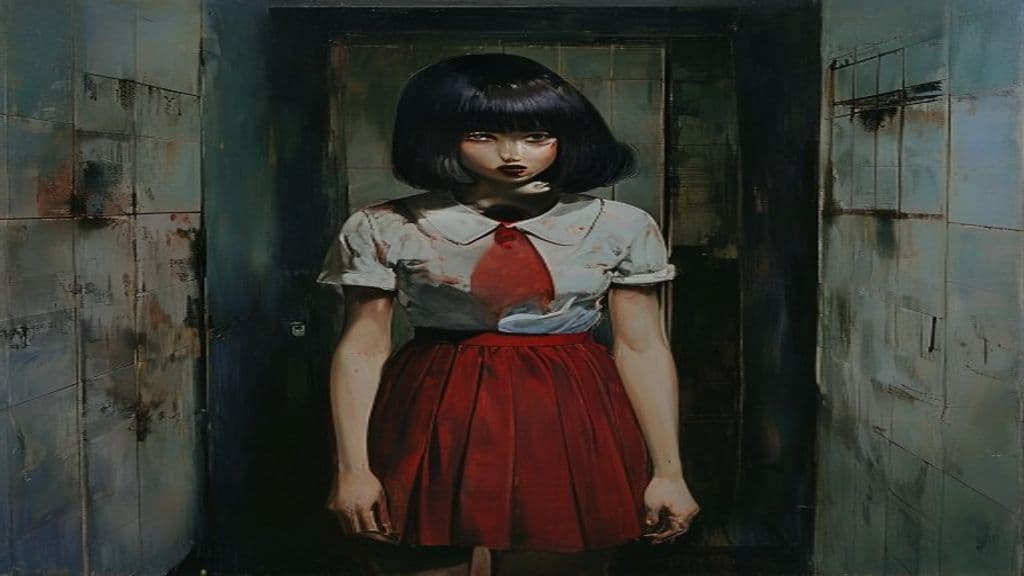
Hanako-san
Hanako-san (Toire no Hanako-san) is a modern Japanese urban-legend spirit said to haunt school toilets. Commonly framed as the ghost of a young girl associated with a particular stall/floor of a school lavatory, the figure is transmitted chiefly in school settings and popular media and is described variously as a yūrei or a yōkai.

Hasshaku-sama
Hasshaku-sama (八尺様) is a contemporary Japanese urban-legend figure depicted as a very tall, pale womanlike spirit associated with isolated rural zones; circulating since the late 2000s in internet folklore, she is said to target children and young people and is warded in stories by sealed rooms, talismans, salt, and boundary Jizō statues.
Kumakatok
The Kumakatok are a trio of robed, hooded door‑knockers in Philippine popular belief who visit houses at night; their knock is regarded as an omen of imminent death for the household, typically affecting the eldest member or someone already ill. Reports situate them chiefly in Luzon and the Visayas and record a vernacular practice of painting white crosses on doors to keep them away.
Kumbhakarna
Kumbhakarna is a gigantic rakshasa featured in the Hindu epic Ramayana as a younger brother of Ravana, famed for prodigious size, an enormous appetite, great martial prowess, and a supernatural sleep pattern produced by a divine curse/boon; he recognizes Rama's divinity but fights out of loyalty and is slain by divine weapons during the war.
Kumbhāṇḍa
Kumbhāṇḍas are a class of dwarfish, misshapen lesser deities or spirit-entities in Buddhist cosmology, commonly listed among the retinues of the Four Great Kings and placed under the Guardian of the South (Virūḍhaka). Their name and traditional imagery link them to gourd- or pot-like bodily forms.
Kumu-Honua
The first man in Hawaiian creation myth, considered a divine or semi-divine figure. (Note: 1. Power tier should be Primordial, as it's a creator figure and not explicitly described with deity-level powers. 2. Abilities section needs to be rewritten or deleted since there are no specific des)
Kumulipo (Hawaiian creation chant and genealogy)
A sacred text holding cultural and historical significance in Hawaiian tradition, recounting the creation of the world and the genealogy of Hawaiian royalty. (Note: 1. Power tier: The Kumulipo does not possess supernatural powers or abilities, making it more likely a Minor Spirit (weak) rather than Primordial. 2. Abilities: Clarify that the Kumulipo's "power" lie)
Kumush
Kumush is attested in the supplied source as a creator god in Modoc cosmology. The available documentation for this entry is limited to that classificatory label; no further attributes, myths, or local traditions are recorded in the provided source.
Kung Jin
Kung Jin is a modern fictional character from the Mortal Kombat video game franchise (debuting in Mortal Kombat X, 2015). He is presented as a Shaolin-trained archer and relative of Kung Lao who joins a new generation of Earthrealm defenders; he is a human narrative character created by NetherRealm Studios, not a traditional spirit or folkloric entity.
Kung Lao
Kung Lao is a fictional Shaolin monk and human warrior character from the Mortal Kombat video game franchise, introduced in Mortal Kombat II (1993). He is presented as one of the last descendants of the Great Kung Lao, a protector of Earthrealm and ally of Liu Kang, notable for his wide razor-brimmed hat used as a weapon and for participating in inter-realm Mortal Kombat tournaments.
Kunthunātha
Kunthunātha (also spelled Kunthunath or Kuntunatha) is the seventeenth Tirthankara of the present half time cycle (Avasarpini) in Jain tradition. He is described in canonical lists as having become a siddha (a liberated soul) and is also recorded as the sixth Chakravartin and the twelfth Kamadeva of the current half-cycle.
Kuntilanak (Pontianak)
A Malay‑world female revenant or vengeful spirit associated with women who died in childbirth or stillbirth; depicted as a pale, long‑haired woman in a blood‑stained white dress who preys on the living (men, pregnant women, women in childbirth, and in some variants virgins/young women). The figure appears across Indonesia, Malaysia, Singapore and neighboring areas and features in oral tradition and popular media.
Kupe
Legendary Māori explorer and ancestral figure credited with being one of the first to discover New Zealand. (Note: 1. Power tier should be Ancient (as a legendary explorer and ancestral figure) rather than Primordial. 2. Summary is somewhat accurate, but could be more concise and focused on Kupe's role as an explo)
Kupua
In Hawaiian mythology, Kupua are a group of supernatural entities considered gods or spirits with unknown powers and behaviors. (Note: * Power tier should be Primordial (cosmic-level) given their deity-like status in Hawaiian mythology * Summary should reflect that Kupua's powers and behaviors are not unknown but rather not well-docu)
Community Record
- [1]Kunekune (urban legend) — Wikipedia. Wikipedia, 'Kunekune (urban legend)'wiki
- [2]Kunekune | Scary For Kids. Scary For Kids, 'Kunekune'other
- [3]Kunekune | Bloodstained Wiki | Fandom. Bloodstained Wiki (Fandom), 'Kunekune' (game adaptation reference)wiki
- [4]Japanese urban legends — Wikipedia. Wikipedia, 'Japanese urban legends' (context on modern urban-legend circulation)wiki