
Born in Ayodhya to King Dasharatha and Queen Sumitra, Lakshmana is the twin brother of Shatrughna and the younger half-brother of Rama. He marries Urmila. In the Puranas he is identified as an incarnation of Shesha, the multi-headed naga upon whom Vishnu rests, which places his human life within a cosmological framework as the attendant of the Rama incarnation of Vishnu.
The provided sources do not supply a detailed physical portrait. Instead they emphasize Lakshmana's relational epithets (Saumitra — 'son of Sumitra'; Ramanuja — 'younger brother of Rama') and his roles as attendant, guardian, and warrior rather than specific bodily description.
Lakshmana is portrayed as an accomplished warrior, vigilant guardian, and devoted attendant. He accompanies Rama and Sita throughout the fourteen-year exile, draws a protective boundary around the hut (the narrative motif of the 'Lakshmana Rekha'), engages in combat with forest and rakshasa opponents (Tataka, Maricha, Subahu, Surpanakha), and fights in the war against Ravana. During the Lanka campaign he is mortally wounded by Meghanada/Indrajit and is later revived through the sanjeevani herb brought by Hanuman; after recovery he participates in slaying Indrajit (Meghanada) and Atikaya. He exemplifies endurance, vigilance, and self-sacrifice rather than invulnerability.
Weaknesses
- conditionmortality (can be mortally wounded in battle)
- otherrequires external healing (revived by sanjeevani herb brought by Hanuman)
Wards
- symbolLakshmana Rekha (narrative protective boundary drawn by Lakshmana around the hut in exile)
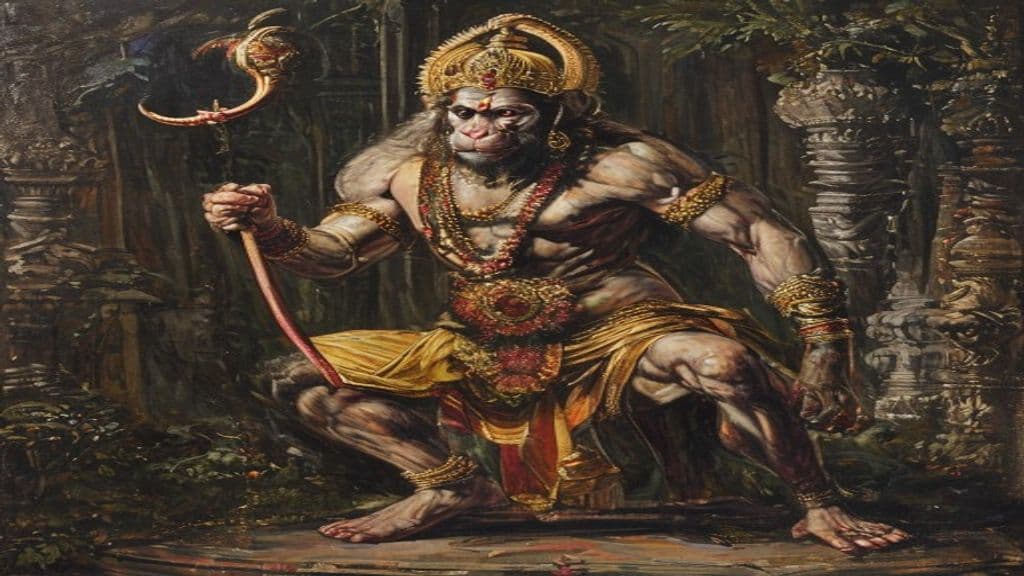
Hanuman
Hanuman is a divine vanara (monkey‑like being) in Hindu literature, foremost companion and devoted servant (Rama-dūta) of Lord Rama in the Ramayana. Revered in later Bhakti traditions, he is worshipped as a protector and exemplar of devotion, strength, and service.
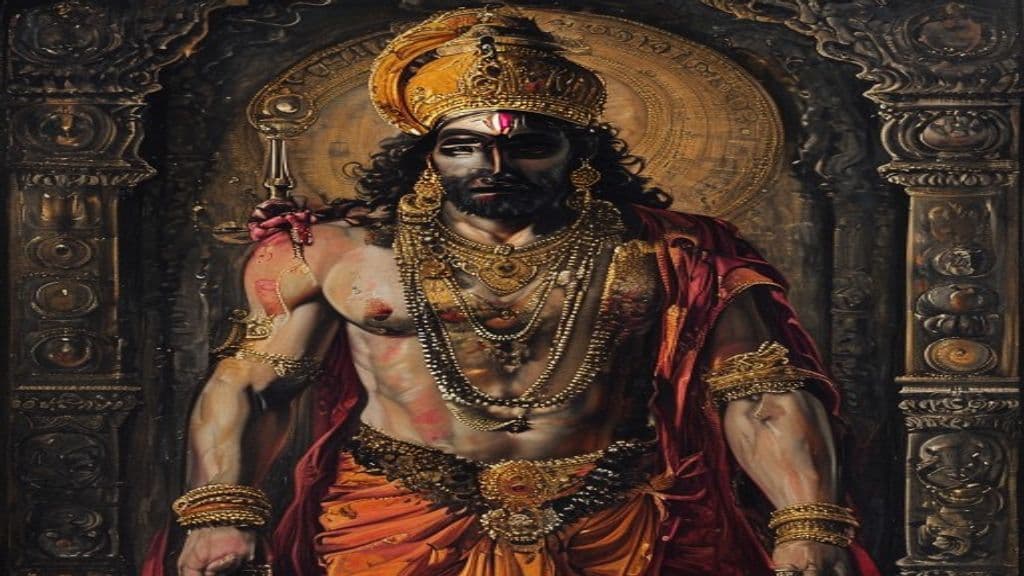
Rāma
Rāma is a major divine-hero in Hindu tradition, worshipped as the seventh avatar of Viṣṇu and the central protagonist of the Ramayana. He is portrayed both as the ideal man (maryāda puruṣottama) and, in Rama-centric sects, as the Supreme Being; his life-story (birth in Ayodhyā, 14-year exile, Sītā's abduction, and the defeat of Rāvaṇa) functions as a primary exemplar of dharma.
Añjanā
Añjanā (Sanskrit: अञ्जना; also Anjani, Anjali) is a semi-divine figure of the Ramayana cycle, described as an apsara reborn among the vanaras and the mother of the hero Hanuman. She figures both in pan-Indian epic narratives (as wife of Kesari and devotee of Vayu) and in regional cultic practice (notably a temple tradition in Himachal Pradesh) and is adapted in Javanese wayang as Dewi Anjani.
Kusha
Kusha (Sanskrit: कुश, IAST: Kuśa) is the elder of the twin sons of Rama and Sita in the Hindu epic the Ramayana. Presented in canonical Uttara Kāṇḍa material as a human prince raised at Valmiki's ashram, he functions as an heir and founder-king who preserves dynastic continuity and helps transmit the Ramayana as a cultural text; a small number of later or regional variants give alternate birth legends or expanded territorial claims.
Kuśadhvaja
Kuśadhvaja is a human royal figure in the Ramayana tradition, described as the younger brother of King Janaka of Mithila, husband of Chandrabhaga, and father of Mandavi and Shrutakirti. He is named as King of Samkasya after Janaka defeats Sudhanvan and appears in the narrative context of the Sita–Rama marriage.
Nila
Nila (Sanskrit: नील, Nīla; also spelled Neela) is a vanara chieftain in the Ramayana epic, described as commander‑in‑chief of the vanara army under Sugriva who leads troops in the war against Ravana and participates in the search for Sita and the building of the Rama Setu in some traditions.
Sanjna
Sanjna (also Samjñā, Saranyu) is a Hindu goddess best known as the chief consort of the sun-god Vivasvant/Surya whose mythic actions (flight, transformation into a mare, and leaving a substitute/Chhaya) link her to themes of motion, identity, and the origins of several important progeny (Yama, Yami, Manu, the Ashvins).
Sati
Sati (Sanskrit: सती) is a Hindu goddess traditionally identified as the daughter of Daksha and the first wife of Śiva. In the sources provided she functions as a divine exemplar of marital felicity, chastity, and longevity; her self‑immolation at Daksha's sacrifice is a pivotal Puranic episode that shapes later narratives in which she is identified with Dakshayani and with the goddess who later appears as Parvati.
Laka
A 'popular hero' in Hawaiian mythology, associated with heroic qualities. (Note: * Power tier should be revised to Greater or Ancient since it's referred to as a "popular hero" and is associated with heroic qualities, suggesting a higher power level. * Appearance should state that)
Lakanica
A traditional Polish folkloric field or meadow spirit described as a shy, elusive creature that can appear in human female form. It is presented in sources as part of the broader family of Western Slavic nature spirits related to ovily/rusalki but lacks detailed folkloric accounts in the supplied material.
Lake monster
A lake monster is a lake-dwelling creature in myth, folklore, and modern reports; treated as a recurring narrative motif (not a single species) that ranges from older kelpie-like horse or serpentine beings to modern reptile/plesiosaur-like sightings such as Nessie, Champ, and Ogopogo.
Lakshmi
Lakshmi is a principal Hindu goddess who personifies śrī (auspiciousness) and is revered as the giver of fortune, wealth, prosperity, beauty, fertility, sovereignty, and abundance. She is the consort and shakti of Vishnu in Vaishnavism, part of the Tridevi with Parvati and Sarasvati, and is the focus of popular devotional and festival practices such as Lakshmi Puja during Deepavali and Navaratri.
Lalli
A historical figure from Finnish medieval legend, responsible for killing Bishop Henry in the late 1150s. (Note: - Power tier: Greater (not Lesser), as Lalli's actions have significant historical and cultural impact. - Sensory cues: none mentioned in source material, so should be deleted or clarified. - Weakness)
Lalo-Honua
In Hawaiian mythology, Lalo-Honua is considered the 'first woman' and a foundational feminine principle associated with creation. (Note: * The source material only confirms that Lalo-Honua is considered the "first woman", but does not explicitly state a Primordial power tier. * No information about appearance, abilities, sensory cues, )
Community Record
- [1]Lakshmana - Wikipedia. Wikipedia, 'Lakshmana' (entry on name, epithets, role in Ramayana, incarnation of Shesha, Urmila Nidra, sanjeevani episode)wiki
- [2]Wikidata: Lakshmana. Wikidata entry for 'Lakshmana' (identifier and modern name-bearer references)other
- [3]High Court for State of Telangana - HBHC010101371998 (2005-09-22). Archive.org copy of a High Court judgment mentioning modern personal name 'Lakshmana' in administrative context (not a source on the epic figure)other
- [4]High Court for State of Telangana - HBHC010481791998 (2007-03-22). Archive.org copy of a High Court judgment with occurrences of the personal name 'Lakshmana' (administrative/legal context)other
- [5]High Court for State of Telangana - HBHC010505542005 (2005-09-21). Archive.org copy of a High Court judgment referencing the name 'Lakshmana' (modern usage of the name)other