
Poludnitsa is not presented in the sourced material as a single originated mythic genealogy but as a longstanding folk personification of midday and sunstroke across Slavic rural traditions. The name derives from roots meaning 'half-day' or 'midday' (Polud-/Połud-), placing her as the spirit of the temporal moment of noon. In some accounts she is grouped with other time-linked female spirits (morning/evening/night sisters) that together order parts of the day in popular cosmology.
Across sources Poludnitsa is most commonly pictured as a young woman dressed in white who roams field bounds; regional variants portray her as an old hag, a beautiful woman, or a twelve-year-old girl. Motifs vary by region: she may be seen surrounded by whirling dust clouds and carrying a scythe, sickle, or shears; a northern Russian variant is reported to carry a giant frying pan; an Upper Silesian Cornflower Wraith (Chabernica) variant is described as a slim woman in azure with cornflowers in her hair. These features are presented in the sources as local or tale-specific variants rather than universal attributes.
Sources portray Poludnitsa primarily as an agent that harms or endangers people who work or rest in tall grain at midday. She is described as causing heatstroke-like symptoms (headache, paralysis, neck pains, madness) and in some tale-variants as inflicting broken limbs, neck injury, or decapitation if victims fail tests set by her. A common motif has her stopping people to ask difficult questions—failure or evasion invites violent punishment. She may abduct or lead astray children in fields and can compel girls to dance with her until evening; outcomes vary regionally (forced exhaustion and danger, or in some tales a reward such as a rich dowry if the human wins). Some local traditions attribute agency over grain itself (blocking sun from rye or burning it) or offer exceptional motifs (showing a flower that grants invisibility in one Arkhangelsk account). Many sources explicitly characterize her as a personification of sunstroke.
Weaknesses
- conditiontaking the midday break during the Angelus (midday prayer)
Wards
- ritualmidday Angelus break (pause from work during Angelus)
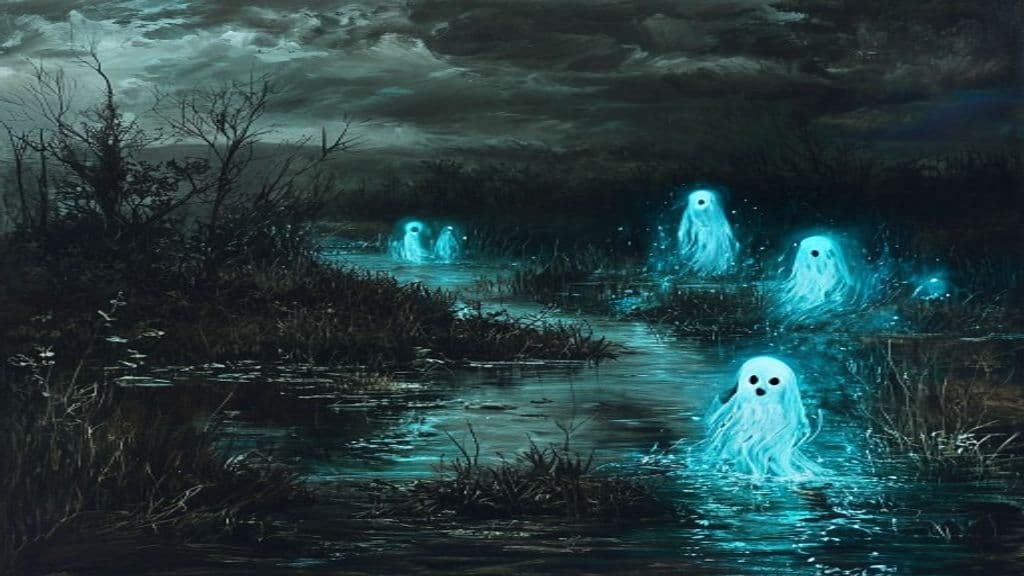
Will-o'-the-Wisp
A wandering light seen over marshy ground at night, leading travellers astray into bogs and fens. Possibly a spirit, possibly the soul of the unbaptised dead, possibly the devil himself.

Cornflower Wraith
A Slavic field spirit associated with midday who enforces proper conduct in cultivated grain. Described as a young woman in azure with cornflowers in her hair, she punishes workers who trample crops or use sharp tools at the wrong time, often by inducing sleep followed by pain or by causing broken limbs.
Baba Yaga
Baba Yaga is an ambivalent female figure of East Slavic folktale tradition, depicted variously as a fearsome, child-eating crone or as a helpful, maternal donor. She is associated with the deep forest, a hut described as standing on chicken legs, and the motific accoutrements of a mortar and pestle.
Bald Mountain (Slavic)
A location in Slavic folklore associated with witchcraft and the Witches' Sabbath. (Note: 1. Power tier should be Primordial since it's associated with witchcraft and has connections to deities (witches are often seen as having deity-level powers). Greater is too low of a power level. 2. A)
Bannik
A place-bound spirit of the Slavic banya (bathhouse) that inhabits the steam room and related spaces; he mediates divination, presides over births within the banya, and must be appeased by offerings or he may harm or otherwise vex users and the building.
Boginka
A Slavic/Polish female nature-spirit category: personifications of wild natural forces (forests, fields, mountains, fresh and sea waters) that appear in folklore as ambivalent beings—often hostile toward humans, especially pregnant women and infants, but also recalled in some sources with neutral or protective aspects.
Błędnica
A Slavic forest demoness who misleads travelers, abandoning them deep in the woods to die of exposure, starvation, or be taken by wild animals. She is typically depicted as a young, attractive woman and is countered in tradition by strong spells or by making sacrifices at home or during the hunt.
Cornflower Wraith
A Slavic field spirit associated with midday who enforces proper conduct in cultivated grain. Described as a young woman in azure with cornflowers in her hair, she punishes workers who trample crops or use sharp tools at the wrong time, often by inducing sleep followed by pain or by causing broken limbs.
Fiery Serpent (Slavic)
A supernatural entity from Slavic folklore, described as a manifestation of fire in the sky or air. (Note: 1. Power tier should be adjusted from Primordial to Ancient, as it appears to be a deity-level entity rather than a cosmic one. 2. Add sensory cues for sounds associated with the entity (e.g., roaring)
Firebird (Slavic folklore)
A marvelous luminous bird from Slavic folktales, the Firebird (zhar-ptitsa) is a glowing, often fire‑colored bird whose appearance initiates quests and whose possession brings both wonder and misfortune. It functions as a coveted wonder and a dangerous omen within tale cycles.
Geira
In Slavic tradition, Geira was a Wendish princess attested by Old Norse sagas who ruled over territory near the border of Germania and married a young Óláfr Tryggvasonr. (Note: * Power tier: Not provided in source material, but can be inferred as Primordial given the lack of detailed information and Geira's significance in Old Norse sagas. * Summary: Inaccurate; correct summ)
Hag
A hag is a folkloric figure typically depicted as an old, wizened woman who appears across European traditions in multiple roles: a nightmare spirit, a witch-like or fairy-type being, a river or household monster, or (in some cases) a form adopted by sovereignty or storm goddesses. The figure functions variously as a cautionary monster, an explanation for sleep paralysis and nightmares, and a liminal test-figure in myth.
Kikimora
A female house spirit in Slavic folklore that functions as a domestic agent: helpful in well-kept homes and disruptive or dangerous where household morals or order fail. Variants include a domestic (house) kikimora paired with the domovoy and a swamp (bolotnaya) kikimora associated with marshland spirits.
Koschei the Deathless
Koschei (also Koshchei, Kashchei), commonly called "the Deathless" or "the Immortal," is an archetypal male antagonist in Russian and wider Slavic folklore. He functions in folk narratives as a legendary villain whose name and legend persist into modern cultural works and references.
Community Record
- [1]Lady Midday. Wikipedia: 'Lady Midday' article (accessed in research notes)wiki
- [2]Lady Midday (Wikidata entry). Wikidata: label and short description as personification of sunstrokewiki
- [3]Upper Silesian Cornflower Wraith / 'Chabernica' motif noted in Lady Midday article. Wikipedia: description of Cornflower Wraith and Angelus midday break prevention customwiki
- [4]Non-academic online retellings and motif lists (used for corroboration of variants). Fandom: variant summaries and motif corroboration cited among research notesother