
Sources do not supply a cosmogonic or origin myth for the Lakanica. The available material situates Lakanica within a cultural pattern in Western Slavic and Polish folklore of personified landscape spirits tied to particular features of the natural world (here, fields and meadows). Scholar Alanna Muniz, as cited in the Wikipedia entry, places Lakanica among a range of ovily/rusalki-type spirits that occupy water- and land-related locales; beyond this classificatory placement, no origin narrative or creation account for Lakanica is recorded in the supplied sources.
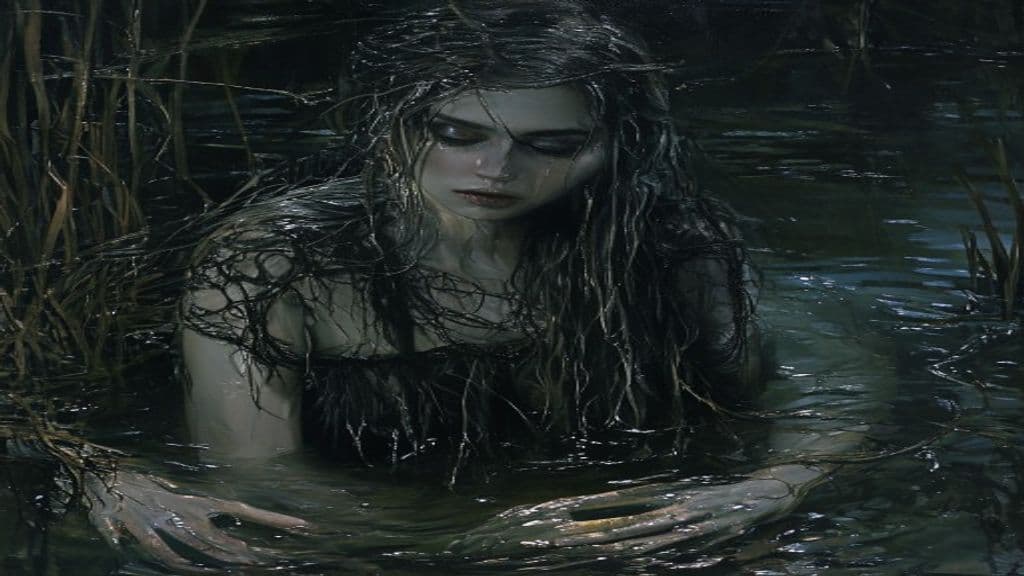
Descriptions in the provided sources are minimal. Lakanica are said to be able to appear in human female form and are characterized as 'shy and elusive.' No further physical details (clothing, age, distinguishing marks, or other iconographic traits) are given in the cited material, and the sources do not supply original-language variants or expanded descriptive motifs.
The supplied material does not attribute specific powers, harmful actions, or beneficial functions to Lakanica. The chief behavioral descriptors in the sources are timidity and elusiveness. A scholarly comparison (Muniz, cited in Wikipedia) groups Lakanica with ovily/rusalki — a range of Western Slavic nature spirits associated with lakes, springs, rivers, marshes, and sometimes fields and woods — but the sources do not transfer particular rusalki behaviors or abilities to Lakanica; thus no concrete abilities are documented in the provided excerpts.
Weaknesses
- othernone attested in sources
Wards
- othernone attested in sources
Boruta
Boruta (called "Devil Boruta" in the cited source) is a folkloric character from Polish mythology, folklore, and literature associated with the town of Łęczyca. The available source frames Boruta as a local legendary figure but provides no extended ethnographic detail.
Leshy
A tutelary forest being in Slavic folklore; an embodied, territorial power of the woods that can protect, mislead, or punish humans depending on their behaviour toward the forest. Highly variable in form and described across many regional variants and names.
Raróg
A Slavic fire-associated avian supernatural being variously described in Czech, Polish, Ukrainian, and Russian summary sources as a fiery falcon or dragon and, in some Polish accounts, as a tiny pocketable bird that brings happiness. It is connected to domestic fire and treated in popular reference as part of the broader fire-bird motif in Eurasian myth.
Rübezahl
Rübezahl is a folkloric mountain spirit of the Giant Mountains (Riesengebirge/Krkonoše/Karkonosze). He appears in German, Czech and Polish traditions as a capricious mountain lord, weather-controller, treasure-guardian and tester of human behaviour, alternately depicted as giant, gnome, woodwose or disguised wanderer.
Lahar
Lahar is a Mesopotamian divine personification of sheep and pastoral resources, attested in literary texts (notably the disputation 'Lahar and Ashnan') and in a local theogonic tradition (Theogony of Dunnu). The figure functions as the embodiment of the ewe/ovine economic domain and appears with variable genealogy and gender across sources.
Laieikawai
In Hawaiian mythology, Laieikawai and her twin sister Laʻielohelohe are princesses born in Lāʻie, Oʻahu. (Note: 1. The name 'Laieikawai' should be broken down into 'Lāʻi.e.' (which means "a place" or "land") and '-ka-wai', which roughly translates to 'water' or 'ocean'. 2. Power tier should be changed to Ancien)
Lailah
Lailah is a post-biblical angelic figure in Jewish rabbinic interpretation identified with the word for "night" and associated in later summaries with conception, pregnancy, and nocturnal guardianship. The principal attestation in the provided materials is a Talmudic exegetical remark that personifies the biblical term "night" as an angelic agent.
Laka
A 'popular hero' in Hawaiian mythology, associated with heroic qualities. (Note: * Power tier should be revised to Greater or Ancient since it's referred to as a "popular hero" and is associated with heroic qualities, suggesting a higher power level. * Appearance should state that)
Lake monster
A lake monster is a lake-dwelling creature in myth, folklore, and modern reports; treated as a recurring narrative motif (not a single species) that ranges from older kelpie-like horse or serpentine beings to modern reptile/plesiosaur-like sightings such as Nessie, Champ, and Ogopogo.
Lakshmana
Lakshmana is the younger half-brother and devoted attendant of Rama in the Ramayana tradition. Portrayed as an ideal companion and protector during Rama’s fourteen-year exile and the war with Ravana, the Puranas also describe him as an incarnation (avatara) of the serpent Shesha, linking him to the divine order surrounding Vishnu.
Lakshmi
Lakshmi is a principal Hindu goddess who personifies śrī (auspiciousness) and is revered as the giver of fortune, wealth, prosperity, beauty, fertility, sovereignty, and abundance. She is the consort and shakti of Vishnu in Vaishnavism, part of the Tridevi with Parvati and Sarasvati, and is the focus of popular devotional and festival practices such as Lakshmi Puja during Deepavali and Navaratri.
Lalli
A historical figure from Finnish medieval legend, responsible for killing Bishop Henry in the late 1150s. (Note: - Power tier: Greater (not Lesser), as Lalli's actions have significant historical and cultural impact. - Sensory cues: none mentioned in source material, so should be deleted or clarified. - Weakness)
Community Record
- [1]Lakanica — Wikipedia. "Lakanica is type of supernatural being from traditional Polish folklore who is a spirit of the fields or meadows. These are reputed to be shy and elusive creatures who can appear in human female form."; Muniz cited on comparison to ovily/rusalki.wiki
- [2]Book review: The Dollmaker of Kraków (reference to mythological characters). Notes that a Lakanica and other mythological characters play a role in the novel The Dollmaker of Kraków; no additional folkloric detail provided.literary