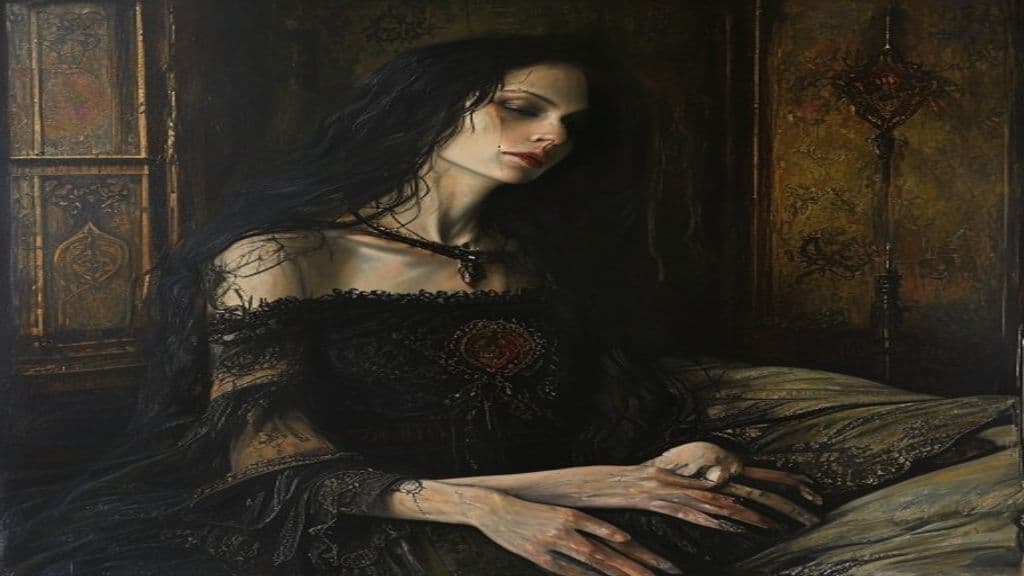
The mara appears within grassroots Germanic and Slavic explanatory systems as a nocturnal, harmful agent rather than the subject of a single origin myth. Folk traditions personified disturbing sleep phenomena—nightmares, a crushing pressure on the chest, sudden suffocation or cold sweats while asleep—as the active work of an exterior being. In these cultural frameworks the mara is therefore used to account for and narrate frightening nocturnal experiences; communities treat the mara as an intentional actor that crosses the boundary from the unseen night-world into the sleeping person's body. The sources provided do not record a single creation or cosmogonic tale for the mara, and instead present it as a recurring explanatory figure in popular accounts of sleep-related affliction.
Descriptions in the available material are not highly specific but convey a consistent profile: the mara is often represented as female and as an animate haunting presence rather than a fixed corporeal form. Accounts emphasize its capacity for magical transformation—shapeshifting—so that its visible form, when described at all, is variable and inconsistent across tellings. The lore centers less on a single physical appearance than on its presence at the sleeper's body (commonly located on the chest) and on its agency in producing nightmares and oppressive sensations.
The mara's primary behavior is to sit, walk, or 'ride' on a sleeping person's chest, producing nightmares and physiological effects commonly associated with sleep paralysis (a suffocating sensation, cold sweats, and an inability to move). Sources describe it as a malicious, active spirit with magical means for haunting victims; shapeshifting is named specifically as one of its powers. The entity's influence is targeted and immediate—attacking sleepers at night rather than exerting broad cosmic or social power—so its actions are narrated as direct intrusions into the boundary between waking and sleeping life.
Weaknesses
- otherno specific weaknesses reported in provided sources
Wards
- otherno specific wards or protective practices are recorded in the provided sources
Baba Yaga
Baba Yaga is an ambivalent female figure of East Slavic folktale tradition, depicted variously as a fearsome, child-eating crone or as a helpful, maternal donor. She is associated with the deep forest, a hut described as standing on chicken legs, and the motific accoutrements of a mortar and pestle.
Bald Mountain (Slavic)
A location in Slavic folklore associated with witchcraft and the Witches' Sabbath. (Note: 1. Power tier should be Primordial since it's associated with witchcraft and has connections to deities (witches are often seen as having deity-level powers). Greater is too low of a power level. 2. A)
Bannik
A place-bound spirit of the Slavic banya (bathhouse) that inhabits the steam room and related spaces; he mediates divination, presides over births within the banya, and must be appeased by offerings or he may harm or otherwise vex users and the building.
Berggeist
A German-language term denoting a mountain-spirit: an immanent, place-bound personality associated with a specific mountain. The concept is discussed in 19th-century German folkloristic classification of nature-spirits (Mannhardt) and appears in 20th-century artistic representation (Josef Madlener's painting "Der Berggeist").
Boginka
A Slavic/Polish female nature-spirit category: personifications of wild natural forces (forests, fields, mountains, fresh and sea waters) that appear in folklore as ambivalent beings—often hostile toward humans, especially pregnant women and infants, but also recalled in some sources with neutral or protective aspects.
Błędnica
A Slavic forest demoness who misleads travelers, abandoning them deep in the woods to die of exposure, starvation, or be taken by wild animals. She is typically depicted as a young, attractive woman and is countered in tradition by strong spells or by making sacrifices at home or during the hunt.
Changeling
A changeling is a human-like substitute left by nonhuman beings (fairies, trolls, demons, etc.) after they abduct a human—most often an infant. Found throughout much of European folklore, the changeling functions as an uncanny domestic replacement whose presence explains sickness, developmental difference, or sudden loss.
Cornflower Wraith
A Slavic field spirit associated with midday who enforces proper conduct in cultivated grain. Described as a young woman in azure with cornflowers in her hair, she punishes workers who trample crops or use sharp tools at the wrong time, often by inducing sleep followed by pain or by causing broken limbs.
Doppelgänger
A supernatural double or look‑alike of a living person, frequently reported in folklore and literature as a haunting counterpart or an omen of misfortune. The motif appears across cultures with related but distinct concepts (e.g., Egyptian ka, Norse vardøger, Finnish etiäinen, Muslim karin/qareen).
Fiery Serpent (Slavic)
A supernatural entity from Slavic folklore, described as a manifestation of fire in the sky or air. (Note: 1. Power tier should be adjusted from Primordial to Ancient, as it appears to be a deity-level entity rather than a cosmic one. 2. Add sensory cues for sounds associated with the entity (e.g., roaring)
Firebird (Slavic folklore)
A marvelous luminous bird from Slavic folktales, the Firebird (zhar-ptitsa) is a glowing, often fire‑colored bird whose appearance initiates quests and whose possession brings both wonder and misfortune. It functions as a coveted wonder and a dangerous omen within tale cycles.
Frau Holle
Frau Holle (also Hulda, Holda, Holla, Perchta/Berchta and regional variants) is a persistent Germanic folkloric female figure associated with household arts (spinning and linen-making), nocturnal spirit-processions of women, and a winter/snow motif (the Grimm tale of shaking featherbeds). She appears across medieval canonical texts and later folklore, where she functions as a domestic protector/teacher, a leader of nocturnal female companies, and an agent of moral reward and punishment.
Community Record
- [1]Mare (folklore) — Wikipedia. Wikipedia contributors, 'Mare (folklore)', Wikipedia, The Free Encyclopedia.wiki
- [2]The Folklore Podcast — Mara. The Folklore Podcast, 'Mara' episode/summary.folk