
Primary attestations do not provide a single origin narrative. Medieval canonical texts (e.g., Burchard's interpolation to the Canon Episcopi) record popular belief that a female figure called Holda led nocturnal companies of women; Jacob Grimm and later scholars interpreted Holda/Holda as survivals of an older Germanic goddess. Some scholarship links the name etymologically to German huld (Middle High German hulde, Old High German huldī) and to a wider Indo-European semantic field of graciousness/hiddenness. Other late-medieval sources record syncretism with Christian figures (the Virgin/Queen of Heaven). Modern scholars debate direct descent from a specific pre-Christian goddess, but the figure's roles (household arts, leader of nocturnal processions, winter associations) are attested across medieval and early-modern sources and in the Grimm tale.
No single consistent physical description is preserved in the cited sources. Folklore and the Grimm tale present her as an old woman who dwells in a house in another realm (notably shaking out featherbeds, producing snow in the human world); other accounts say she 'dwells at the bottom of a well' or 'rides a wagon.' Medieval canonical and early-modern texts depict her as the head of a crowd of women or female spirits (accounts sometimes describe armed or sickle-bearing companies in polemical contexts), but precise bodily details (height, clothing specifics) are not consistently recorded in the provided materials.
Sources attribute several recurrent roles and powers: teacher of domestic crafts (said to have 'first taught the craft of making linen from flax'); leader of nocturnal spirit-processions (canonical texts accuse women of riding with a 'crowd of demons' 'in the likeness of women' under Holda's leadership, see Canon Episcopi/Burchard); seasonal/weather association (Grimm fairy-tale motif of shaking featherbeds causing snowfall and epithets such as 'Old Mother Frost'); and moral adjudication (Grimm tale tradition assigns reward for industry and punishment for laziness). Church documents associated Holda with witchcraft/Diana-like huntress figures to argue against popular belief. The evidence shows a being both immanent to household practice and connected to otherworldly night-processions rather than explicit cosmically omnipotent control.
Weaknesses
- otherNo consistent folkloric weaknesses recorded in supplied sources; canonical responses focused on denial/penitential correction rather than prescribed folk vulnerabilities.
Wards
- ritualEcclesiastical penance and denunciation (Canon Episcopi/Burchard) — documented clerical prescription: prohibit belief and practice and impose penance rather than supplying a folk protective rite.
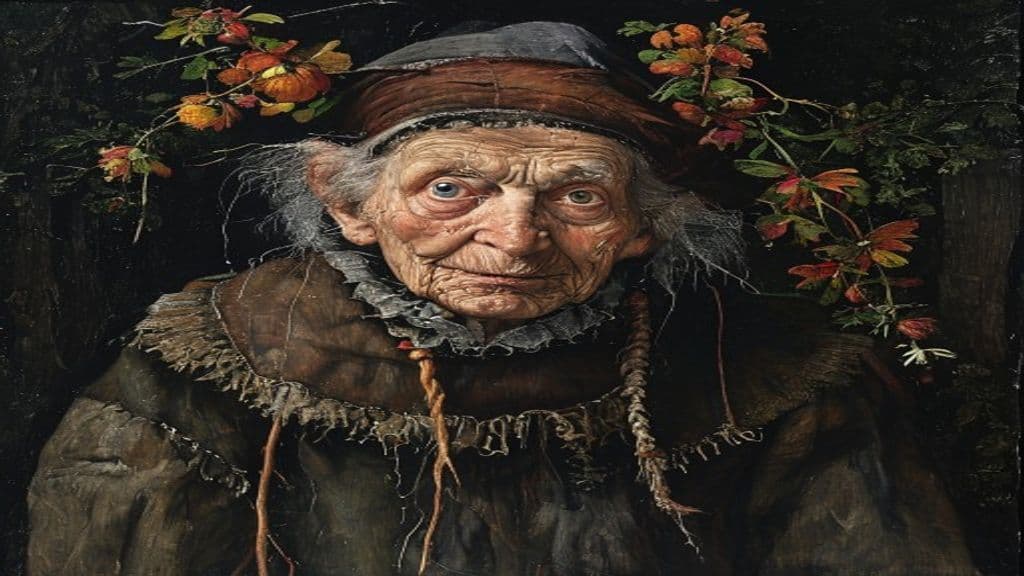
Perchta
Perchta (also Berchta/Berchta etc.) is a female midwinter supernatural figure of the Alpine folkloric complex (Upper Germany, Austria, South Tyrol, Slovene-Carinthia and adjacent areas). She functions as a seasonal guardian-inspector who enforces proper domestic labour (especially spinning) and fasting observance during the Rauhnächte (the twelve days between Christmas and Epiphany) and is realized both in narrative folklore and in local masquerade traditions (Perchtenlauf).

Hulder (Huldra)
The hulder (Norwegian huldra) is a class of Scandinavian 'hidden folk' — a forest-associated local spirit traditionally conceived as a race or kind rather than a single individual. They are counted among the rå (wardens/keepers) of particular natural places and are widely attested in Scandinavian toponyms and folk belief.
Berggeist
A German-language term denoting a mountain-spirit: an immanent, place-bound personality associated with a specific mountain. The concept is discussed in 19th-century German folkloristic classification of nature-spirits (Mannhardt) and appears in 20th-century artistic representation (Josef Madlener's painting "Der Berggeist").
Changeling
A changeling is a human-like substitute left by nonhuman beings (fairies, trolls, demons, etc.) after they abduct a human—most often an infant. Found throughout much of European folklore, the changeling functions as an uncanny domestic replacement whose presence explains sickness, developmental difference, or sudden loss.
Doppelgänger
A supernatural double or look‑alike of a living person, frequently reported in folklore and literature as a haunting counterpart or an omen of misfortune. The motif appears across cultures with related but distinct concepts (e.g., Egyptian ka, Norse vardøger, Finnish etiäinen, Muslim karin/qareen).
Haymon
A giant from Germanic folklore associated with the founding of Stift Wilten, a premonstratensian abbey. (Note: 1. The power tier should be Primordial, as it is described as a "giant" from Germanic folklore and associated with founding an abbey, implying a significant level of cosmic influence. 2. Add origin st)
Loathly Lady
In Germanic folklore, the Loathly Lady is a narrative device used in medieval literature to convey transformation and redemption. She appears unattractive but becomes desirable upon being approached by a man. (Note: - Power tier: Greater (deity-level abilities not specified, but transformative power implies regional or greater scope) - Appearance: Clarify that physical description is implied to be ugly/unpleasant)
Mara
A nocturnal malevolent spirit in Germanic and Slavic folk belief that sits on or 'rides' sleepers' chests to produce nightmares and the sensations associated with sleep paralysis. Frequently depicted as female and possessing magical abilities such as shapeshifting, the mara functions as an agentive folk explanation for oppressive nocturnal experiences.
Mare (folklore)
A nocturnal malicious spirit from Germanic and neighboring Slavic popular belief that afflicts sleepers and animals by 'riding' or pressing on chests, producing nightmares, sleep‑suffocation, night‑sweats, and exhausted animals. The mare overlaps with related Germanic night‑beings (alp, Mahr, Trute/Drude) and appears in varied regional tale forms and household practices.
Neck (water spirit)
A class of humanoid water spirits in Germanic mythology and folklore, often described as shapeshifting; names include nixie, nix, nixy, neck, and nicker. The provided sources give only a brief classificatory statement without extended ethnographic detail.
Nixie
A category of water spirit from Germanic and neighbouring European folklore associated with lakes, streams, ponds and waterfalls. Commonly described as shapeshifting and linked to enchanted music, nixies may be helpful or dangerous to humans depending on local tales.
Nøkk (Nixie)
A class of freshwater-associated humanoid spirits from Germanic and Nordic folklore, variously called nixie, nix, neck, Nøkk, Näcken, or nykur. They are consistently tied to rivers, streams, reeds and other inland waters and are commonly described as humanoid and often shapeshifting.
Nøkken
Nøkken (variants: nixie, nixy, nix, neck, nicker, Nykken) is a class of water-associated humanoid spirits in Germanic folklore. They are localized freshwater spirits tied to ponds, rivers, and similar places and are commonly described in referenced sources as often shapeshifting water-spirits rather than a single unified mythic figure.
Queen of Elphame
Supernatural entity tied to elven and faerie traditions in Germanic folklore, ruler of Faerie or Fairyland, but with poorly defined powers and appearance. (Note: 1. Power tier should be Primordial since she's tied to elven and faerie traditions, suggesting a more cosmic level of power. 2. Ability descriptions are incomplete; source mentions parallels with Thom)
Community Record
- [1]Frau Holle - Wikipedia. Wikipedia, 'Frau Holle' (overview, etymology, attestations, Canon Episcopi citations, links to Perchta and regional variants).wiki
- [2]Mother Hulda (Wikidata entry). Wikidata entry for Mother Hulda, confirming Grimm tale attribution and identifiers.other
- [3]Die Frau Hulle: A Bavarian Legend (germanicmythology.com). GermanicMythology.com, 'Die Frau Hulle: A Bavarian Legend' and related commentary on Grimm tale motifs and distribution.folk
- [4]FRAU HOLLE (Timm excerpt and illustrations). Classical illustrations and Timm summary on Frau Holle, noting distribution and links to Perchta.folk
- [5]Frau Holle in ihrem himmlischen Haus (bachlund.org). Bachlund page referencing the featherbed/shaking motif from the Grimm tale and related popular images.folk
- [6]Canon Episcopi / Burchard interpolation (as cited in summaries). Cited canonical material (Burchard's interpolation to the Canon Episcopi) describing popular belief in a female leader (Holda) who leads nocturnal rides; cited via Wikipedia summary.other
- [7]Grimm Brothers — 'Frau Holle' (KHM 24) (literary tradition referenced). Grimm tale 'Frau Holle' (KHM 24) as collected fairy-tale source for the featherbed/snow motif and the reward/punishment moral pattern (Aarne-Thompson type 480).literary