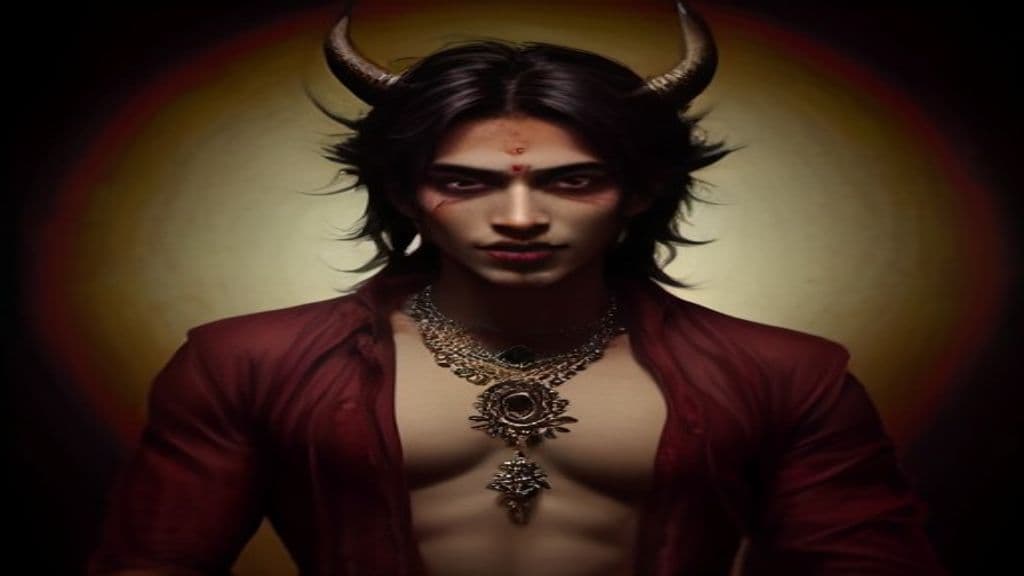
Maricha appears in the Ramayana as a member of a familial group transformed into hostile supernatural beings after a curse; his mother is Tāṭakā (Tadaka) and his brother is Subahu. After terrorizing kingdoms and menacing sages on the banks of the Sarayu, the family seeks succour among rakshasha kin in Patala and later allies with Ravana of Lanka. In the epic he repeatedly attacks sages and sacrificial rites until confronted by Rama, and later is used by Ravana in the stratagem that leads to Sita's abduction.
Accounts describe Maricha before the curse as handsome and noble in character; after the curse he is described as a hideous rakshasha. In the narrative he adopts multiple guises: a ferocious beast described as having a flaming tongue and two sharp horns (in one Dandakaranya episode), a saintly ascetic appearance when he lives as a hermit (matted hair, wearing tree bark), and notably the guise of a golden deer used to lure Rama and Lakshmana away from Sita.
Maricha and his brother are said to be skilled in sorcery and to disrupt yajna by showering sacrificial altars with blood, flesh, and bones. They terrorize people and are recorded as feasting on human flesh in some episodes. Maricha is a shape‑changer who assumes animal and deceptive forms (notably the golden deer) and employs disguises in service of rakshasha aims. Encounters with Rama show he fears Rama's weaponry and mantras: Rama's astras or the sound of his bow drive Maricha away or strike him a great distance, and after one such sparing Maricha adopts an ascetic life and becomes a devotee of Rama for a time.
Weaknesses
- conditionfear of Rama's weapons/mantras
- otherrepulsion/defeat when confronted by a divinely empowered protector (Rama) taught by Vishvamitra
Wards
- ritualwell-protected yajna with sage and divinely sanctioned protector present

Lava (Ramayana)
Lava is the younger of the twin sons born to Rama and Sita in the Ramayana tradition. Raised at the hermitage of the sage Valmiki alongside his brother Kusha, he is taught the epic, recites it publicly, takes part in the ashvamedha yajna episode, and in later traditions is credited with rulership or city-founding in northern Kosala/Lavapuri.
Mare (folklore)
A nocturnal malicious spirit from Germanic and neighboring Slavic popular belief that afflicts sleepers and animals by 'riding' or pressing on chests, producing nightmares, sleep‑suffocation, night‑sweats, and exhausted animals. The mare overlaps with related Germanic night‑beings (alp, Mahr, Trute/Drude) and appears in varied regional tale forms and household practices.
Mares of Diomedes
A herd of man-eating horses belonging to the Thracian chieftain Diomedes, famed as the eighth labour of Heracles. They are monstrous animals whose carnivorous habit and violence against guests make them a canonical threat in Greek heroic narrative.
Margot la fée
A vernacular class-name in Breton and Mayenne folklore for a type of powerful, territorial earthly fairy associated with the land, subterranean riches, megalithic monuments, and ambivalent dealings with humans. The category is traditionally linked in local imagination to Morgana (Morgan le Fay) and, more distantly and tentatively, to an aspect of the Earth Mother.
Maria Cacao
A localized Visayan diwata associated with Mount Lantoy (Argao, Cebu) and with nearby cacao cultivation; traditionally depicted as a female mountain/plant spirit who travels by a golden boat along the mountain's river and whose movements are invoked to explain floods and broken bridges. Contemporary variants add a soul‑harvesting/ punitive role in post‑disaster rumors.
Maria Sinukuan
Maria (Mariang) Sinukuan is a Kapampangan mountain diwata associated with Mount Arayat who, in oral tradition and later folklore, oversees the mountain's abundance, aids villagers in need, and punishes greed. The figure is also linked in local narratives to an earlier pre‑colonial deity known as Aring (Apúng) Sinukuan, a solar/war god; sources describe a Spanish‑era reshaping that introduced the Marian honorific and a feminized diwata form in later tradition.
Mariamman
Mariamman is a South Indian village mother-goddess venerated chiefly as a bringer of rain and as a protector against epidemic pustular fevers (historically smallpox, chicken pox, cholera). Rooted in Dravidian folk religion, she is often identified with pan-Indian Shakti figures (Parvati, Durga, Kali) and functions as a kaval deivam (village guardian deity).
Marid
The most powerful class of jinn in Islamic tradition — beings of the sea, associated with the deep ocean, storms, and the granting of wishes at terrible cost. The classic genie of the Arabian Nights.
Marmennill
A sea-associated humanoid figure in Icelandic and broader Scandinavian tradition, attested chiefly in saga contexts as an otherworldly being accidentally caught by fishermen and notable for revealing hidden knowledge and prophesying events. Primary medieval attestations emphasize its role as an informant and its laughter at human folly rather than a consistent anatomical description.
Marozi
The marozi is a name given in early 20th‑century Kenyan naturalist reports to purportedly spotted adult lions—lion-like felids retaining rosette-like juvenile markings and occurring at unusually high elevations in the Aberdare Mountains and Kinangop Plateau. Sources treat the marozi as a taxonomic puzzle or regional morph rather than a supernatural being.
Marraco (Gegants del Clot)
The Marraco is a dragon or frightening creature in Catalan myth associated with the city of Lleida, described in sources as possessing a mouth wide enough to swallow a human whole and commonly invoked in tales told to frighten children.
Mars
Mars is the ancient Roman god of war who also functions as an agricultural guardian; a chief civic deity of early Rome, he is described as the son of Jupiter and Juno and is commonly equated with the Greek Ares while retaining distinct Roman agrarian aspects.
Community Record
- [1]Maricha (Wikipedia). Wikipedia contributors, 'Maricha,' Wikipedia, The Free Encyclopediawiki
- [2]Maricha (Mythology entry). Mythology/folklore encyclopedia entry on Marichaliterary
- [3]Was the name mArIcha (मारीच), a demon in Raamayana, adopted from the word marīcikā (मरीचिका)?. Discussion on Hinduism StackExchange regarding possible etymologyother
- [4]Is Maricha a yogi? (discussion). Hinduism StackExchange discussion referencing Maricha's ascetic episodeother