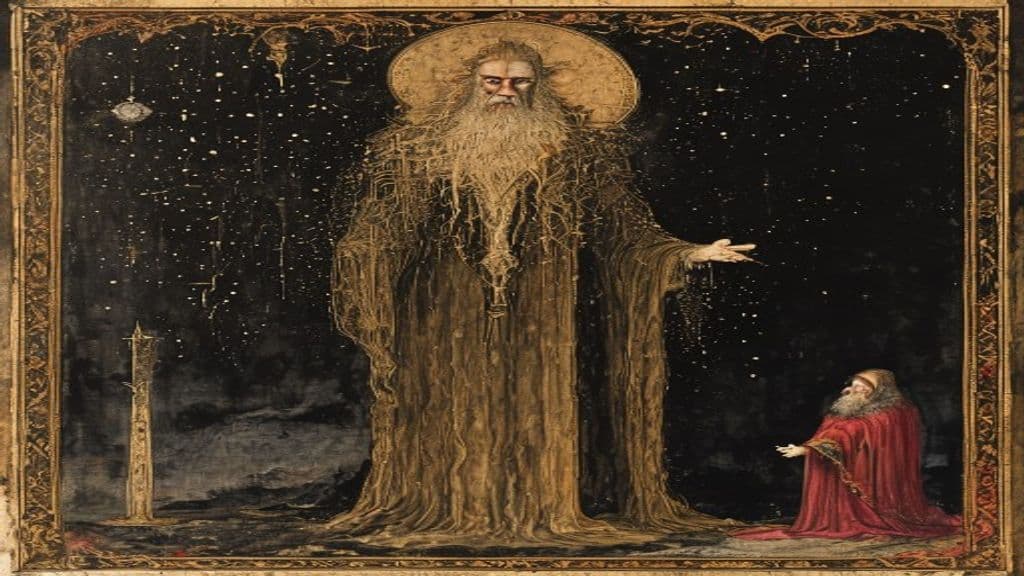
The term 'Muspilli' is derived from Old High German, but its etymology and meaning are unclear due to controversy among scholars. The poem appears in a ninth-century Bavarian manuscript.
Munisuvrata
Munisuvrata (Munisuvratanātha) is the twentieth tīrthaṅkara of the present Jain avasarpini (descending half cycle), a human exemplar who, according to Jain tradition, attained kevala jñāna and later liberation. He is venerated in temple cults, liturgical poetry, and monumental images across the Indian subcontinent.
Munjeon (Munjeon Bonpuri)
A Jeju Island household deity-concept focused on the house doorway, preserved in a shamanic narrative genre (Bonpuri) that explains the doorway's place within the Gasin, the ensemble of household deities.
Munjya
Spirit of a Konkani boy who died before his sacred thread ceremony, forever trapped between childhood and adulthood — mischievous, lonely, and hungry for belonging.
Murmur
Murmur is a named infernal figure attested in modern reference compilations and cultural listings of Western grimoire/demonological names. The supplied sources show Murmur appears as an entry on Wikipedia/Wikidata and in contemporary creative occult writing, but the present corpus does not include primary grimoire texts or historical conjurations specifying origin, appearance, or powers.
Muses
Divine inspirational figures of ancient Greek religion and mythology who personify and authorize the arts, literature, and learned knowledge; traditionally enumerated as nine daughters of Zeus and Mnemosyne in the Hesiodic account and associated with sacred springs and cult sites such as Mount Helicon and Delphi.
Musgosu
Musgosu (alternately attested as busgosu) is a named figure in the folk catalogs of Cantabria and is also mentioned in Asturian popular-legends material. Available sources record the name and regional placement but provide no detailed ethnographic description; one comparative commentary equates the name with the Basque Basajaun as an analogue rather than supplying direct Cantabrian testimony.
Mustukene
Mustukene is attested in a literary source as the proper name of a dog listed among 'the dogs of the sons of Kalev.' The cited passage glosses the name as meaning 'Blackie' and notes a disputed alternative translation ('Throttler'). No supernatural status, actions, or rituals are provided in the source.
Mut
Mut is an ancient Egyptian mother goddess associated with the primordial waters (Nu), the Theban Triad, and the Eye of Ra corpus. She functions as a cosmic maternal principle, a local patroness of Thebes with temples and priesthood, and a shifting consort/maternal figure within Amun-centered theology.
Mutya (TV series character)
Mutya is a fictional child mermaid character from a 2011 Philippine television drama who is portrayed as the love child of a human woman and a prince of an underwater kingdom; the narrative emphasizes her liminality between human society and a seaworld royal realm rather than a traditional folkloric ontology.
Mušḫuššu
The Mušḫuššu (Sumerian MUŠ.ḪUŠ; Akkadian mušḫuššu) is a named Mesopotamian hybrid creature — a composite serpentine monster — attested in Sumerian and later Babylonian art and myth. It functions primarily as a sacred emblem and mythic adversary-turned-attendant of major gods (notably Marduk) and appears in cultic, monumental, and astral contexts (e.g., the Ishtar Gate and the Bašmu/Hydra constellation).
Mycene
Mycene (Greek Mykēnē) is an eponymous female figure in Greek myth identified as a daughter of the river-god Inachus and the wife of Arestor. She is presented in the tradition as the naiad or local woman who gives her name to the city of Mycenae and functions as a place-bound genealogical figure rather than a universal deity.
Mydon
Mydon is a mortal warrior-figure named in the corpus of ancient Greek epic, attested as a defender of Troy in the Iliad. He appears only briefly in the surviving summaries and reference entries as a named casualty, and may represent one or more minor Homeric combatants who share the name.
Community Record
- [1]Muspilliwiki