
In several commentarial traditions Nala is described as a son of Viśvakarmā (the divine architect), a genealogy cited to explain his role as the vanara architect. He appears in the Ramayana narrative as a member of Rama’s vanara army whose technical skill is called on during Rama’s campaign to cross the ocean to reach Lanka. Different redactions and regional tellings vary in emphasis: some credit Nala alone with designing and building the bridge, some present him working together with his brother Nila and the wider vanara workforce, and later traditions (e.g., some Jain accounts) recast his end-life fate differently.
Textual sources identify Nala simply as a vanara, an anthropomorphic simian member of Rama’s monkey-like retinue; the supplied narrative sources give no sustained distinctive physical portrait. Nala appears as a subject in Indian miniature-painting cycles (Pahari, Guler, Kangra and other catalogued series), but the art-catalog entries cited are indexical and do not provide a single, consistent iconographic description beyond depicting him among vanaras in narrative scenes.
Nala is principally credited with mastery of architecture and engineering—traditionally named the architect of the vanaras and responsible for the Rama Setu project either by direct construction or by supervising the workforce. A recurrent miraculous motif holds that stones thrown by Nala (and in many versions by his brother Nila as well) floated on the ocean; explanations for this vary across sources: a sages' decree narratively sanctions the floating property as recompense for earlier misdeeds, Varuṇa and other theophanies figure in versions of the episode, and in some tellings Hanuman proposes writing Rama’s name on stones to make them adhere. Nala also fights in the Lanka campaign: Valmiki’s Yuddha Kanda lists him among combatants, and some accounts record him wounding or being wounded in battle and killing rakshasas (e.g., Tapana in certain redactions). Regional retellings preserve episodic interactions and disputes with other vanaras (notably Hanuman) over work practices in the bridge-building episode.
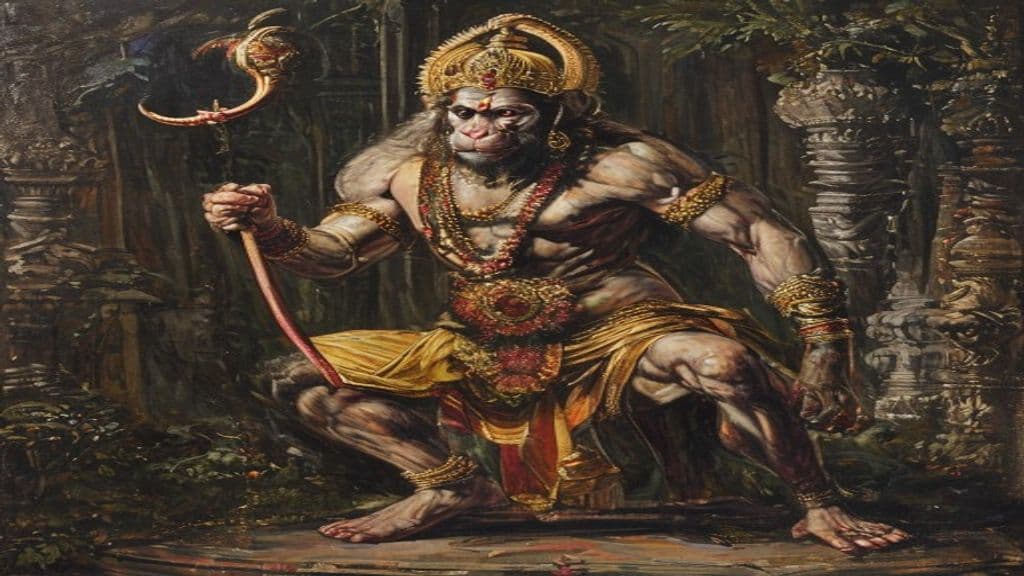
Hanuman
Hanuman is a divine vanara (monkey‑like being) in Hindu literature, foremost companion and devoted servant (Rama-dūta) of Lord Rama in the Ramayana. Revered in later Bhakti traditions, he is worshipped as a protector and exemplar of devotion, strength, and service.

Rakshasa (Himalayan variants)
A Himalayan reception of the pan-Indian rakshasa motif: hostile or disruptive non‑human beings known from Sanskrit epic and Puranic literature, here noted where Himalayan sources and discussions intersect with the broader epic tradition. The supplied sources do not document distinct, well‑attested Himalayan folklore variants; the entry therefore presents primarily the epic/legendary profile as transmitted into Himalayan contexts in general references.
Nagual (Maya tradition)
A human shapeshifter in Maya tradition who transforms into their tonal animal counterpart. (Note: - Power tier: Greater (not Ancient, as it's regional rather than deity-level) - Sensory cues: unknown (according to source material, not explicitly stated) - Weaknesses: no information provided - Ward)
Nahual (Nagual)
In Mesoamerican folk religion, a nahual (also spelled nagual) is a human believed able to shapeshift into a linked animal 'tonal' counterpart. Nagualism connects personal power and spiritual insight to a human's relationship with that animal aspect.
Naiad
A class of female nature-spirits in ancient Greek religion whose being is bound to particular bodies of fresh water (springs, wells, fountains, streams). Naiads are local, embodied presences venerated in community cults and invoked in rituals of purification, healing, and life-cycle events, yet they may also act harmfully toward humans.
Naimiṣāraṇya (forest)
Sacred forest in Hindu tradition, mentioned in major epics like the Ramayana and Mahabharata. (Note: 1. Summary needs clarification that it's specifically mentioned in Hindu epics, not "major epics" which could be misleading. 2. Power tier should be Primordial or Ancient, as a sacred forest mentioned)
Naka moli
A term attested in an archive discussion of Lahaina (Malu'ulu o Lele) that appears associated with the place's cultural significance; the supplied sources do not define the term or describe it as a specific supernatural being. The only direct textual evidence in the provided material is the phrase "the Naka moli" linked to Lahaina and to a statement that the place "is rich in cultural traditions and history kept alive through generations."
Nakchhong
Nakchhong (नाक्छोङ) is the shamanic tribal priestly office of the Khambu Rai (Kirat) community. Serving as the main priest of the Sakela (Sakewa) shrine, Nakchhong functions as an intermediary between the living and ancestral/local spirits and leads seasonal rites such as Udhauli and Ubhauli.
Nale Ba
A Kannada witch-spirit that calls at your door in the voice of a dead relative; answering means death. In 1995 Karnataka, people wrote 'Nale Ba' on their doors in one of India's most documented supernatural mass panics.
Naminātha
Naminātha is the twenty-first Tīrthaṅkara of the present half time-cycle (Avsarpini) in Jain tradition. As a Tīrthaṅkara he is described in the sources as having become a siddha (a liberated, enlightened soul) and thereby exemplifying the role of a spiritual teacher who establishes the ford (tīrtha) across saṃsāra.
Nammu
Nammu is a Mesopotamian primeval mother-goddess associated with the origin of the world and with watery depths in local theology (especially Eridu). She functions as a creatrix and as an invoked deity in incantations and apotropaic rites for purification, consecration, and protection against demons, illness, and scorpions.
Namtar
The Sumerian god-demon of fate and disease, vizier of the Underworld who carries sixty diseases and acts as herald of death — he who determines the day of dying.
Nana-Ula
Hero and first King of Hawaii in Hawaiian mythology, who led his people from Tahiti to establish the royal dynasty. (Note: - Power tier should be at least Primordial given the entity's role in shaping the foundation of Hawaiian society. - Appearance: Consider adding that no physical description is mentioned, but this does)
Nanabozho (Nanabush)
Nanabozho (also Nanabush) is a spirit figure in Anishinaabe aadizookaan, foremost among the Ojibwe as a trickster and culture hero who appears in oral narratives including creation stories. The figure functions within storytelling as a foundational and didactic agent rather than a documented historical person.
Community Record
- [1]Nala (Ramayana) — Wikipedia. Wikipedia, 'Nala (Ramayana)'wiki
- [2]Valmiki Ramayana - Yuddha Kanda, Sarga 22 (prose). Valmiki Ramayana, Yuddha Kanda, Sarga 22 (online translation)literary
- [3]Valmiki Ramayana - Yuddha Kanda, Sarga 43. Valmiki Ramayana, Yuddha Kanda, Sarga 43 (online translation and indices)literary
- [4]PAHARI PAINTINGS FROM THE EVA AND KONRAD SEITZ COLLECTION (catalog). Pahari painting catalog (archive listing referencing Nala in miniature cycles)other
- [5]Sotheby 1978 Oriental (catalog). Sotheby 1978 Oriental catalogue (indexes of miniature paintings including Nala subjects)other
- [6]Ramayana-related Q&A and commentary (Hinduism StackExchange entries cited in notes). Community-sourced explanatory notes on Nala and Nila traditions (stack exchange discussion referenced in research notes)other
- [7]Jain retellings note (secondary summary). Wikipedia summary noting Jain versions that recast Nala's later life (diksha and moksha at Mangi-Tungi)wiki
- [8]Valmiki Ramayana - Yuddha Kanda (romanized sarga 43). Valmiki Ramayana, Yuddha Kanda (romanized sarga 43).literary