
In the surviving place-lore and mythic summaries, Nechtan is presented as the named owner or guardian of a well of wisdom which issues as the River Boyne. Narrative variants in the medieval and modern summaries record that the well sits beneath nine hazel trees and that the well's wisdom becomes implicated in stories of Boann (the eponymous figure of the Boyne) and of her being impregnated by a suitor who gains access to the well's knowledge. The corpora also show the personal name Nechtan borne by historical kings and ecclesiastics, indicating overlap between mythic toponymy and onomastic practice in Irish tradition.
The sources supply no consistent anthropomorphic physical description of Nechtan. What is repeatedly emphasized is the site-association: Nechtan's well is described as situated beneath nine hazel trees, with hazelnuts forming part of the well-of-wisdom motif. Beyond this locus imagery and his relational identity (named figure connected to Boann or to variant wife-names), the texts do not record distinctive bodily features, dress, or enumerated attributes of Nechtan's person.
Primary attributes ascribed in the sources are custodianship of a 'well of wisdom' and proprietorship of the spring that becomes the Boyne. The well is explicitly linked to supernatural knowledge in the tradition; narratives recount that access to the well's wisdom factors into the conception stories surrounding Boann and her offspring. The supplied materials do not attribute to Nechtan other explicit powers such as routine blessings, curses, or other magical acts toward humans, nor do they record ongoing cultic interactions.
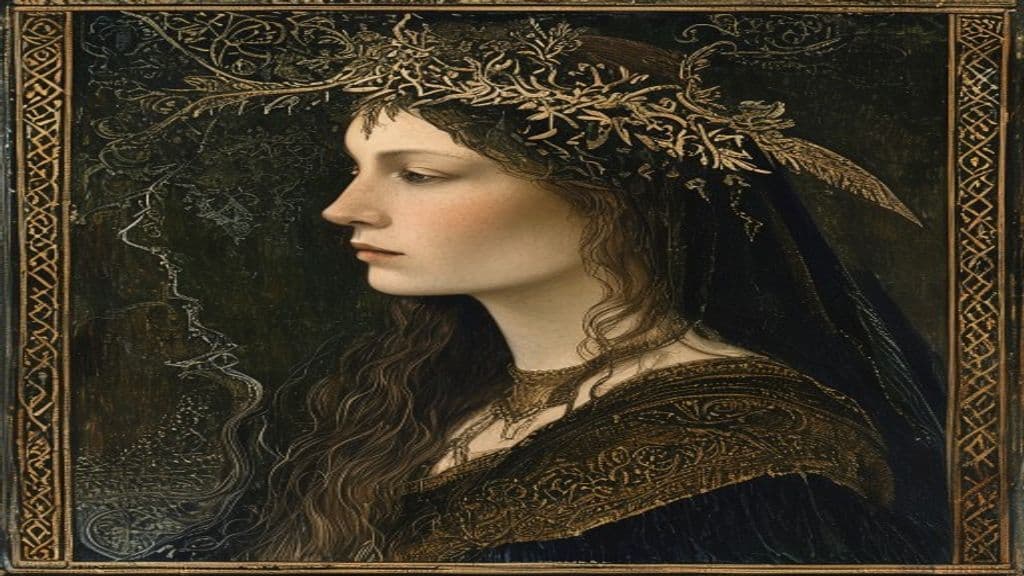
Boann
Boann (also Boand) is a figure of early Irish tradition associated with the River Boyne (Bóinn) and the Well of Segais. Presented in the Dindsenchas and other medieval sources as a member of the Tuatha Dé Danann, she functions as a mythic landscape-progenitor, mother of the god Aengus, and a woman whose transgressive actions at a sacred well bring the river into being.
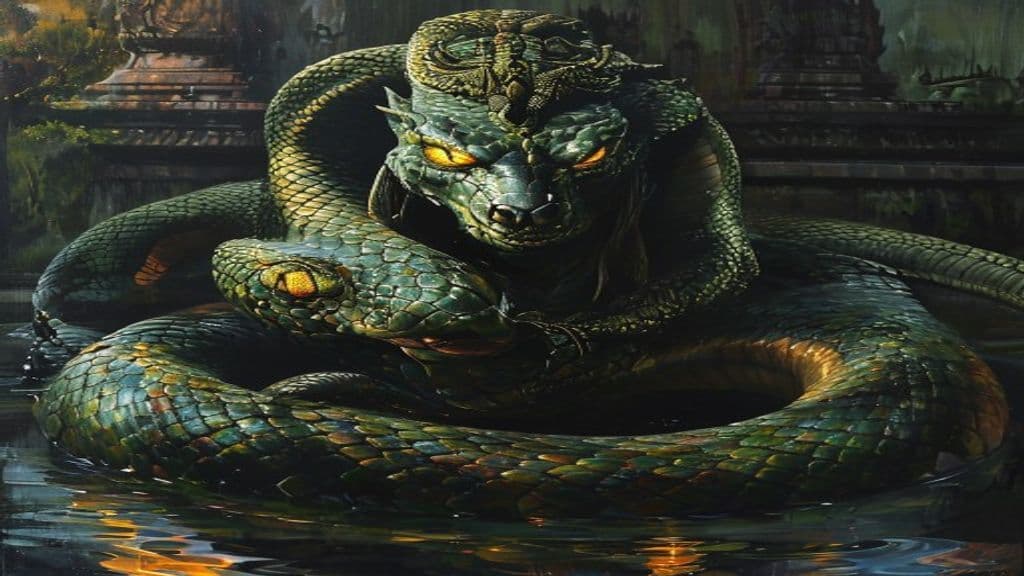
Naga
Divine serpent beings of Hindu, Buddhist, and Jain cosmology — powerful guardians of water, earth, and underground treasures. Revered as deities in South and Southeast Asia.
Mór Muman
Mór Muman is an early Irish sovereignty and mother-figure personifying the province of Munster. In medieval tales she appears alternately as an enchanted, wandering 'loathly' woman and as a restored queen whose union with the rightful king legitimizes rulership over Munster.
Naʼashjéʼii Asdzą́ą́ (Naashjeii Asdzaa) — "Spider Woman / Spider Grandmother"
Naʼashjéʼii Asdzą́ą́, commonly rendered in English as Spider Woman or Spider Grandmother, is a Navajo ancestral/feminine figure entrusted by the Holy People to weave the pattern of the universe. She functions in Navajo narrative as a teacher and guide encountered by culture heroes and embodies an instructional, creative, and guardian role rather than a malicious spirit in the provided sources.
Neaera
Neaera (Νέαιρα / Neaira) is a personal name applied in Greek tradition to several minor female figures—principally nymph-types (an Oceanid, a Thrinacian nymph consort of Helios, and a Thracian naiad wife of river-god Strymon). She functions mainly as a localized nature-associated mythic figure and as a genealogical consort/mother rather than as an independently culted major deity.
Nebethetepet
Nebethetepet (nb.t-ḥtp.t) is an ancient Egyptian goddess and personified female principle associated with creation and offerings. Worshipped in the Heliopolitan tradition, she is described as the personification of Atum's hand and can function as a title or manifestation of Hathor; surviving attestations are limited and mainly cultic or late-period in date.
Nebtuwi
Nebtuwi is an ancient Egyptian goddess who personifies fertility and is attested as the wife of the creator/fertility god Khnum. Her cult was centered at Latopolis (Esna) and over time her local cult was gradually relegated to that of Neith.
Nebty Name
One of the 'great five names' used by Egyptian pharaohs, representing a specific aspect of their divine authority. (Note: - Power tier should be Ancient (deity-level) since it's one of the 'great five names' used by pharaohs, representing divine authority. - Abilities need to be clarified or removed, as the text currentl)
Nebu
An ancient Egyptian hieroglyph representing gold with phonetic value nb, associated with royalty and divine authority. (Note: 1. Power tier: Change Primordial to Ancient (since Nebu is a hieroglyph associated with royalty and divine authority, but not described as cosmic). 2. Abilities/Origin story: Add that Nebu has no know)
Neck (water spirit)
A class of humanoid water spirits in Germanic mythology and folklore, often described as shapeshifting; names include nixie, nix, nixy, neck, and nicker. The provided sources give only a brief classificatory statement without extended ethnographic detail.
Nedymnos
Nedymnos is a named member of the Kentauroi (centaurs) attested only in classical name-lists and modern catalogues; he appears as an individual centaur figure in compilatory sources rather than as a figure with independent narratives or cult. Attestations are limited to a Pauly-Wissowa catalogue entry (via Wikidata) and a modern compilation of Thessalian centaur names (Theoi).
Nehmetawy
Nehmetawy is an ancient Egyptian goddess attested chiefly at Khemenu (Hermopolis) and in the Tebtunis Mythological Manual. She functions as a local, protective and consoling deity who appears as the pacified or returned form in the 'returning goddess' cycle and is associated with festival rites and maternal iconography.
Neith
Neith is an ancient Egyptian deity attested from the Predynastic period onward, venerated as a creator and primordial mother, a warlike patron and 'Opener of the Ways,' and a funerary guardian associated with weaving and the protection of the dead. Her primary cult center was Sais in the western Nile Delta, and she remained important into the Greek and Roman periods.
Nekhbet
Nekhbet is an ancient Egyptian tutelary goddess of the city Nekheb (El Kab) who became the patron and protector of Upper Egypt and, after political unification, one of the Two Ladies safeguarding the king and the unified land. She is primarily portrayed as a vulture in royal and funerary iconography and is associated with protective, maternal, and royal-ideological functions in Egyptian state religion.
Community Record
- [1]Nechtan (mythology) - Wikipedia. Wikipedia, 'Nechtan (mythology)'wiki
- [2]Nechtan - AncientTexts / Mary Jones. AncientTexts.org / Mary Jones, 'Nechtan' (Celtic text summary)literary
- [3]Boann - AncientTexts / Mary Jones. AncientTexts.org / Mary Jones, 'Boann' (Celtic text summary)literary
- [4]Wikidata: Nechtan (Q580163). Wikidata, 'Nechtan' (metadata entry labeling as water deity)other
- [5]Nechtan - Celtsite. Celtsite character listing, 'Nechtan'other
- [6]Nechtan (archival reference). Archive.org item on Nechtan Morbet (historical bearer of the name)other
- [7]Part 5 of Annals of Loch Cé (T100010B/text005). CELT: Annals of Loch Cé (textual corpus reference)literary