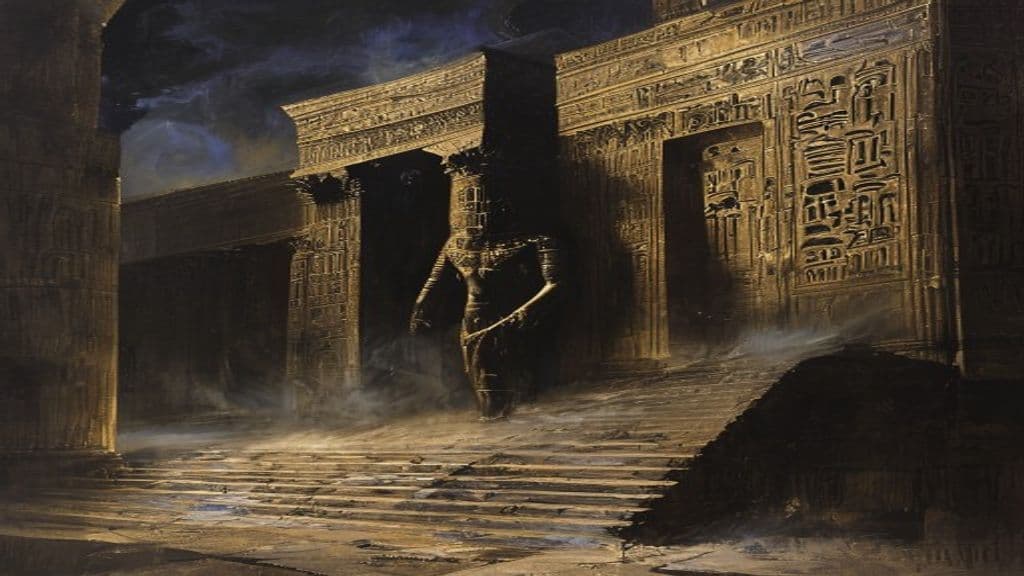
Nebu is represented as a hieroglyph with phonetic value nb, rather than a living entity with a physical appearance.
There is no information about Nebu's abilities or behaviors beyond its association with gold and royalty.
Atef Crown
Egyptian feathered white crown associated with Osiris, symbolizing his status and power. (Note: * Power tier should be Ancient, not Greater, since it's associated with a deity. * Abilities statement is accurate based on source material, but can be rephrased for clarity: "As an inanimate object, )
Egyptian Supernatural Beings
In Egyptian mythology, various supernatural entities inhabit different realms, including gods, goddesses, demons (uncertain), and spirits. They are considered Primordial beings, with cosmic-level powers. (Note: 1. Remove the claim that demons are considered Primordial beings (Source 1 does not mention this). 2. Update the power tier to Ancient, as Egyptian gods have cosmic-level powers but the text describes)
Thinis (Egyptian tradition)
A significant cultural and administrative center in ancient Egyptian history, mentioned as the capital city of pre-unification Upper Egypt. (Note: - Power tier should be Primordial, not Greater, since it's a significant cultural and administrative center and its decline is tied to pharaonic unification. - Abilities should be stated as "No record)
Two Ladies (Egyptian)
In ancient Egyptian tradition, the Two Ladies refer to the goddesses Wadjet and Nekhbet as national symbols of unified Egypt. (Note: - Power tier should be Ancient (not Greater), since the article describes them as "protectors" which aligns with deity-level powers. - Abilities should include specific references to their roles as pa)
Neaera
Neaera (Νέαιρα / Neaira) is a personal name applied in Greek tradition to several minor female figures—principally nymph-types (an Oceanid, a Thrinacian nymph consort of Helios, and a Thracian naiad wife of river-god Strymon). She functions mainly as a localized nature-associated mythic figure and as a genealogical consort/mother rather than as an independently culted major deity.
Nebethetepet
Nebethetepet (nb.t-ḥtp.t) is an ancient Egyptian goddess and personified female principle associated with creation and offerings. Worshipped in the Heliopolitan tradition, she is described as the personification of Atum's hand and can function as a title or manifestation of Hathor; surviving attestations are limited and mainly cultic or late-period in date.
Nebtuwi
Nebtuwi is an ancient Egyptian goddess who personifies fertility and is attested as the wife of the creator/fertility god Khnum. Her cult was centered at Latopolis (Esna) and over time her local cult was gradually relegated to that of Neith.
Nebty Name
One of the 'great five names' used by Egyptian pharaohs, representing a specific aspect of their divine authority. (Note: - Power tier should be Ancient (deity-level) since it's one of the 'great five names' used by pharaohs, representing divine authority. - Abilities need to be clarified or removed, as the text currentl)
Nechtan
Nechtan is a figure in Irish tradition associated with a sacred spring called Nechtan's Well or the Well of Wisdom, described as the source of the River Boyne. In the corpus he appears as the named owner/custodian of the well and as a personal name borne by historical figures; sources vary over whether he is the husband of Boann or whether other husband-names (e.g., Nemed, Elcmar) appear in different texts.
Neck (water spirit)
A class of humanoid water spirits in Germanic mythology and folklore, often described as shapeshifting; names include nixie, nix, nixy, neck, and nicker. The provided sources give only a brief classificatory statement without extended ethnographic detail.
Nedymnos
Nedymnos is a named member of the Kentauroi (centaurs) attested only in classical name-lists and modern catalogues; he appears as an individual centaur figure in compilatory sources rather than as a figure with independent narratives or cult. Attestations are limited to a Pauly-Wissowa catalogue entry (via Wikidata) and a modern compilation of Thessalian centaur names (Theoi).
Nehmetawy
Nehmetawy is an ancient Egyptian goddess attested chiefly at Khemenu (Hermopolis) and in the Tebtunis Mythological Manual. She functions as a local, protective and consoling deity who appears as the pacified or returned form in the 'returning goddess' cycle and is associated with festival rites and maternal iconography.
Community Record
- [1]Wikipediawiki