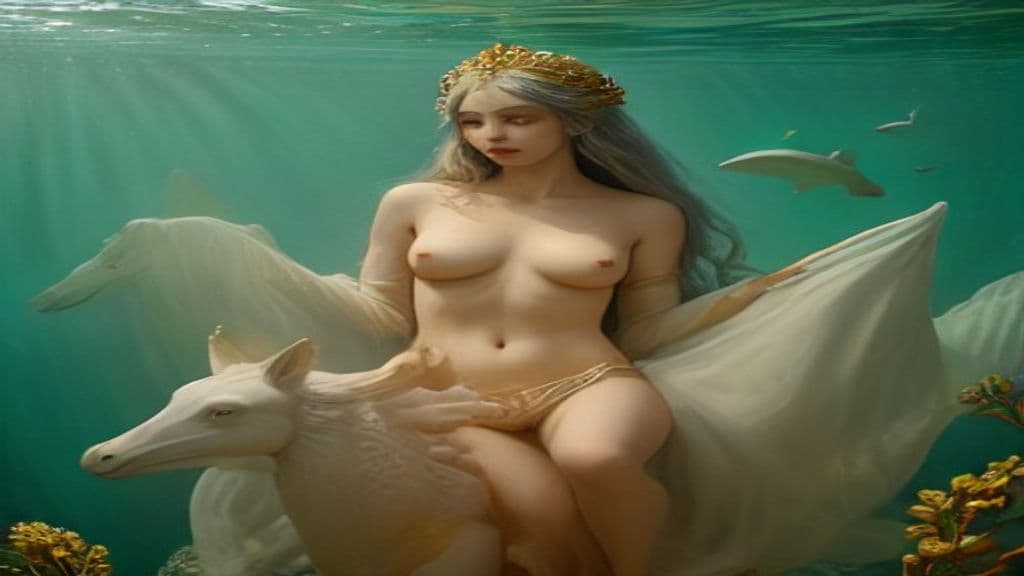
In the Greek mythological genealogy preserved in the sources, the Nereids are the daughters of the sea-god Nereus (the 'Old Man of the Sea') and the Oceanid Doris. They are traditionally numbered at fifty and include figures who form part of the sea-divinities' household and retinue. Their parentage and role locate them within classical Greek cosmology as minor divine or semidivine beings born of sea deities.
Classical descriptions represent Nereids as beautiful young women, often crowned with branches of red coral and clothed in white silk robes trimmed with gold; in ancient art they are depicted riding dolphins, sea-horses, or grouped with Tritons, and later iconography sometimes shows them nude or partially nude. In modern Greek folktales (where the name survives as neráides) they are described as extraordinarily beautiful, with golden hair, wearing white or rose garments, dancing at noon or midnight, and sometimes wearing a veil or carrying a handkerchief.
In the mythic corpus the Nereids symbolize the kind and beautiful aspects of the sea: they sing and dance, serve in the retinues of major sea-deities (such as Poseidon and Amphitrite), and assist humans at sea — for example helping sailors, heroes such as the Argonauts, consoling Thetis over Achilles, and aiding Aeneas in storm narratives. Some sources report they were said to reveal to men the mysteries of Dionysus and Persephone. In modern folktales the nereida can form temporary marital bonds with mortal men, a union often conditioned on the retention of a personal garment (veil or handkerchief) which, if stolen and hidden, keeps her in the human realm until recovered.
Weaknesses
- conditionloss or concealment of personal garment
Wards
- otherthe stolen-veil motif (retention of the nereida's veil or kerchief to bind her to the mortal realm)
Cecrops I
Cecrops I is a legendary autochthonous founder‑king of Attica and the first king of Athens, portrayed as a culture‑hero who instituted marriage, burial rites, civic divisions, and cult practices. He appears in Greek tradition as human above and serpentine or fish‑tailed below, and as the mortal witness/arbitrator in the mythic contest between Athena and Poseidon over patronage of the city.
Charon
Charon (Χάρων) is the ferryman of the Greek underworld who conveys the souls of the dead across the boundary river (variously Acheron or Styx). He functions as an underworld attendant and psychopomp whose service typically requires funeral rites and payment (Charon's obol).
Karakoncolos (Kara Kongolos)
A name attested in modern descriptions of Southeastern European and Anatolian folk belief referring to a malevolent household/forest goblin figure associated in comparative accounts with the Greek kallikantzaros tradition. The available sources describe the being only in general terms as a 'malevolent creature' or 'malevolent goblin' and do not provide detailed indigenous origin myths, appearance, powers, or ritual responses.
Vrykolakas
A harmful undead revenant in Greek folklore that returns from the grave to harm the living. Described as a reanimated corpse associated with poltergeist activity, epidemics, nocturnal roaming, and cannibalistic eating of flesh (especially livers); practices to prevent or destroy it are tied to burial rites and community action.
Neper
Neper (also Nepra or Nepri) is an ancient Egyptian deity personifying grain and the productive principle of cereal crops. He functions as the divine guarantee of seed, growth and sustenance within the Egyptian agricultural and domestic religious framework.
Nephilim
Enigmatic figures from the Hebrew Bible and later Jewish and Christian writings, the Nephilim are described in brief, ambiguous passages as ancient, exceptional beings associated with the antediluvian world and with later memory of formidable inhabitants; traditions variously render them as 'giants,' 'fallen ones,' or legendary elite warriors.
Nephthys
Nephthys (Egyptian Nebet-ḥwt) is an ancient Egyptian goddess associated with funerary transition, night/darkness, temple service, protection, and ritual magic. Member of the Heliopolitan Ennead and sister of Isis, Osiris, and Set, she functions as a liminal guardian and ritual attendant who assists the deceased's passage through the Duat and appears widely in tomb and temple iconography.
Neptune
Neptune (Latin: Neptūnus) is the Roman god of freshwater and the sea, often treated in Roman religion as the counterpart of the Greek Poseidon and placed in a fraternal relationship with Jupiter and Pluto. The classical deity's name was later adopted in modern astronomy for the eighth planet of the Solar System, a cultural reuse noted in scientific sources.
Nereus
Nereus is an archaic Greek sea-god, eldest son of Pontus and Gaia, known as an aged, truthful 'Old Man of the Sea' who fathers the Nereids and functions as a source of prophetic counsel; he shares traits with other sea-elders like Proteus and later recedes in prominence beneath Poseidon.
Nergal
Nergal is a major Mesopotamian deity associated with war, disease, inflicted death, and rulership of the underworld. Principal cult center at Kutha (temple E‑Meslam), he appears in hymns and myths (e.g., the Epic of Erra, "Nergal and Ereshkigal") and is sometimes equated with or called Erra or Meslamtaea.
Nerrivik
Nerrivik (also Nerivik) is an Inuit sea-mother figure—an elder female supernatural who is the owner/provider of sea creatures and the patron of fishermen and hunters. She appears in Greenlandic and Canadian Inuit traditions as a principal sea goddess (regional equivalents include Sedna, Arnapkapfaaluk, and Arnakuagsak). Her origin myths explain her residence at the bottom of the sea and a mutilated condition (one-handed) resulting from being cast off a boat.
Nerthus
Nerthus is an early Germanic cultic deity attested in Tacitus's Germania as the focus of a wagon‑procession cult kept on an island in a sacred grove. Tacitus reports a ritual in which a cart draped in white is drawn among communities, bringing a suspension of warfare and communal celebration, followed by ritual washing of cult objects in a secluded lake.
Community Record
- [1]Nereids (Wikipedia). Wikipedia: 'Nereids' article (accessed source material provided in research notes)wiki
- [2]Wikidata: Nereids. Wikidata entry for Nereids (referenced in research notes)other
- [3]Pompeii: Thermopolium with painting of nereid. Image and description of nereid iconography at Pompeii (referenced in research notes)other
- [4]The Lighted Fountains of Nereid (short fiction). Short fiction referencing Nereid imagery (included in research notes)other