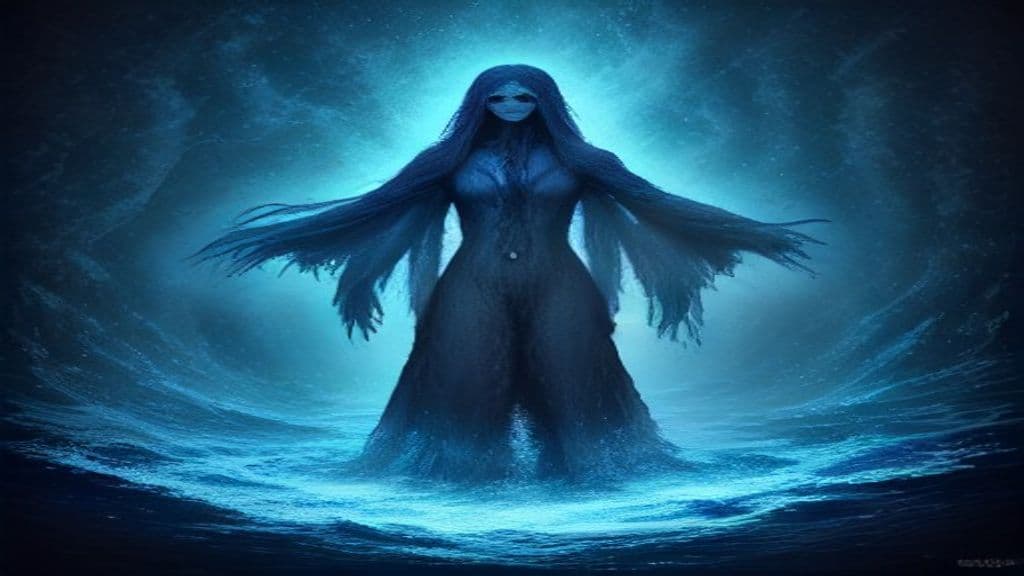
The supplied sources do not record a single canonical origin myth for the Nøkken. Reference material frames the beings as part of a wider corpus of Germanic supernatural creatures tied to specific natural places — freshwater locales such as ponds and rivers — rather than presenting a unified cosmogonic origin. Modern usages of the name in literature, music, place-names, and products reflect cultural persistence of the term but do not supply a traditional origin narrative in the cited excerpts.
Within the provided material Nøkken are described generally as humanoid and often shapeshifting water-spirits. The supplied sources do not give a consistent, detailed canonical physical description (such as exact clothing, coloration, or fixed form) beyond the broad characterization of humanoid and shapeshifting; modern creative works use the name evocatively but do not provide authoritative folkloric physical details in the excerpts cited.
The sources identify Nøkken primarily as water-associated spirits with a capacity for shapeshifting and close association with freshwater places (ponds, rivers, etc.). The supplied materials characterize them as localized water spirits within Germanic folklore but do not provide a detailed catalogue of additional powers, rituals, or standardized behaviors in the excerpts available. Modern cultural references show the name's continued use but do not expand the traditional powers in the cited texts.
Berggeist
A German-language term denoting a mountain-spirit: an immanent, place-bound personality associated with a specific mountain. The concept is discussed in 19th-century German folkloristic classification of nature-spirits (Mannhardt) and appears in 20th-century artistic representation (Josef Madlener's painting "Der Berggeist").
Changeling
A changeling is a human-like substitute left by nonhuman beings (fairies, trolls, demons, etc.) after they abduct a human—most often an infant. Found throughout much of European folklore, the changeling functions as an uncanny domestic replacement whose presence explains sickness, developmental difference, or sudden loss.
Doppelgänger
A supernatural double or look‑alike of a living person, frequently reported in folklore and literature as a haunting counterpart or an omen of misfortune. The motif appears across cultures with related but distinct concepts (e.g., Egyptian ka, Norse vardøger, Finnish etiäinen, Muslim karin/qareen).
Frau Holle
Frau Holle (also Hulda, Holda, Holla, Perchta/Berchta and regional variants) is a persistent Germanic folkloric female figure associated with household arts (spinning and linen-making), nocturnal spirit-processions of women, and a winter/snow motif (the Grimm tale of shaking featherbeds). She appears across medieval canonical texts and later folklore, where she functions as a domestic protector/teacher, a leader of nocturnal female companies, and an agent of moral reward and punishment.
Haymon
A giant from Germanic folklore associated with the founding of Stift Wilten, a premonstratensian abbey. (Note: 1. The power tier should be Primordial, as it is described as a "giant" from Germanic folklore and associated with founding an abbey, implying a significant level of cosmic influence. 2. Add origin st)
Loathly Lady
In Germanic folklore, the Loathly Lady is a narrative device used in medieval literature to convey transformation and redemption. She appears unattractive but becomes desirable upon being approached by a man. (Note: - Power tier: Greater (deity-level abilities not specified, but transformative power implies regional or greater scope) - Appearance: Clarify that physical description is implied to be ugly/unpleasant)
Mara
A nocturnal malevolent spirit in Germanic and Slavic folk belief that sits on or 'rides' sleepers' chests to produce nightmares and the sensations associated with sleep paralysis. Frequently depicted as female and possessing magical abilities such as shapeshifting, the mara functions as an agentive folk explanation for oppressive nocturnal experiences.
Mare (folklore)
A nocturnal malicious spirit from Germanic and neighboring Slavic popular belief that afflicts sleepers and animals by 'riding' or pressing on chests, producing nightmares, sleep‑suffocation, night‑sweats, and exhausted animals. The mare overlaps with related Germanic night‑beings (alp, Mahr, Trute/Drude) and appears in varied regional tale forms and household practices.
Neck (water spirit)
A class of humanoid water spirits in Germanic mythology and folklore, often described as shapeshifting; names include nixie, nix, nixy, neck, and nicker. The provided sources give only a brief classificatory statement without extended ethnographic detail.
Nixie
A category of water spirit from Germanic and neighbouring European folklore associated with lakes, streams, ponds and waterfalls. Commonly described as shapeshifting and linked to enchanted music, nixies may be helpful or dangerous to humans depending on local tales.
Nøkk (Nixie)
A class of freshwater-associated humanoid spirits from Germanic and Nordic folklore, variously called nixie, nix, neck, Nøkk, Näcken, or nykur. They are consistently tied to rivers, streams, reeds and other inland waters and are commonly described as humanoid and often shapeshifting.
Queen of Elphame
Supernatural entity tied to elven and faerie traditions in Germanic folklore, ruler of Faerie or Fairyland, but with poorly defined powers and appearance. (Note: 1. Power tier should be Primordial since she's tied to elven and faerie traditions, suggesting a more cosmic level of power. 2. Ability descriptions are incomplete; source mentions parallels with Thom)
Community Record
- [1]Nixie (folklore) — Wikipedia. Wikipedia, entry 'Nixie (folklore)'wiki
- [2]Nøkken — Wikidata. Wikidata entry Q11992951wiki
- [3]Nøkken (Abyss & Apex: 'Nykken'). Abyss & Apex, short literary piece titled 'Nykken'literary
- [4]Spirit of Nøkken • liner note (Procol Harum). Album liner note referencing 'Spirit of Nøkken'other
- [5]Nøkken (disambiguation / place-name usages) — Wikipedia. Wikipedia entry 'Nokken' (uses of the name in modern contexts)wiki
- [6]Nokken, Copenhagen — Wikipedia. Wikipedia entry 'Nokken, Copenhagen' (modern place-name sharing the term)wiki