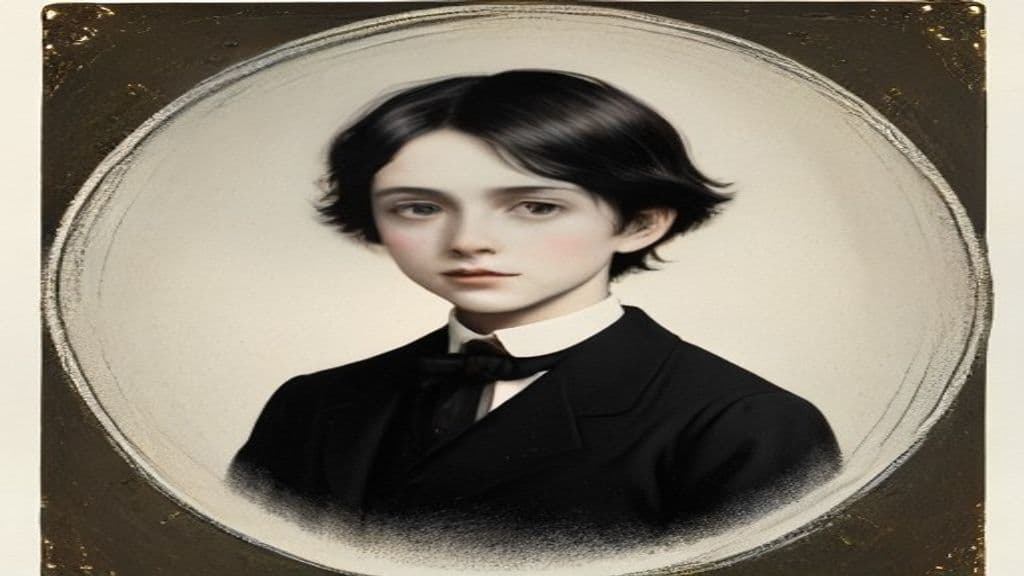
Oswald Bastable originates as a literary creation in late 19th–early 20th century children's fiction by Edith Nesbit. He functions there as one of the Bastable siblings and a child narrator in episodic family adventure stories published in magazines and later compiled into the novels The Story of the Treasure Seekers (1899), The Wouldbegoods (1901), New Treasure Seekers (1904), with additional Bastable stories collected in Oswald Bastable and Others (1905). Decades later, Michael Moorcock deliberately reused the same name for a different character in his speculative fiction, presenting an adult Captain Oswald Bastable whose depiction and narrative uses were intended to evoke and critique a particular Fabian 'liberal' imperialism associated with Nesbit's milieu; Moorcock stated that his reuse was not meant to make his novels direct sequels to Nesbit's works.
In Edith Nesbit's stories Oswald Bastable appears as one of six Bastable children (siblings include Dora, Dicky, Alice, Noel, and Horace Octavius) and functions as a child narrator involved in family schemes to recover the family fortune; the supplied sources do not provide detailed physical description for his juvenile form. In Michael Moorcock's works Bastable is presented as an adult military officer, identified specifically as Captain of the 53rd Lancers in British India and later depicted in roles such as airship captain and renegade Englishman within Moorcock's multiverse; the provided materials give rank, role, and behavioral traits (notably opium use) but no comprehensive physical features beyond his military status.
Oswald Bastable is not described as possessing supernatural powers in the supplied sources. In Nesbit's juvenile fiction he behaves as an enterprising child protagonist and narrator engaged in domestic adventure and schemes to recover family wealth. In Moorcock's reinterpretation Bastable's defining behavioral trait is opium use, which Moorcock's sources describe as playing for Bastable a narrative and motivational role analogous to the role of the sword Stormbringer for Moorcock's Elric — that is, a vice or driving personal force shaping choices and actions. Moorcock's Bastable functions across alternate-historical and speculative contexts in political, military, and social capacities rather than through magical abilities.
Weaknesses
- conditionopium addiction (Moorcock's Bastable)
Wards
None recorded.
Osan Kitsune
A regional fox-spirit folktale from Hiroshima Prefecture in Japan. The Osan Kitsune appears in human guise (notably as a woman carrying an infant) to deceive passersby; after entrusting the child to a helper the figure vanishes and the child is revealed to be a stone. The tale is tied to place-names and a small public statue in the Eba area of Hiroshima.
Osangangan Obamakin
Osangangan Obamakin is attested in the provided sources as an early ancestral monarch in the Ife royal genealogy. He appears in lists of predecessors to Obalufon Ogbogbodirin and is invoked in local dynastic accounts as part of the foundational sequence of Oonis of Ife.
Ose
Ose appears in the supplied source corpus only as a listed entry labeled "Ose (demon)" on an English-language Wikipedia disambiguation page. No descriptive, ritual, linguistic, or cultural information about the entity is present in the available materials; the entry is therefore attested but unelaborated in the provided sources.
Oshiroibabā
A Japanese yōkai literally named "white-face-powder old woman," depicted as an elderly woman with her face thickly smeared in oshiroi (white facial powder). She appears in Edo-period yōkai imagery (Toriyama Sekien) and in localized Nara Prefecture traditions (notably a Totsukawa river account and a distinct Hase-dera temple legend).
Oshun
Oshun (Ọṣun, Ochún, Oxúm) is a major orisha and Irunmole in the Yoruba religious corpus and its diasporic traditions, associated with freshwater (rivers), love, fertility, femininity, divination, prosperity and beauty. She is honored at the Osun-Osogbo Sacred Grove and in festivals and ritual forms across Yorubaland and Afro‑Atlantic religions such as Candomblé and Regla de Ocha/Santería.
Osiris
Osiris is the major ancient Egyptian god of fertility, vegetation, death, resurrection, and the afterlife. He functions as sovereign of the realm of the dead, a guarantor of postmortem renewal and agricultural fertility, and the archetypal divine figure with whom deceased kings and mortals ritually unite to gain continuity after death.
Otake Dainichi Nyorai
Japanese manifestation of Vairocana, embodying wisdom and compassion. (Note: 1. Power tier should be Ancient (deity-level) rather than Primordial (cosmic). 2. Appearance should be noted as "Not specified" due to lack of source material. 3. Abilities, sensory_cues, weaknesses, )
Otoroshi
Otoroshi is an Edo-period yōkai type known from painted emaki (picture-scrolls) and yōkai compendia. Primarily an image-and-name pairing with little classical explanatory prose, it is depicted as a fearsome, hair-covered creature that recurs across several visual catalogues of supernatural beings.
Otso
Otso is the sacred collective bear spirit in Finnish mythology, regarded as the king of animals and leader of the forest. Treated with deep fear and reverence, Otso functions as an animistic ancestral figure integrated into origin myths and communal ritual life (notably the Peijaiset).
Ouli
Ouli is not attested in the supplied corpus as a supernatural being; the string appears across place-names, personal names, institutional and commercial uses, and as a linguistic label in diverse regions. No primary-source folkloric description of an entity called Ouli is present in the provided materials.
Ovoo Spirits (sacred cairn spirits)
Spirits understood as the local, animating presences of ovoo (sacred cairn) sites within Mongolian shamanic practice (Böö Mörgöl/Tengerism). They function as place-spirits tied to specific cairns and the social-religious life surrounding those sites.
Oxylus
Oxylus (Greek: Ὄξυλος) is a name applied to multiple related figures in Greek tradition: a local woodland daimon associated with mountain beech-woods (son of a mountain-god and linked to Hamadryads), a genealogical offspring (son of Ares and Protogeneia in some accounts), and a mortal/foundational king of Elis recorded in regional heroic histories. The traditions treat these referents as distinct but related uses of the same name tied to landscape, kinship, and local founding narratives.
Community Record
- [1]Oswald Bastable — Wikipedia. Wikipedia contributors, 'Oswald Bastable,' Wikipedia, The Free Encyclopedia.wiki
- [2]Oswald Bastable — Wikidata. Wikidata entry Q589193 for Oswald Bastable.other
- [3]ba_michael_moorcock_nomad_of_the_time_streams_part_deux (Archive.org podcast). Archive.org podcast episode discussing Moorcock's Nomad of the Time Streams series and Moorcock's reuse of the name Oswald Bastable.other
- [4]The Story of the Treasure Seekers (LibriVox recording / Archive.org). Edith Nesbit, The Story of the Treasure Seekers (LibriVox recording / Archive.org).literary
- [5]Oswald Bastable and Others (Archive.org digitization). Edith Nesbit, Oswald Bastable and Others (1905) digitized at Archive.org.literary