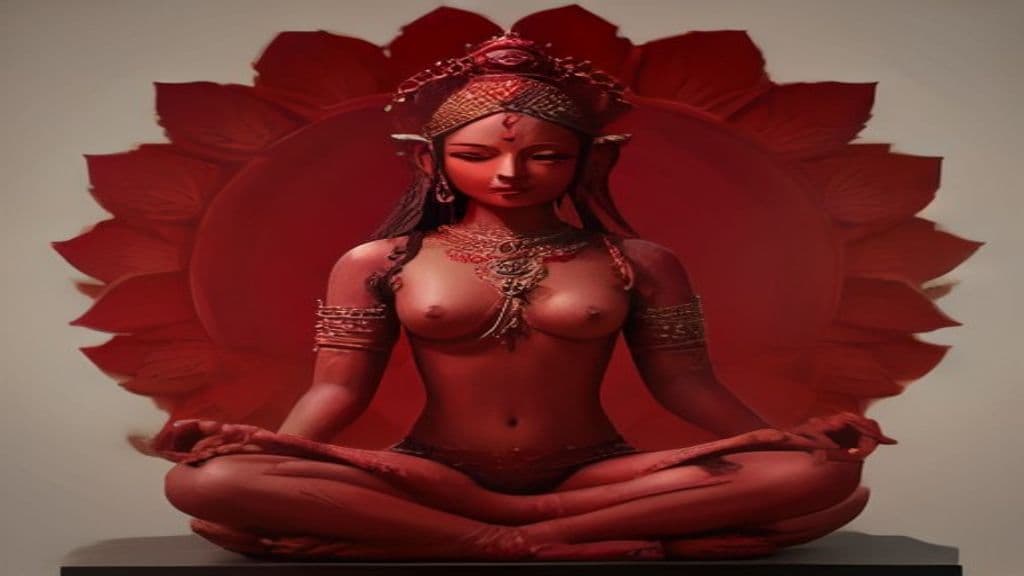
Within Jain universal chronology Padmaprabha is the sixth tirthankara of the present avasarpini (descending age). Traditional accounts record his birth in the city of Kosambi to King Sridhara (also named Dharana in some accounts) and Queen Susima; hagiography places his birth long after his predecessor (often given as 90,000 crore sagara later) and his successor Suparsvanatha similarly separated by vast cosmological intervals. He renounced worldly life, practiced rigorous asceticism and meditation, attained Kevala Jnana (omniscience) and eventually achieved moksha; his liberation is commemorated on Mount Shikharji. These details appear in standard Jain biographical and devotional sources and are expressed in cosmological measures customary to Jain hagiography.
Padmaprabha is traditionally depicted in meditative pose (often Padmasana) with a distinct red physical complexion and is associated with a red lotus emblem (a red, eight-petalled lotus in devotional visualization). Sculptural representations include a lotus emblem stamped on the pedestal and may show a mukkudai (canopy or head-ornament) over the image. Hagiographic texts ascribe symbolic monumental measurements to him (for example, a traditional height of 250 dhanushas and a lifespan of 3,000,000 purvas) reflecting Jain cosmological scale rather than literal biography.
As a tirthankara Padmaprabha's primary capacities are spiritual: he attained Kevala Jnana (omniscience) through ascetic practice and meditation and functioned as a preacher of Jain doctrine, providing the soteriological example and path (a tirtha) for others to cross samsara. He is venerated rather than feared; attendant shasanadevatas (yaksha and yakshi) are associated with his devotional cult. Sectarian traditions record differing attendant names: Digambara sources name Manovega (yaksha) and Manasi (yakshi), while Śvētāmbara lists Kusuma (or Mangupta) and Syama (or Achyuta) among his attendants.
Weaknesses
None recorded.
Wards
- ritualVeneration of attendant yaksha and yakshi (shasanadevatas)
Yaksha
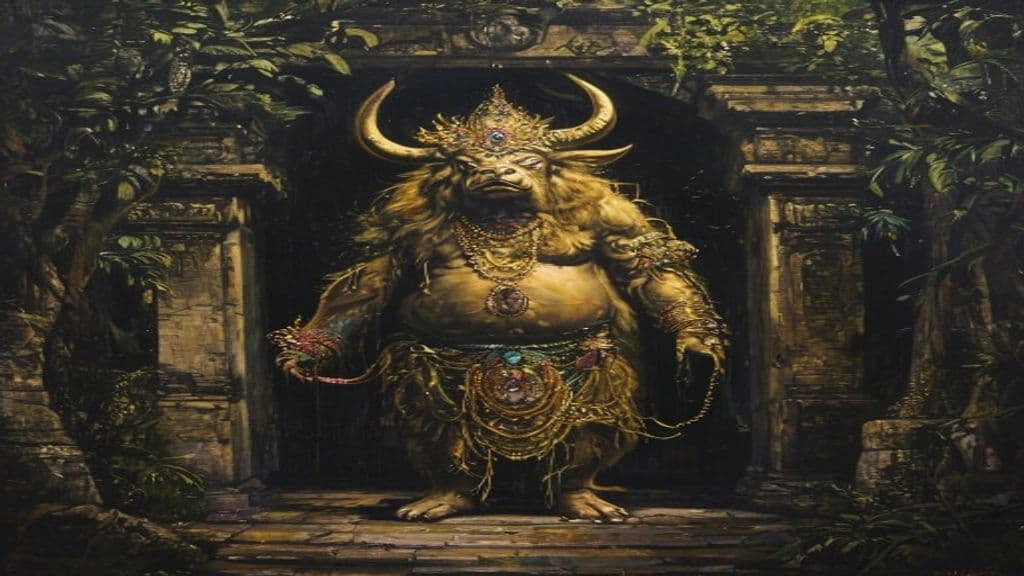
Nature spirits of Hindu, Buddhist, and Jain cosmology — guardians of forests, treasures, and wilderness. Ambivalent beings, capable of great benevolence to the respectful and terrible harm to the greedy.
Yaksha
Nature spirits of Hindu, Buddhist, and Jain cosmology — guardians of forests, treasures, and wilderness. Ambivalent beings, capable of great benevolence to the respectful and terrible harm to the greedy.
Abhinandananātha
Abhinandananātha is the fourth Tīrthaṅkara (ford-maker) of the current Jain cosmic age (avasarpini). Traditional accounts place his birth in Ayodhyā to the Ikshvāku (Solar) dynasty, describe his renunciation and attainment of omniscience beneath a priyangu tree, and record his liberation on Mount Śikharjī.
Ajitanātha
Ajitanātha is the second tirthankara of the current cosmic age in Jainism: an enlightened spiritual teacher who renounced worldly life, attained omniscience (kevalajñāna), and achieved liberation (moksha), and who is credited with establishing a large four-part monastic order in the tradition's hagiography.
Akshayavata
In Hindu mythology, Akshayavata is a sacred banyan tree and/or lake that symbolizes eternal life. It is mentioned in both Hindu and Jain traditions and associated with the Puranas. (Note: - The power tier should be "Greater" or at least "Ancient", as it is associated with the Puranas, which are considered ancient texts. - No specific physical description is provided, but that doesn't m)
Ambika (Jainism)
Ambika is the yakṣiṇī (Śāsana Devī, protector-goddess) and tutelary attendant of the 22nd Tīrthaṅkara Neminatha in Jain tradition. Venerated both as an attendant spirit and an independent goddess (kuladevi) she features in devotional, temple and tantric ritual contexts, and is associated with fertility, prosperity and protection.
Anantanātha
Anantanātha is the fourteenth Tīrthaṅkara of the present age (Avasarpini) in Jain tradition, a perfected spiritual teacher who became a siddha (liberated soul) after destroying all karma and whose role is to reveal the dharma and provide a ford (tīrtha) across saṃsāra.
Aranātha
Aranātha is the eighteenth Tīrthaṅkara (ford‑maker) in the Jain tradition of the present half‑cycle (Avasarpini). In the provided sources he is presented as a spiritual exemplar born in the Ikshvaku dynasty at Hastinapur who attains siddhahood (liberation) after completing his life.
Arihant
In Jain doctrine an arihant is a soul (jiva) that has conquered inner passions and destroyed the four inimical (ghātiyā) karmas, thereby attaining kevala jñāna (omniscience) while still embodied; on final shedding of remaining karma an arihant attains siddhahood (moksha).
Chakreshvari
Chakreshvari (also Chakreshwari or Apraticakra) is an attendant goddess (yakshini) in Jain cosmology who serves as the guardian or tutelary deity of the first Tirthankara, Rishabhanatha. She is an object of popular devotion in Jain communities and is counted among the three yakshinis—alongside Ambika and Padmāvatī—that attract the most devotional worship.
Dharmanātha
Dharmanātha is the fifteenth Tirthankara of Jainism's present age (Avasarpini). Sources state he attained siddhahood (liberation by destroying all karma) and is portrayed in tradition as a supreme spiritual teacher who establishes the ford (tīrtha) across saṃsāra.
Gandharva
A class of non-human celestial or semi-celestial beings in Indic religions associated principally with music, song, dance, fertility, and an escort/guardian role for liminal arrivals (such as Soma or beings). In Hinduism they are minor deities and musicians of the devas; in Buddhist cosmology they are a low rank of devas and the term (gandhabba in Pāli/commentary) is also used doctrinally for a sentient intermediate state between death and rebirth.
Garuda
Garuda is a divine, eagle-like being in South Asian traditions best known as the vahana (mount) of the god Vishnu. In Vedic, Purānic and later texts he appears as a powerful, solar-associated bird-personage who is both an individual mythic personality (son of the sage Kaśyapa and Vinatā) and an archetype invoked in temple iconography and theological metaphor.
Guardians of the Directions (Dikpāla / Lokapāla)
A class of deities or divine offices that guard and sacralize spatial directions in South Asian and some Southeast Asian religious cosmologies. Appearing in Hinduism, Jainism and Vajrayāna Buddhism (and in regional systems such as Meitei and Javanese/Balinese traditions), they are represented in temple architecture and invoked as protectors of sacred space and the dharma.
Community Record
- [1]Padmaprabha - Wikipedia. Wikipedia entry 'Padmaprabha' (accessed in provided notes).wiki
- [2]Jain Hymns (Hrīm meditation visualization). Archive: 'Jain Hymns' (Veeral Chovishi) containing the Hrīm meditation visualization and devotional lines addressing 'Lord of the Lotus'.literary
- [3]Government Museum Chennai — Jain gallery captions. Government Museum Chennai gallery captions describing Padmaprabha statues (Padmasana, mukkudai canopy, lotus pedestal).other
- [4]Niyama Sara Tika Padmaprabha Maladhari Deva (archive listing). Archive listing for a traditional commentary/work related to Padmaprabha (title appears in provided notes; full contents not quoted).other
- [5]Padmaprabha — Indianetzone summary. Online devotional summary of Padmaprabha's life and attributes cited in the notes.other