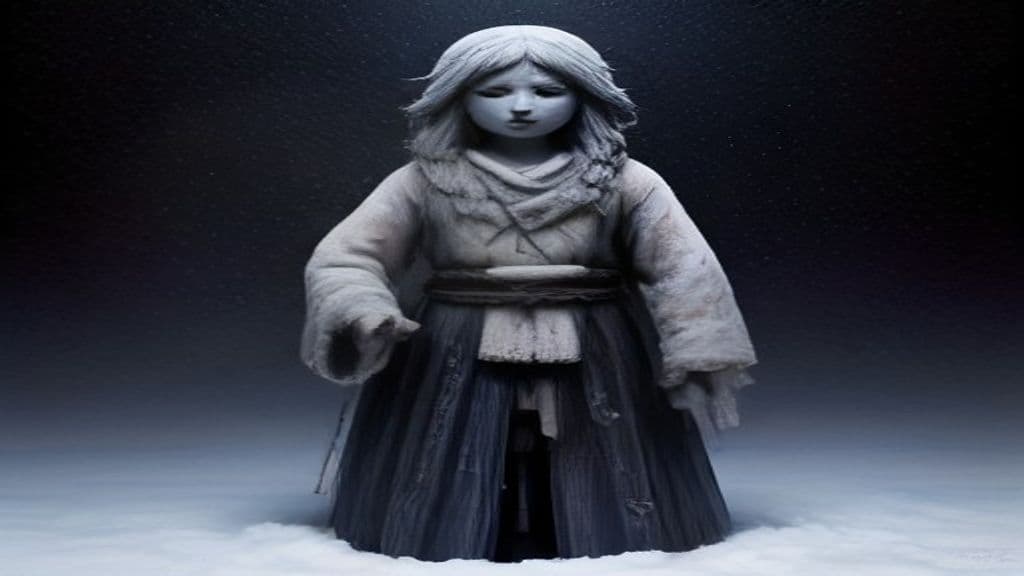
Scholarship records multiple, competing hypotheses about Peko’s deeper origins: some scholars have proposed connections to Norse barley‑figures such as Byggvir, others have noted later syncretism or comparison with Saint Peter, while ethnographers also classify him as a pellon/field haltija (guardian of the field). In Seto tradition specifically (reflected in songs and communal cult) Peko is represented as a heroic, quasi‑royal ancestral figure who sleeps and may be roused to bring rain and abundance; this Seto heroic/sleeping‑king portrayal is an internal traditional motif rather than a singular historical origin.
No single standardized anthropomorphic description is preserved in the surveyed sources. In Seto practice Peko was represented by carved wooden idols kept in granaries; the heads of these idols typically had holes for candles. Poetic and epic sources sometimes portray his spirit metaphorically (for example, flying like a butterfly in Anne Vabarna’s songs), but detailed physical attributes (height, clothing, color) are not consistently recorded.
Peko functions primarily as an agricultural and cultic agent: he is credited with ensuring the growth of barley, providing brewing wort called pellon maito ('milk of the field'), and bringing rain when invoked in specific Seto poetic/ritual contexts. He acts as a protector/owner of fields and granaries, is honored at seasonal feasts, and in Seto lore is said to protect people against certain evil spirits (for example, those who cause excessive drinking). His name is also used in a soil‑related healing prescription in which boiled earth is given to a patient while a spell orders pain back into the ground, invoking Peko’s authority over the field and soil.
Weaknesses
None recorded.
Wards
- ritualGranary concealment of carved idol
- ritualLast sheaf offering (the last sheaf thrown as a pillow for Peltopekka)
- mantraChanting and invitation: 'Peko, Peko, come to drink the beer'
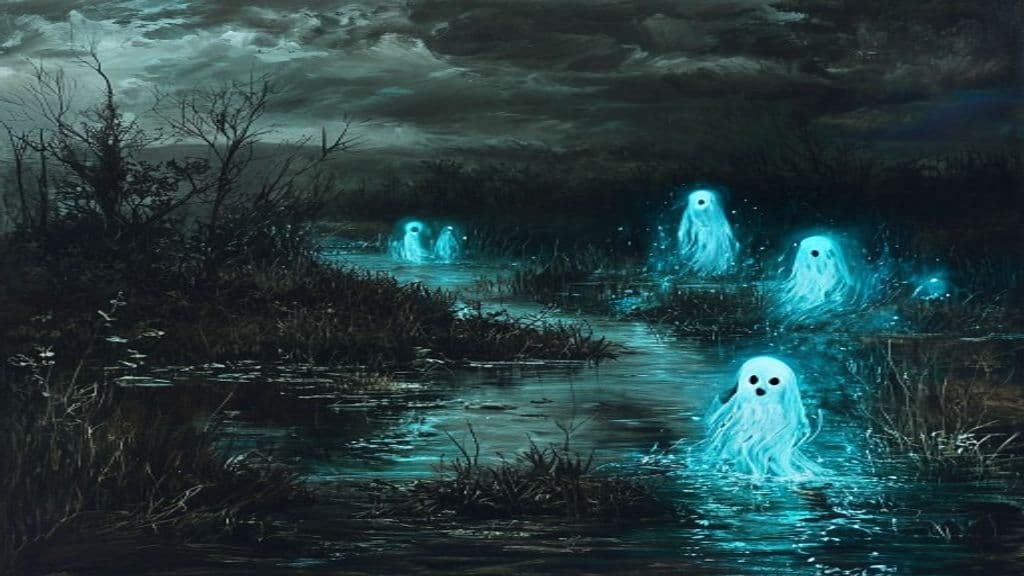
Will-o'-the-Wisp
A wandering light seen over marshy ground at night, leading travellers astray into bogs and fens. Possibly a spirit, possibly the soul of the unbaptised dead, possibly the devil himself.
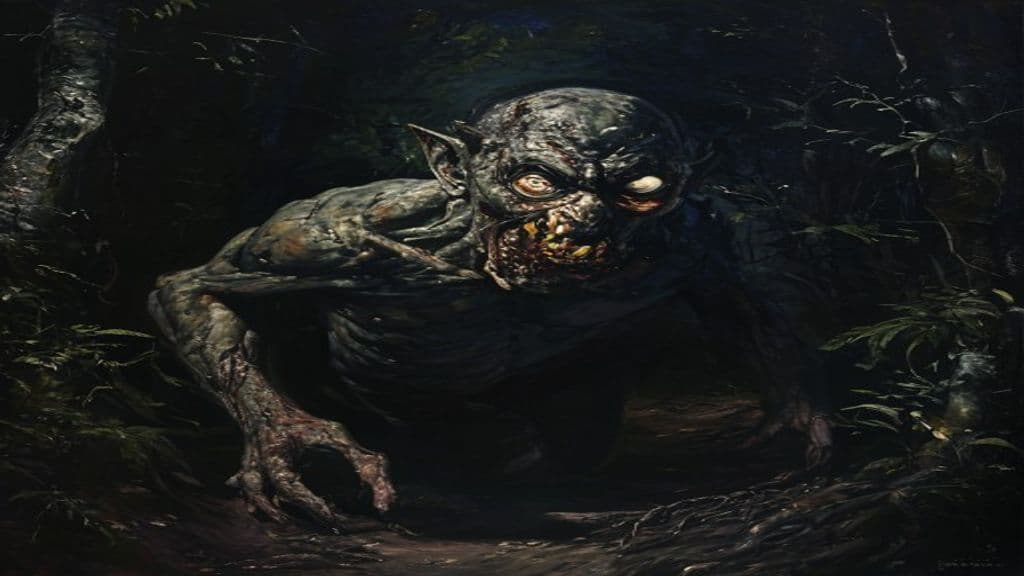
Pishacha
Flesh-eating spirits of Hindu mythology that haunt cremation grounds and are associated with disease, madness, and possession. The lowest class of demon in the Vedic hierarchy.

Pikne
Pikne is the Estonian supernatural figure associated with lightning and thunder; treated in tradition as a weather-personification who could be petitioned by priests and farmers for rain and whose name functioned as a taboo euphemism for the dangerous phenomenon of lightning.

Byggvir
Byggvir is a minor named attendant of the Vanir god Freyr attested in the Old Norse poem Lokasenna (prose introduction and stanzas 55–56). Scholarly commentary commonly reads him as an agricultural personification linked to barley or to mill-refuse (chaff), though the primary texts give only sparse narrative detail.
Ilmarinen
Ilmarinen is a Finnic divine artificer and sky-associated being from Finnish and broader Finno-Ugric tradition, known as the archetypal smith who forges cosmological works such as the dome of the sky and the Sampo. He appears throughout oral rune-song material and in the Kalevala corpus and is invoked in several incantation runes.
Metsänväki
A Finnish term attested in fragmentary sources referring either to the animate power of the forest or to forest-dwelling spirits/creatures; sources supplied are brief and inconsistent about whether it denotes an impersonal force or a class of beings.
Vanatühi (Vanapagan)
Vanatühi, also called Vanapagan, is a figure from Estonian folk tradition described in available sources as a giant farmer and characterized as a devil or god of the underworld who is portrayed as more foolish than malevolent. The character appears in Estonian folk tales rather than in documented organized religious practice.
Pegasus
A singular winged horse of ancient Greek myth, usually depicted as a white stallion. Born in variants tied to Medusa's death and the springs of Oceanus, Pegasus creates sacred springs, serves as a bearer of Zeus's thunderbolts or storm-attendants, is tamed by Bellerophon with divine aid, and is later taken to Olympus and catasterized as a constellation.
Peird van Appels
Peird van Appels is attested in available sources as the name of a folkloristic horse associated with the town of Appels in East Flanders, Belgium. The extant references supply the name and classification only; no narrative, descriptive, or ritual details are recorded in the provided sources.
Peird van Sint-Gillis (Bayard)
A single legendary magical bay horse originating in the medieval chansons de geste and preserved in regional folkloric tradition (notably Belgian). Described as an intelligent, strong mount with the supernatural ability to adjust its size to its riders, serving as a wondrous companion to human heroes.
Peisistratus (son of Nestor)
In the Homeric tradition Peisistratus is a mortal nobleman, the son of Nestor of Pylos, who accompanies Telemachus during parts of his voyage in the Odyssey. The same name also belongs to a separate historical figure, the 6th-century BC Athenian ruler Pisistratus; modern sources sometimes conflate the two by name only.
Peitho
In ancient Greek thought Peitho (Πειθώ) is the personification and occasional goddess of persuasion, winning eloquence, and charm. She functions both as a named divine attendant in myth and cult and as the abstract power or virtue of persuasive speech, especially in erotic/nuptial and civic contexts.
Pelagon
Pelagon is a personal name attested in ancient Greek mythic and genealogical sources for several distinct mortal or semi-divine figures (kings, warriors, hunters, companions). The supplied sources present multiple individuals called Pelagon rather than a single coherent supernatural entity; later modern uses of the name are homonymous and do not indicate a unified mythic being.
Pelasgians
In Greek tradition, the Pelasgians were a collective term for indigenous people inhabiting Greece before the emergence of the Greeks. (Note: 1. Power tier should be Primordial is incorrect; given that there's no information about their abilities or behaviors, they should not have a power tier assigned. 2. Appearance should state "No physic)
Pelasgos
Pelasgos is an eponymous ancestral figure (and ethnic label Pelasgians/Pelasgoi) from Greek mythohistory used to account for the antiquity and origins of certain peoples and cults in Greece. He appears across regionally variable traditions as a foundational progenitor rather than a supernatural monster or spirit.
Pelasgus
Pelasgus (Πελασγός) is a mythic ancestral and eponymous founder figure in ancient Greek tradition credited in various local accounts with founding cities, teaching agriculture, receiving Demeter, and giving his name to the Pelasgians and regions such as Pelasgiotis. He appears across competing regional genealogies (Argive, Arcadian, Thessalian) rather than as a standardized supernatural being.
Community Record
- [1]Peko (Wikipedia). Wikipedia contributors, 'Peko', Wikipedia, The Free Encyclopediawiki
- [2]Domata Peko (Wikipedia). Wikipedia contributors, 'Domata Peko', Wikipedia, The Free Encyclopediawiki
- [3]Wikidata: Peko. Wikidata entry Q106103834other