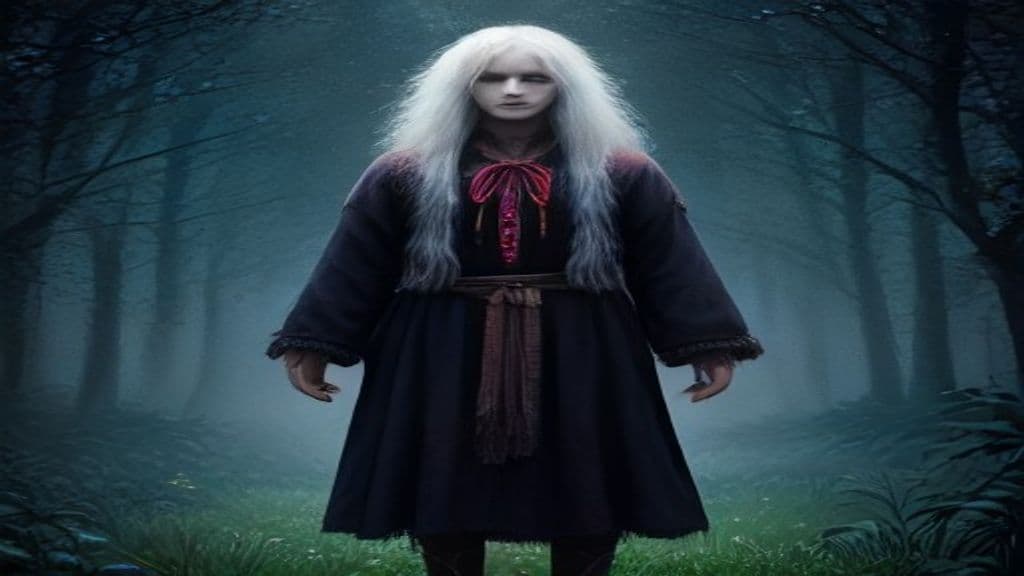
The provided sources do not record a cosmogonic or detailed origin story for Vanatühi/Vanapagan. What is attested in the cited material is that the figure appears within Estonian folk tales and is described in summary terms as a devil or god of the underworld and a giant farmer; beyond that, no creation myth, lineage, or systematic origin narrative is given in the available excerpts.
Source material gives only a brief description: Vanatühi/Vanapagan is described as a 'giant farmer.' The citations do not supply further specifics about clothing, coloration, or other physical details. In the absence of additional sources, any fuller physical portrayal cannot be asserted from the provided material.
The available excerpts do not enumerate concrete supernatural abilities. One source labels Vanatühi/Vanapagan as a 'devil or god of the underworld,' which implies a chthonic association, but the cited descriptions emphasize character — notably that he is 'more stupid than malevolent' — rather than catalogued powers or routine magical behaviors. There is no detailed list of abilities or customary actions in the provided notes.
Peko
Peko is a Baltic‑Finnic agrarian spirit and cult figure associated with barley, brewing, and field fertility, particularly attested in Seto, Estonian, and Finnish traditions. He appears in cult practice as a guardian of granaries and crops, a focus of seasonal feasts and offerings, and is invoked in rituals for rain, abundance, and certain soil‑related cures.
Valravn
A valravn is a supernatural raven in Danish folk tradition associated with the slain and battlefields. In the principal ballad tradition it appears as a knight transformed into a raven whose curse in the story can only be broken by consuming the blood of a boy; other anecdotal sources present valravne as ravens with human speech connected to battlefield carrion.
Valuas & Gertrude
Valuas & Gertrude are recorded, in the consulted source, simply as named figures classified under the category "Giants (mythology)." The single available entry provides no further narrative, descriptive, ritual, or contextual information about them.
Valþjófsstaður Door
A medieval wooden door in the National Museum of Iceland featuring a unique representation of the Lion-Knight legend, a popular theme in Icelandic chivalric sagas and a rare example of runic script carved in wood. (Note: * Remove Power tier as it's not mentioned in the source material. * Update Appearance to match Source 1: The door depicts scenes from the Lion-Knight legend, including a knight slaying a dragon and fr)
Vamana
Avatar of Vishnu in Buddhist tradition, representing a physical manifestation or descent into the world. (Note: - Summary: The article should clarify that Vamana is an avatar of Vishnu primarily in Hindu tradition (not Buddhist), representing a divine descent into the world. - Power tier: Based on the source ma)
Vammatar
Vammatar (also presented in a Finnish-mythology-derived source under the names Kivutar or Kiputyttö) is described in the cited material as a spirit or goddess who is asked to take the pains and injuries of humans onto herself. She is located on named places associated with pain (Kipumäki / Kipuvaara / Kipuvuori) and is called a 'maiden of the underworld' in the cited encyclopedia entry.
Vampire (tradition)
A class of revenant beings in southeastern and eastern European folk belief that subsist by feeding on the vital essence (generally blood) of the living. Recorded chiefly in early modern to modern oral traditions, these vampires are typically described as reanimated corpses whose presence explains unexplained illness, death, and post-mortem disturbances in their communities.
Vanemuine
Vanemuine is an Estonian cultural institution — originally the Vanemuine Society (Vanemuise Selts) founded in Tartu in 1865 — that gave rise to the first Estonian-language theatre and later a multi-genre theatre company and concert organization. It played a foundational role in staging Estonian-language drama, organising song festivals, and training theatre practitioners during the late 19th and 20th centuries.
Vanishing Hitchhiker
A widespread modern folk-narrative type in which a traveler (often a motorist) gives a ride or shelter to a passenger who later disappears without mundane explanation; subsequent corroboration often reveals the passenger had died earlier or leaves a token such as a garment on a grave.
Vanth
Vanth is an Etruscan chthonic female attendant depicted in funerary art as a benevolent psychopomp who escorts and assists the dead on their journey to the Underworld. She appears in tomb paintings, sarcophagi, and ash urns from the classical Etruscan period and is often shown with attributes such as a torch, key, and scroll.
Vapula
Vapula is a named goetic spirit represented in Western grimoire-derived and modern occult literature as a high-ranking Duke/Prince who teaches crafts and sciences and commands numerous legions. In contemporary occult commentary he is frequently characterized as a patron of technical knowledge and 'Prince of Technology'.
Varatantu
A sage in Hinduism associated with the Vāratantavīya philosophy, embodying spiritual and intellectual authority. (Note: 1. Power tier: Downgrade to Ancient (deity-level) as the sources only mention his association with a school of thought, but do not indicate cosmic powers. 2. Abilities: More specific description of hi)
Community Record
- [1]Vanapagan — Wikipedia. Wikipedia: Vanapagan — summary stating Vanatühi/Vanapagan is a devil or god of the underworld, a giant farmer who is more stupid than malevolent.wiki
- [2]Vanapagan — Wikidata. Wikidata: entry labeling Vanapagan as a 'Mythological character in Estonian folk tales.'wiki